
Every ad-generation tool assumes you have a product ready to photograph. Upload the image, pick a size, generate the ad. That works when you're selling a specific SKU. It doesn't work for the campaign that comes before that: the one where you're building recognition for a brand that doesn't have one hero product to point at yet, or a launch window where the goal is simply "people should know we exist" before a single sale matters.
A new studio brand introducing itself. A service business with nothing to photograph. A company running a seasonal or category-level push where naming one product would undersell the point. All of these need a creative, and none of them have a productId to hand a generator.
Why brand-only campaigns get worse creative, not just fewer options
Meta's own Brand Lift documentation is explicit about what a brand campaign is measuring: not clicks or purchases, but ad recall, brand awareness, and message association, tested against a holdout group that never saw the ad at all. That's a different job than a product ad does, and it means the creative itself carries more weight, since there's no product photo doing half the persuading.
An independent analysis of 46 Meta Brand Lift studies across 225 campaigns, run by the paid-social agency Brainlabs, found the size of that weight directly: highly-produced brand creative and product-focused creative drove the largest awareness lift (8% and 7.5%) specifically when shown to a new, lower-awareness audience, the exact audience a brand-only campaign is built to reach. The same analysis found reach-objective campaigns skew toward people who don't already know the brand, with 69% of that group reporting brand familiarity in the control group versus 82% for other campaign objectives. In plain terms: a genuinely new-audience brand campaign has a real recall gap to close, and the creative that closes it looks different from a product ad. It has to carry brand identity as the entire message, not as a footnote under a product shot.
That's the gap most ad-generation tools leave open. They're built around a product because a product ad is the easier, more common job. A brand-only ad still needs an identity-first creative built around color, voice, and mood rather than a product hero shot, and setting that up by hand in a template tool built for product photos is exactly the kind of friction that gets a brand campaign skipped or done badly.
What Coinis's brand-only generation path actually does
Ad Studio's Image Agent path for brand-awareness creative works from brand identity alone, no product required. Point it at a brand, either by resolving an existing one in the workspace or by adding a brand's site so its identity gets pulled in, and it generates one organic-feeling, text-free image built from that brand's colors and voice. There's no product picker, no template-category field, no aspect-ratio matrix to fill in first. The one platform target is Facebook, which sets the native aspect ratio automatically, so there's one less decision to make before something renders.
You can optionally point it at a reference image for mood or composition, which it uses for structure only, never pulling that reference's own logo, colors, or text into the output. Most brand-only requests skip that step entirely and let the brand's own identity carry the generation. A short line of direction, a seasonal hook or a specific vibe, goes in as plain text alongside the brand, and that's the entire brief.
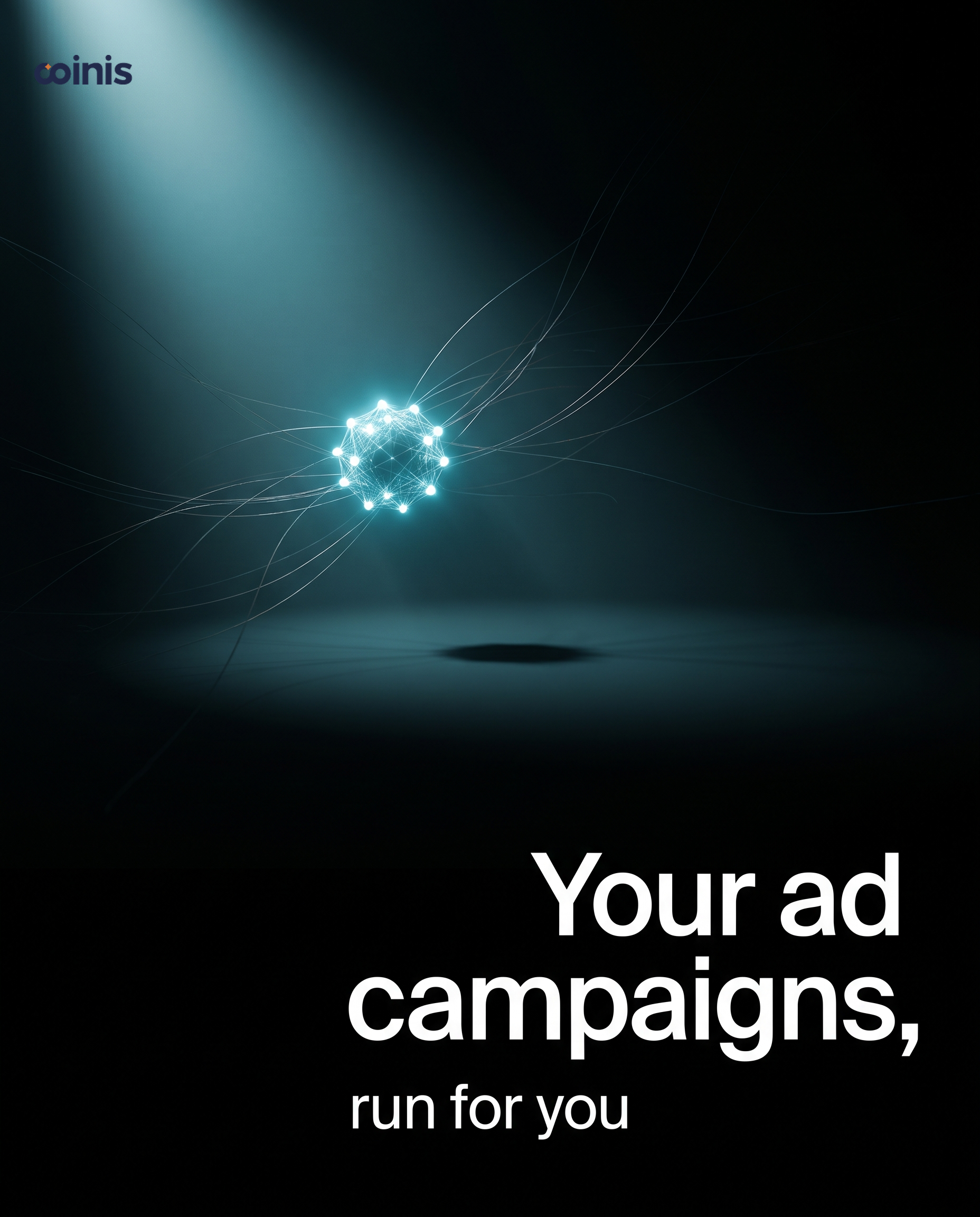
This is a real generated output, not a mockup. Brand: Coinis (workspace 163, brand id 368, resolved from an existing brand record, no product attached). Platform: Facebook. Brief sent: userHook="Your ad campaigns, run for you", additionalInformations="A brand-awareness post introducing Coinis as the AI marketing agent that runs paid ads end to end. Confident, technical-but-approachable energy, no specific product or screenshot, just the brand identity and mission." Token cost: 58 (previewed before firing, confirmed sufficient balance). The result is a text-minimal, moody dark-teal network-sphere image with the Coinis logo and the hook line, generated entirely from brand identity, with no product photo involved anywhere in the request.
The brief that goes in when there's no product to describe
The difference from a product-ad brief is what's missing, not what's added. A product-ad brief names the item, its physical detail, the audience, and a beat the ad should hit. A brand-only brief drops the item entirely and leans on three things instead: the brand's established identity (colors, tone, existing visual language), a short line of seasonal or campaign direction, and, optionally, a hook phrase under 40 characters if there's a specific line the creative should carry.
That's a deliberately smaller brief than a product ad needs, and it should stay that way. Padding it with invented product detail to make it feel more complete just confuses a generation path that's designed to work from brand identity, not from a product that doesn't exist yet. If there's a real product to describe, that's the signal to use a different Coinis path entirely, not to force product language into a brand-only brief.
Where this sits next to Coinis's product-ad tools
The discriminator between this path and every other Ad Studio generation tool is intent, not whether a product happens to exist somewhere in the workspace. A brand with products can still run a brand-only campaign on purpose, when the goal really is awareness rather than a specific sale. The moment the ask becomes "an ad for this product," that's a different Ad Studio path built around a resolved product ID and a template or preset matrix.
This brand-only path is closest in spirit to the Ad Studio Agent's brief-first approach to product ads: both skip the usual setup tax and work from a short plain-language input instead of a form. The difference is what that input describes. The Agent's brief always centers a product, even a loosely described one. This path never does. It's the version for the specific moment a business has a brand worth putting in front of people and nothing else ready yet, not even a URL to scrape.
Once a real product exists, the natural next step is testimonial-style UGC creative or a full product-ad setup once there's something concrete to sell against the awareness this campaign built. Before any of that, getting the Facebook Page and ad account actually set up is its own separate step worth having done before the first brand creative is even ready to run.
Running this without letting it go stale
- Treat awareness creative like any other creative: it fatigues. Facebook ad fatigue sets in from repeated exposure just as fast on a brand campaign as a product one, and a brand-only rotation needs the same refresh discipline, not a pass because there's no product to swap out.
- Keep the brief tight. Brand identity, one line of campaign direction, an optional hook. Resist the urge to over-specify. The tool works from identity, not from invented product detail.
- Generate a small rotation, not one hero image. A single ad shown at high frequency to the same cold audience is exactly the pattern that erodes recall. Multiple brand-only variants sharing an identity but not a single asset hold up longer.
- Move to a product-ad path the moment there's something to sell. This path exists for the gap before a product is ready. Once one is, the resolved-product tools are built for scale in a way a brand-only image isn't.
FAQ
Do I need a product set up in Coinis to run a brand awareness ad? No. This is the one Ad Studio generation path built specifically for a brand with no product resolved yet. Every other generation tool, from image templates to cinematic video to UGC-style clips, needs a productId first.
What platform does the brand-only creative generate for? Facebook only. The platform sets the native aspect ratio automatically, so there's no separate format picker to fill in.
Can I use a reference image to guide the style? Yes, optionally. A reference image's structure or mood can guide the generation, but the brand's own logo, colors, and text are never pulled from that reference. Most requests skip this and let the brand's existing identity drive the output on its own.
Is a brand-awareness ad worse for performance than a product ad? It's measuring something different, not something lesser. Brand campaigns are built to move recall and awareness metrics among people who don't know the brand yet, not immediate conversions. Independent analysis of Meta Brand Lift data shows brand and product-focused creative can move awareness by 7 to 8 percent among exactly that new-audience group, a real, measurable outcome even though it isn't a purchase.
When should I switch from brand-only to a product-ad path? As soon as there's a real product to point the ad at. Brand-only creative exists to fill the gap before that point, not to replace product-focused advertising once a product is ready to sell.
Sources
- Meta, "About Brand Lift Tests," Meta Business Help Center, 2026. https://www.facebook.com/business/help/1693381447650068
- Brainlabs, "46 Meta Studies, 225 Campaigns: Which Objectives and Creatives Drive Results?" December 2025. https://www.brainlabsdigital.com/meta-brand-lift-studies-objectives-creatives-results/

Isidora Matovic
Author
Social media enthusiast and a full time researcher. She takes digital presence very seriously and that is why you are always in touch in what is going on with us! Follow us for more posts like this.