
Google just put a date on the end of Dynamic Search Ads. Starting in September 2026, any Search campaign still running DSA, automatically created assets, or campaign-level broad match will be upgraded to AI Max on its own, and you will no longer be able to spin up new DSA campaigns in the UI, Editor, or API. If you run Google Search to pull in long-tail product demand, the tool you have leaned on for years is about to change shape underneath you.
For an e-commerce brand owner, this is not a memo to file away for Q4. The auto-upgrade preserves your old settings, but AI Max behaves differently from DSA, and the accounts that come out ahead are the ones that move before the deadline forces the switch. Here is what is actually changing, why it lands differently for online stores, and the short list of things worth setting up now.
The September deadline that quietly changes your Search setup
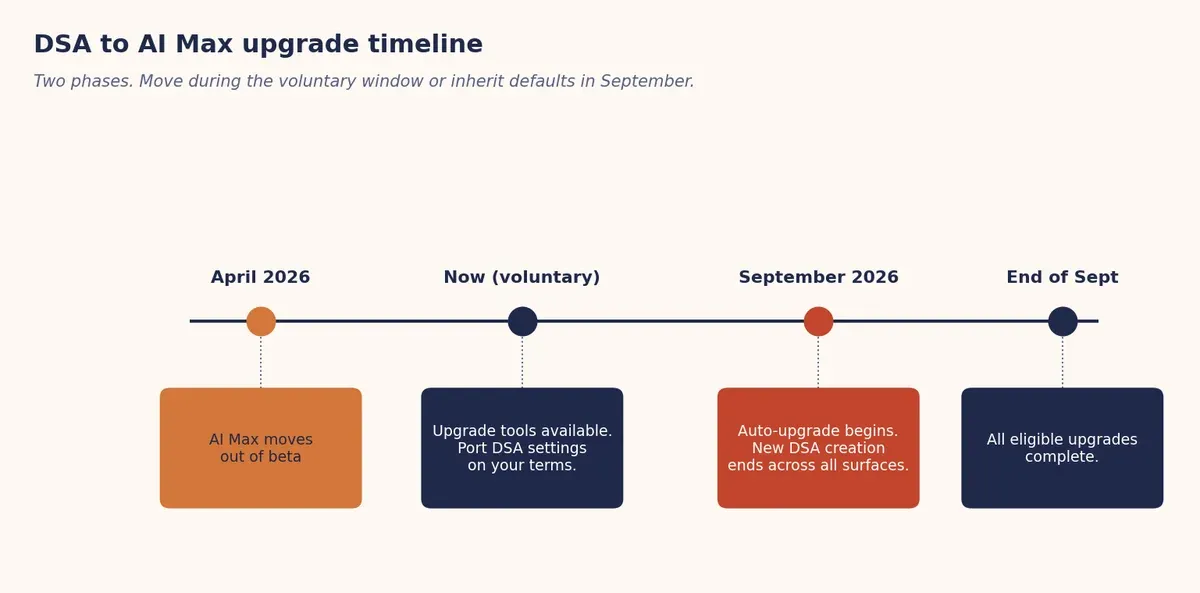
Google confirmed in April that AI Max for Search has moved out of beta after roughly a year of open testing with hundreds of thousands of advertisers. The rollout comes in two phases. Right now you are in the voluntary window: DSA users get upgrade tools to port historical settings and data into standard ad groups, and accounts on automatically created assets or campaign-level broad match see a banner offering the move. Phase two starts in September, when the remaining eligible campaigns upgrade automatically and new DSA creation ends across every Google interface.
Google says it expects all eligible upgrades to conclude by the end of September. When the auto-upgrade hits, AI Max turns on with settings mirrored from your legacy setup. DSA campaigns get all three AI Max features enabled with your URL controls preserved. Accounts on automatically created assets get search term matching and text customization. Campaign-level broad match accounts get search term matching only. The full detail sits in Google's official announcement.
What AI Max does differently from DSA
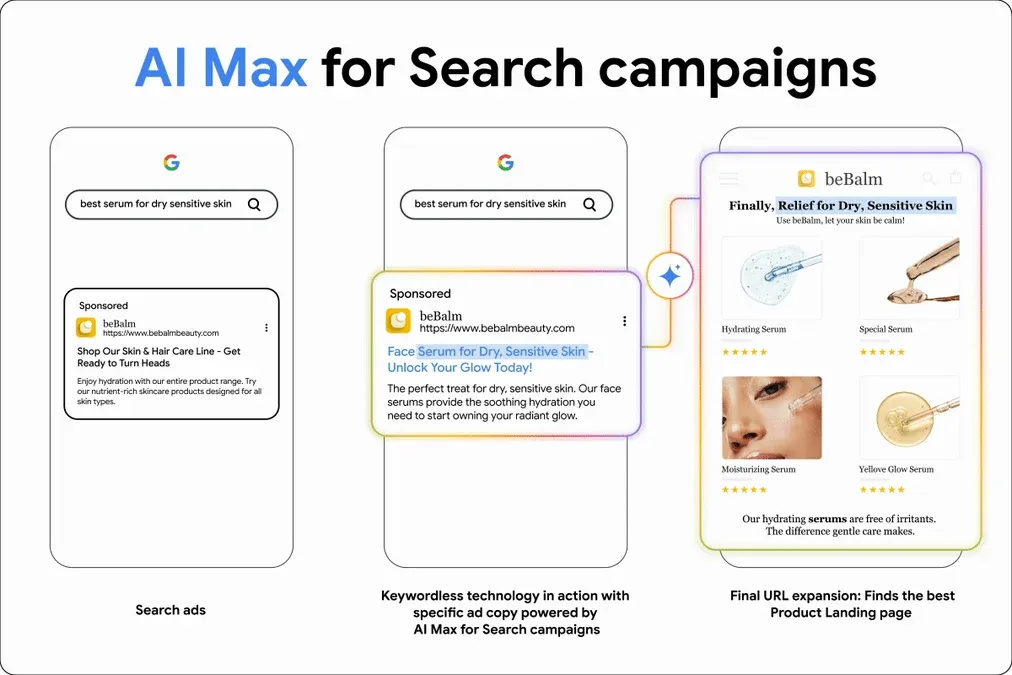
DSA was a catch-all. You pointed it at your site, and it generated headlines and matched queries based on your landing page content. Useful, but bounded by what your pages said. AI Max widens the input. It combines your ads and website content with broader real-time intent signals to find queries DSA never would have surfaced, then keeps the ad relevant with AI-generated text customization and final URL expansion.
The trade most operators worry about is control, and this is the part worth reading closely. AI Max ships with more steering than DSA ever had: brand controls, location controls, and text guidelines that constrain what the AI can write. The expansion is wider, but the guardrails are tighter, if you set them. Accounts that let the upgrade happen passively and never touch the controls are the ones that get burned. Our primer on choosing and optimizing where your ads appear is a good warm-up for those guardrails.
Why the upgrade hits e-commerce differently
Here is the number everyone is quoting, with the caveat almost nobody includes. Google reports that AI Max for Search campaigns see an average of 7% more conversions or conversion value at a similar CPA or ROAS when running the full feature suite, search term matching plus text customization plus final URL expansion, versus search term matching alone.
AI Max widened the net. Your creative has to fill it.
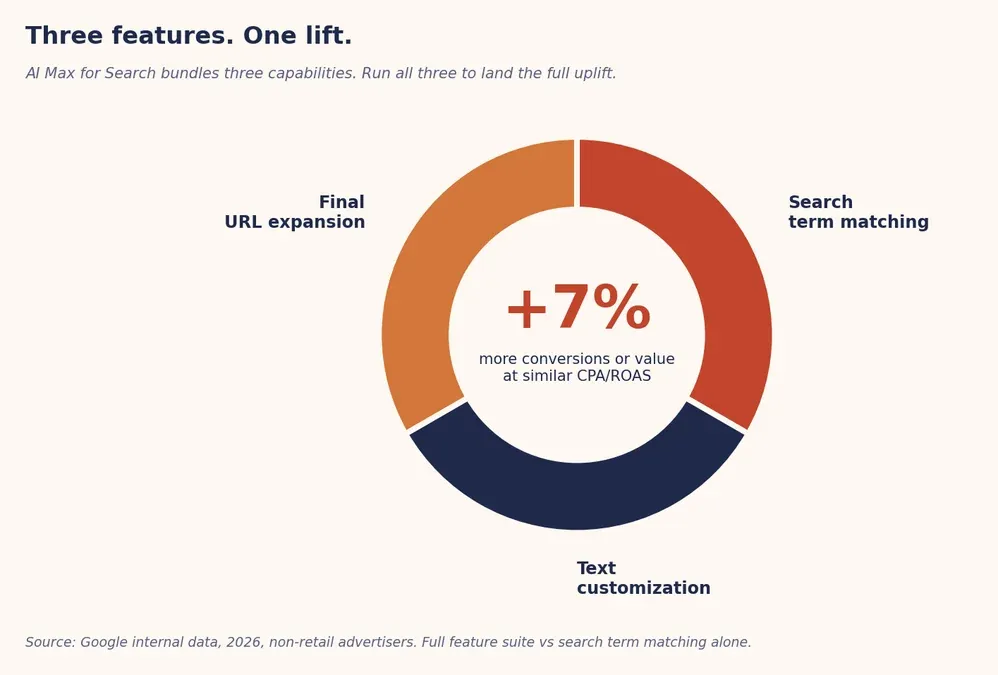
Read the fine print: that 7% is reported for non-retail advertisers. If you sell physical products, your mileage will differ, and Google is steering retail toward a separate track. The same week it detailed the DSA sunset, Google published a parallel piece on bringing AI Max to Shopping campaigns, which is the surface that actually carries most e-commerce spend. So for a brand owner, the real homework is twofold: protect your Search campaigns through the upgrade, and watch how AI Max lands on Shopping, where your catalog lives. If most of your demand capture runs through Shopping and Performance Max already, the DSA change touches the edges of your account, not the core. If you still run text Search to defend brand terms and catch long-tail product queries, it touches the center. Our guide to running Google Ads for an online store walks through where each campaign type earns its keep.
Two things separate the brands that ride AI Max from the brands that get dragged by it: clean conversion tracking the AI can optimize against, and enough creative variation to fill the wider net it casts. Feed it one tired headline and AI Max will amplify the same weakness at greater scale.
Your migration checklist before September
You have a clear runway. The smart move is to upgrade on your own terms during the voluntary window rather than wake up to an auto-migrated account in September. Here is the order that works.
First, audit your conversion tracking before you change anything. AI Max optimizes against the signals it can see, so a broken or shallow conversion setup will quietly cap your results. Second, use Google's upgrade tools now to port your DSA settings into standard ad groups, so you control the migration instead of inheriting defaults. Third, set your brand, location, and text guidelines deliberately. Decide where the AI is allowed to expand and where it is not. Fourth, run a one-click experiment to A/B the full feature suite against your current setup on real spend before you commit the whole campaign. Measure to the revenue line, not just clicks. If you only watch CTR, a wider net can look like a win while your cost per acquisition creeps up.
That last point is the one that separates operators from passengers. More query coverage means more variety in who sees your ad, which means your creative and your landing pages have to hold up against a broader, less predictable audience. The targeting got smarter. The burden of relevance shifted onto your assets.
Run Search creative without the manual grind
The thread running through every platform update this year is the same: the machines are taking the manual campaign work, and the differentiator is moving to creative and signal quality. AI Max can expand your reach, but it cannot write a better product story or build a sharper landing page. That part is still on you, and it is where most brands run out of time.
This is the gap Coinis closes. You paste a product URL and the platform generates AI-generated ads as image, video, UGC, and copy across Meta, TikTok, and Google, then the AI optimizes spend 24/7 while you sleep. The old way meant briefs, designers, and weeks of back and forth. This way is paste, review, launch, in about five minutes, with 10x more creative variations per campaign. While AI Max widens your query net on the Google side, AI ad optimization keeps the creative behind those clicks fresh and the budget pointed at what converts.
September is closer than it looks. Brands that treat the AI Max upgrade as a setup project, not a notification to dismiss, will hold Search performance steady through the switch. Clean your tracking, set your controls, make sure the creative behind those campaigns can carry the wider reach. Try Coinis AI and turn a product URL into launched, self-optimizing ads before the deadline does it for you.