

Most AI image generators still choke on text. Ask for a slide with a headline, three bullet points, and a chart label, and you get garbled letters, mismatched fonts, or text that looks right until you zoom in. Qwen-Image-2.0, released by Alibaba's Qwen team on February 10, 2026, is built specifically to fix that. It is a 7B-parameter unified generation-and-editing model that reads up to 1,000 tokens of instruction and renders professional typography, PPT slides, posters, and comics with accurate text in the same pass as the image itself.
That is a narrow but genuinely useful capability. If you make ad creative, social graphics, or explainer visuals, "the text actually renders correctly" is the difference between a usable asset and a redo. Here is what the model does, a real prompt-and-output example, and how to think about using text-heavy AI image generation in your own workflow.
What Qwen-Image-2.0 actually changed
Qwen's official release notes and independent testing on Reddit's r/LocalLLaMA converge on the same four points:
- Professional typography rendering. The model accepts prompts up to 1,000 tokens long and can lay out full infographics, PPT-style slides, and posters with legible headlines, body copy, and labeled data points in one generation.
- Native 2K resolution. Detailed scenes, including people, architecture, and nature, render at native 2K rather than upscaled from a lower base resolution.
- Unified generation and editing. Earlier Qwen-Image releases split generation and editing into separate tracks. Qwen-Image-2.0 merges them into one model that handles both text-to-image and image editing on the same architecture.
- A smaller, faster model. At 7B parameters, it is a meaningful step down in size from the prior 20B-class Qwen-Image release, which shortens inference time without sacrificing the typography gains.
Independent coverage lines up on the headline claim. The r/LocalLLaMA thread on the release calls it out as "7B unified gen+edit model with native 2K and actual text rendering," and third-party writeups from outlets like wavespeed.ai confirm the same three pillars: 2K resolution, professional text rendering, and a unified generate/edit workflow. As of this writing, access is API- and chat-based through Qwen Chat and Alibaba Cloud Model Studio. Broad open-weight availability has not been confirmed.
Why text rendering is the real story, not resolution
Higher resolution is a spec bump. Reliable text rendering is a workflow change. Most image models treat text as a texture to approximate, which is why a generated poster often has letters that are the right shape from a distance and nonsense up close. Qwen-Image-2.0's approach treats the instruction itself, not just the visual description, as something the model has to satisfy exactly, which is why it can hold up through dense infographic layouts, multi-language captions, and even calligraphy-style scripts in its published examples.
For anyone producing ad creative or marketing visuals, that opens up a category of asset that used to require a design tool: text-native graphics generated directly from a written brief, without a separate step to overlay copy afterward.
A real prompt and output
Qwen-Image-2.0 is not yet available through Coinis's connected generation marketplace, so the example below was produced with GPT Image 2, the nearest available model that demonstrates the same professional-infographic, text-rendering capability described above. We're saying that plainly rather than mislabeling the output.
Prompt used:
"A minimalist bilingual infographic slide, deep navy background, three-step vertical timeline in cream and orange accents, headline text reading AI IMAGE GENERATION 2026 in bold sans-serif, clean flat icons for camera, brush, and lightning bolt at each step, professional presentation-slide layout, sharp legible typography, high contrast, 2K quality."
Output:
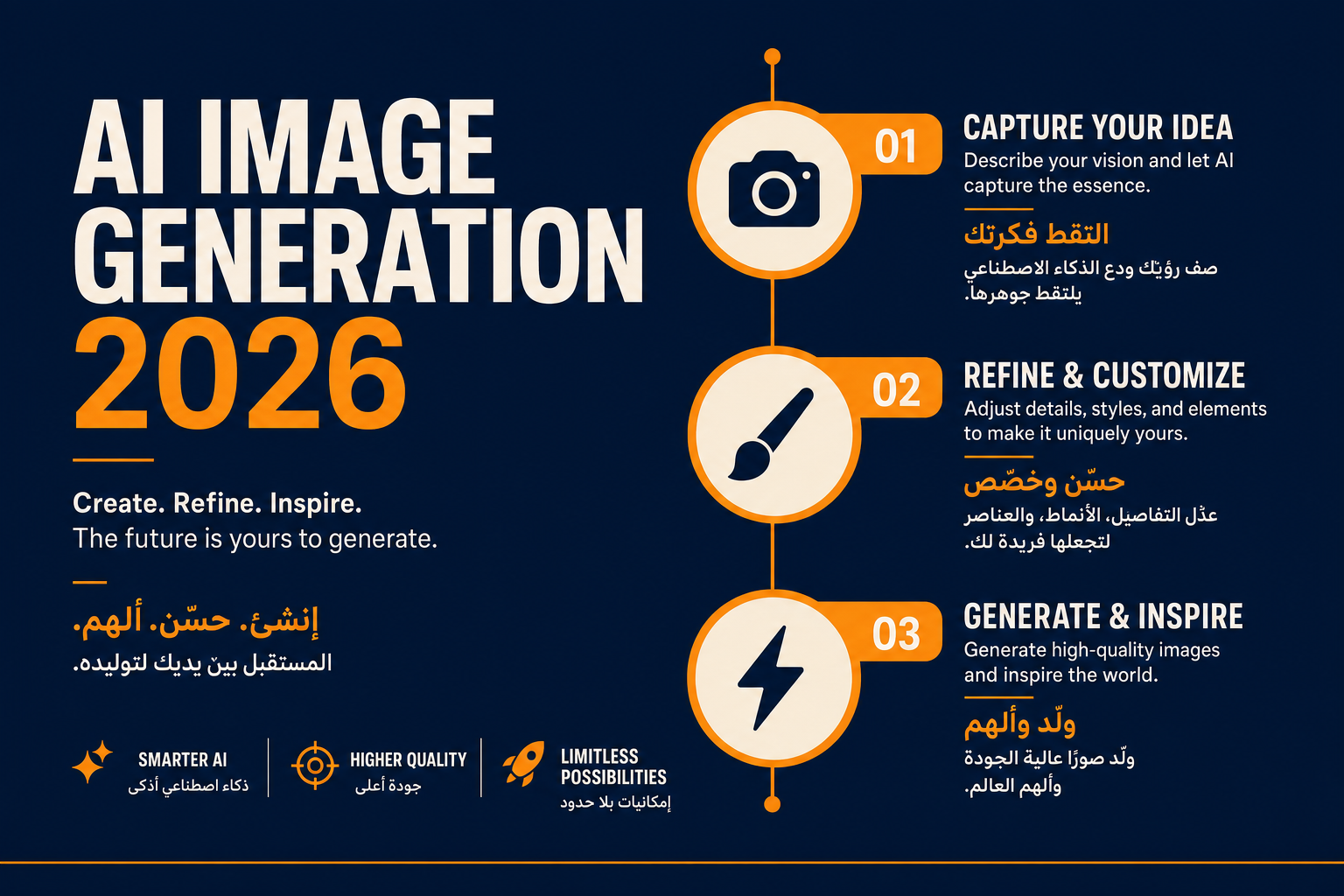
Every headline, step label, and bilingual caption in that image rendered legibly on the first pass, no manual text overlay required. That is the exact capability Qwen-Image-2.0's release claims for itself, demonstrated here on a comparably text-focused model so you can see the standard this new generation of "typography-native" image models is setting.
What this means for creative teams
- Fewer design-tool handoffs. If your team currently generates a background image and then adds text in Canva or Photoshop, text-native models compress that into one step for simple layouts.
- Faster iteration on ad variants. Testing five headline variations on the same visual concept becomes five prompts instead of five design-tool round trips.
- Multi-language creative gets easier. Qwen-Image-2.0's own examples show bilingual Chinese/English layouts rendering cleanly in a single generation, which matters for teams running creative across multiple ad markets.
- Check the output before shipping. Text-rendering accuracy is dramatically better across this new model generation, not perfect. Proofread generated copy the same way you would proofread a first draft from a junior designer.
For a broader look at how AI image generation slots into paid creative production, see our guide on creating a Facebook ad from a product photo and our existing writeup on GPT Image 1/2.
What to do now
If you are evaluating text-heavy AI image generation for infographics, slide decks, or ad creative, treat "does the text actually render" as a pass/fail test before anything else. Run the same prompt across two or three models, generate a genuinely dense layout (headline plus at least three data points), and judge legibility at full size, not thumbnail size. Qwen-Image-2.0 is the clearest current example of a model built around solving that problem first, and the rest of the image-generation field is visibly racing to close the same gap.
FAQ
Is Qwen-Image-2.0 available to use right now? Yes, through Qwen Chat and Alibaba Cloud Model Studio's API. Broad open-weight release for local/self-hosted use had not been confirmed as of this writing.
Do I need to know Chinese to use it? No. The model handles English prompts and output text natively. Its own release examples happen to showcase Chinese calligraphy and bilingual layouts because that is a strong point for a model from a Chinese lab, but English-only infographics and posters work the same way.
How is this different from a model like Nano Banana or Ideogram? Ideogram built its reputation specifically on text rendering, so it is the closest existing comparison. Qwen-Image-2.0's distinction is combining that same typography focus with a unified generate-and-edit workflow and native 2K output in one 7B model. See our Ideogram 3.0 page for a direct point of comparison.
Can I use this for ad creative today? For static infographic-style ads, yes, once broader API access lands outside Alibaba Cloud Model Studio. For anything requiring precise brand-kit fonts and pixel-level control, a design tool pass after generation is still the safer bet.
Will Coinis add Qwen-Image-2.0 to its generation tools? Model availability in Coinis's connected marketplace changes as new releases roll out. Check back for updates rather than assuming any specific model is or isn't wired in at a given time.
Sources
- Qwen-Image-2.0: Professional infographics, exquisite photorealism, qwen.ai official blog, published 2026-02-10: https://qwen.ai/blog?id=qwen-image-2.0
- "Qwen-Image-2.0 is out - 7B unified gen+edit model with native 2K and actual text rendering," r/LocalLLaMA: https://www.reddit.com/r/LocalLLaMA/comments/1r0w7st/qwenimage20_is_out_7b_unified_genedit_model_with/
- "What to Expect from Qwen Image 2.0: 5 Things That Change AI Image Generation," wavespeed.ai: https://wavespeed.ai/blog/posts/blog-what-to-expect-from-qwen-image-2-0-ai-image-generation/

Isidora Matovic
Author
Social media enthusiast and a full time researcher. She takes digital presence very seriously and that is why you are always in touch in what is going on with us! Follow us for more posts like this.