

Most Meta advertisers aren’t losing to competitors, they’re losing to their own account structure. Rising CPAs, stalling campaigns, and declining ROAS are rarely a budget problem. In the majority of cases, they come down to three operational mistakes that compound quietly over time: running too few creatives, ignoring format specs, and producing ads that look unmistakably like ads. Each of these errors directly affects how Meta’s auction algorithm evaluates and delivers your content. Together, they can gut campaign efficiency before you see it in the numbers. Here’s how to identify all three in your account — and fix them.
Mistake #1: You’re Not Running Enough Ad Creatives
The most widespread Meta Ads mistake at scale isn’t budget allocation or audience targeting. It’s creative underinvestment. Not in production quality, but in raw volume.
Meta’s algorithm runs on signal. Every creative variant you push into the auction generates a stream of behavioural data: who stopped scrolling, who clicked, who watched three seconds, who converted. The more distinct creative inputs the algorithm has to work with, the more precisely it can identify which segments of your target audience convert at what cost. When you’re running three or four creatives per ad set, you’re starving the system.
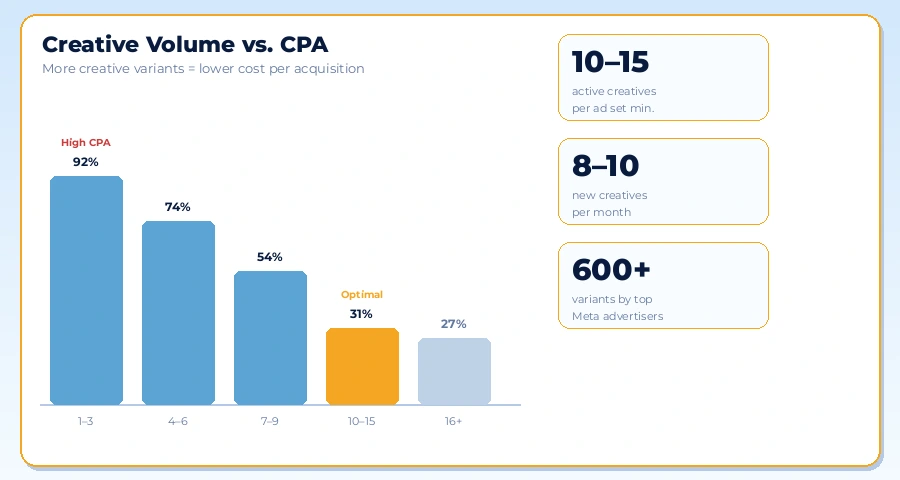
The practical benchmark is 10–15 active creatives per ad set minimum if you’re running Advantage+ Shopping or broad targeting at meaningful spend. Below that threshold, the algorithm optimises within a narrow data set, finds a ceiling, and your CPA plateaus. Accounts pulling 600+ active ad variants from the Meta Ads Library for a single brand aren’t doing it for vanity, but because creative volume is the primary lever for sustained efficiency.
There’s a second dimension most media buyers miss: creative volume is your best defence against ad fatigue. Frequency caps are a blunt instrument. When you’re shipping 8–10 net-new creatives per month and retiring underperformers weekly, you’re not just fighting fatigue. What is happening is that you’re continuously feeding new signals back into the learning phase. The compounding effect on CPAs over a 90-day window is significant.
Takeaway: If your account isn’t producing at least 8–10 new creatives per month, you’re leaving optimisation signal on the table and paying for it in rising CPAs.
Mistake #2: You’re Using the Wrong Creative Specs
This one is deceptively easy to overlook, and Meta penalises it in ways that aren’t immediately visible. Serving a creative in the wrong aspect ratio doesn’t just look off — it actively degrades delivery quality and inflates CPM.
The format matrix is non-negotiable: Feed (Facebook & Instagram) requires 4:5 vertical. It occupies maximum real estate without crossing into Story territory. Stories & Reels require 9:16 full vertical, a 4:5 creative served in a Story placement gets letterboxed with black bars, signals “this is an ad” before a single frame registers, and Meta’s system measures the engagement drop and adjusts your CPM upward. Feed & Explore (secondary): 1:1 square works as a fallback but is not optimal.
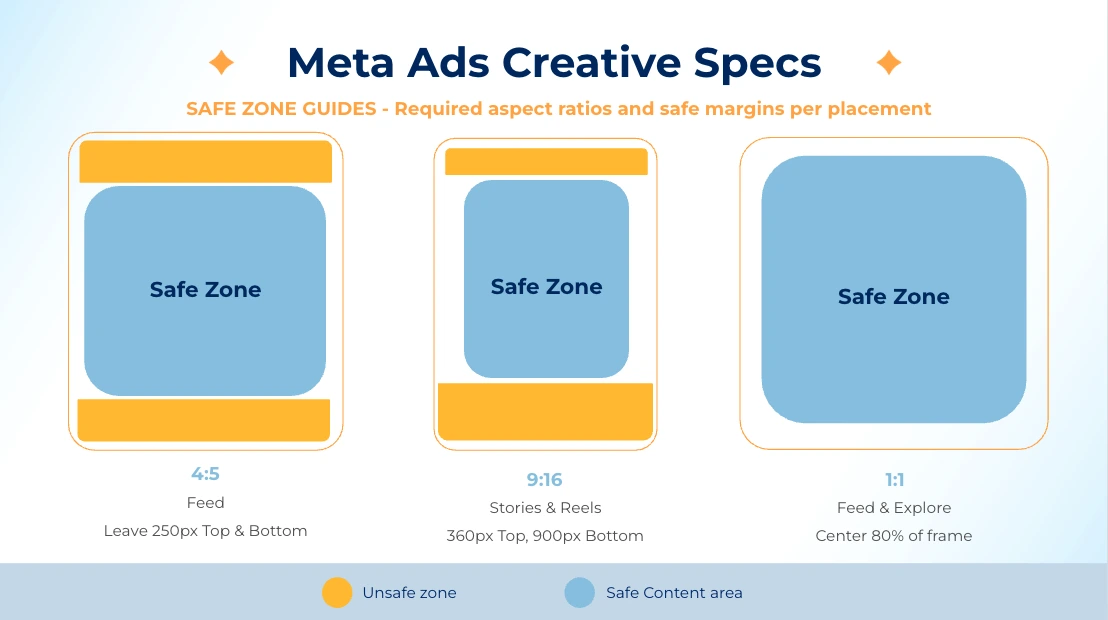
The safe zone issue is equally critical. For 9:16 Stories and Reels, leave roughly 360px at the top and 900px at the bottom clear of key text, logos, and CTAs, that space is covered by platform UI. For 4:5 verticals, maintain 250px clear margins at top and bottom. This is not cosmetic advice. Format compliance is an auction competitiveness issue. Meta’s quality scoring system penalises creatives where key elements fall outside safe zones, directly affecting how aggressively your ads enter auctions.
Takeaway: One master creative does not fit all placements. Build format-specific variants for every significant spend channel or use Dynamic Creative with platform-native specs as the base input.
Mistake #3: Your Ads Look Like Ads
This is the hardest mistake to fix because the fix requires a real change in creative direction, not just a technical adjustment. Polished, brand-produced ads, studio-lit, logo-forward, agency-crafted, are among the worst-performing creative formats on Meta right now. Not because of production quality, but because they pattern-match as advertisements in the first 1.5 seconds. The thumb keeps scrolling.
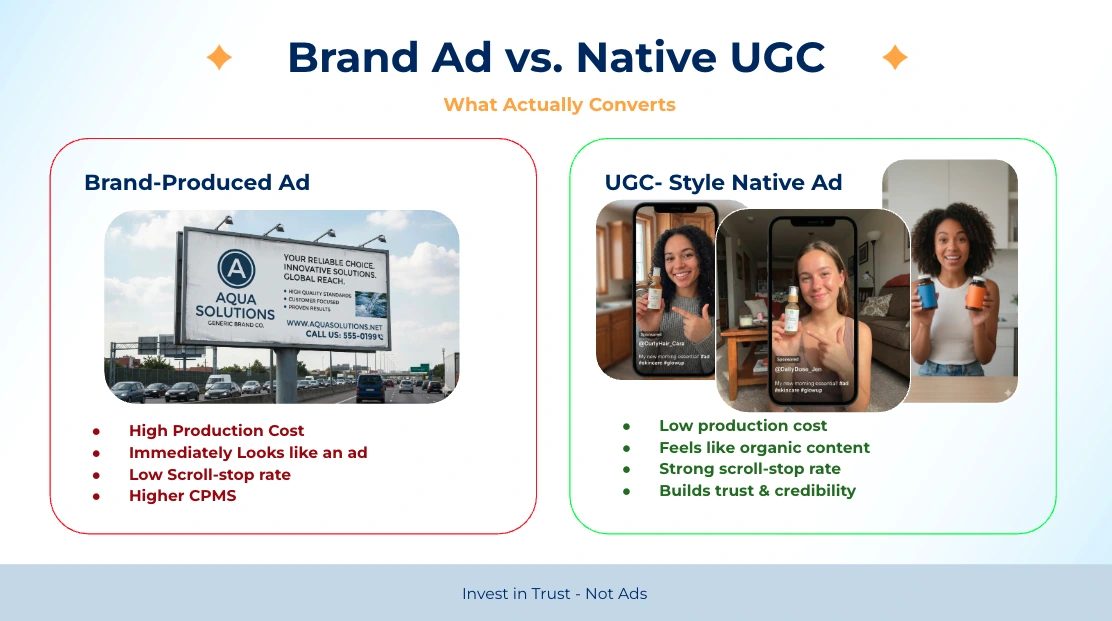
What’s actually stopping the scroll is content that looks and feels native to the feed. A slightly shaky phone video, a product sitting on a real kitchen counter, sticky notes on packaging, these formats earn attention before the viewer has consciously decided to engage. The example from this breakdown is instructive: a simple card ad stating “$0.29 per day to get bright skin”, cost-per-use framing, problem/solution structure, no glossy production. That format converts because it mirrors how organic content communicates. It gives the viewer a reason to stop before pitching a product.
Accounts hitting strong ROAS share one creative characteristic: their content is indistinguishable from organic posts in the first 1.5 seconds. No polished intros, no logo bumpers, no “Hi, I’m BRAND” openers. The UGC formats that work best as a pattern interrupt, sticky notes on products, casual flat lays, handwritten labels, cost almost nothing to produce and routinely outperform expensive studio content.
Takeaway: UGC doesn’t mean low effort, it means intentional authenticity. If your creative team is producing ads that look like ads, you’re fighting the feed instead of working with it.
The Creative Frameworks That Actually Convert
Beyond production style and format compliance, specific creative frameworks consistently outperform generic product showcases. Two are worth building into your testing rotation immediately.
Us vs Us — Rather than comparing your brand to a competitor, you compare your product against itself across different use cases, benefit sets, or customer types. AG1 executes this particularly well: the same product, two columns, different benefits surfaced for different audience segments within a single ad. It works because it’s simultaneously educational and personalised, the viewer self-selects their reason to buy within the content itself.
Solution + Proof: Open with a clear problem statement (the scroll-stopper), present your product as the direct solution, close with proof (a review, a measurable result, a before/after). This mirrors the narrative arc of organic content that performs well. The proof element is what separates it from basic feature advertising: it answers the objection before the viewer forms it.
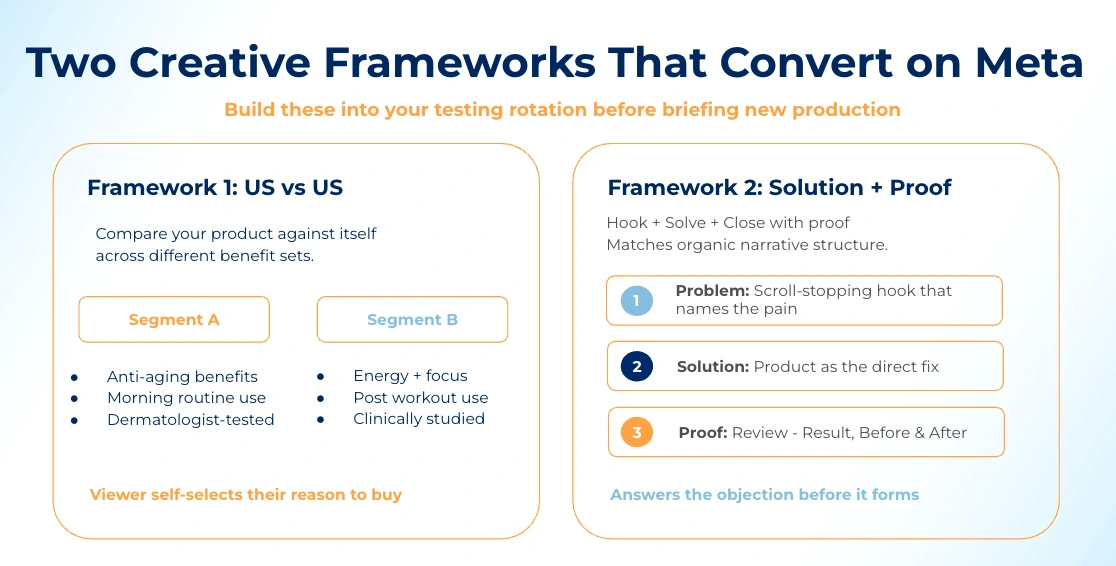
Both frameworks adapt naturally to UGC-style production. A real customer on camera doing an “Us vs Us” breakdown carries far more credibility than the same information in a polished carousel. For affiliate and e-commerce operators managing multiple offers, these frameworks make creative testing more systematic, testing framework variants against each other and building a knowledge base about what works for specific audience segments.
Takeaway: Creative frameworks reduce guesswork. Test Us vs Us and Solution + Proof against your current controls before committing to new production.
How to Research What’s Working Before You Spend a Dollar
One of the most underused tools available to every Meta advertiser is the Meta Ads Library, and it’s completely free. Before briefing a single creative, you should know exactly what your top competitors are running, how long they’ve been running it, and what formats they’re using. Filter by country and sort by oldest active date first. Ads that have been live for 60+ days without pausing are your highest signal data points — if something is still running after two months, it’s almost certainly profitable.
According to Meta’s own research, advertisers who regularly refresh creatives based on performance data see up to 30% lower CPAs over time compared to accounts running static creative sets. The Ads Library gives you the competitive context to make those refreshes targeted rather than speculative.
Takeaway: Spend 30 minutes in Meta Ads Library before your next creative brief. Longevity of competitor ads is your best proxy for what’s converting right now in your category.
Shortlist for Those Who Don’t like Long Posts
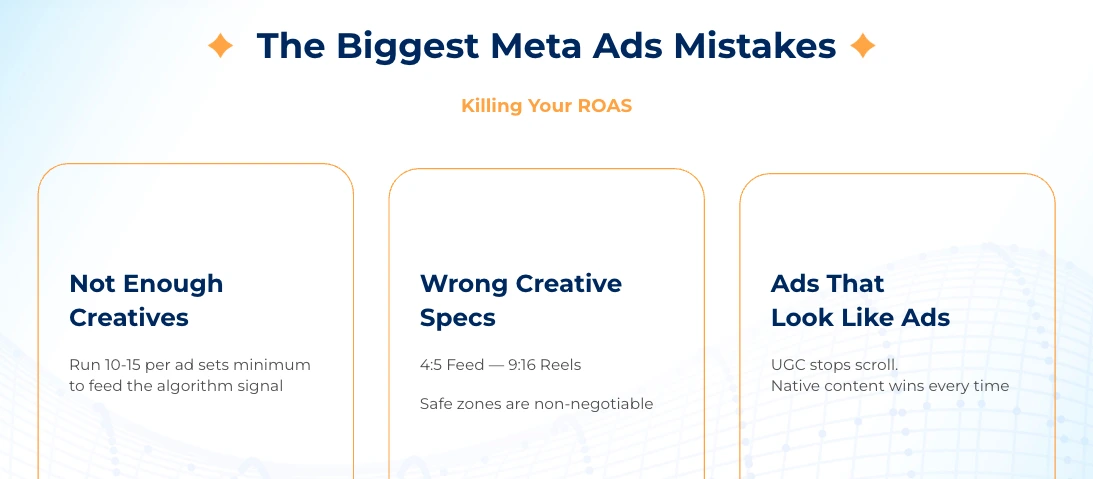
- Volume is a lever: Run 10–15 active creatives per ad set minimum. Creative underinvestment starves the algorithm of the signal it needs to optimise delivery.
- Specs are not optional: Use 4:5 for feed, 9:16 for Stories and Reels, and respect safe zone margins — wrong specs trigger delivery penalties and inflate CPMs.
- Native beats polished: UGC-style content outperforms brand-produced ads because it doesn’t pattern-match as advertising in the first 1.5 seconds.
- Cost-per-use framing works: Reframe price as a daily or per-use cost — it lowers perceived friction and maps naturally to problem/solution creative structures.
- Use proven frameworks: “Us vs Us” and “Solution + Proof” are two high-converting creative structures that work across formats and audience types.
- Research before you produce: The Meta Ads Library is free competitive intelligence — use it to identify what’s already converting before investing in new creative.
Ready to Scale Your Performance Marketing? Let’s Talk.
If your Meta campaigns are hitting a ceiling, the bottleneck is almost always creative — not budget, not targeting, not bidding strategy. At Coinis, we work with media buyers and performance marketers who are ready to fix the structural issues holding their accounts back.
No sales pitch. Just real performance insights tailored to your campaigns.

Tamara Jelic
Author
Part-time researcher, part-time marketing enthusiast. Wanted to be a teacher, ended up working for the best ad tech company in Eastern Europe.