

Open Ads Manager and pull up Advantage+ Shopping, even if it threw you out before. The thing that locked small stores out was volume, plain and simple. That bar just dropped, hard, and most of the sellers who bounced off it last year have not looked since. Look again.
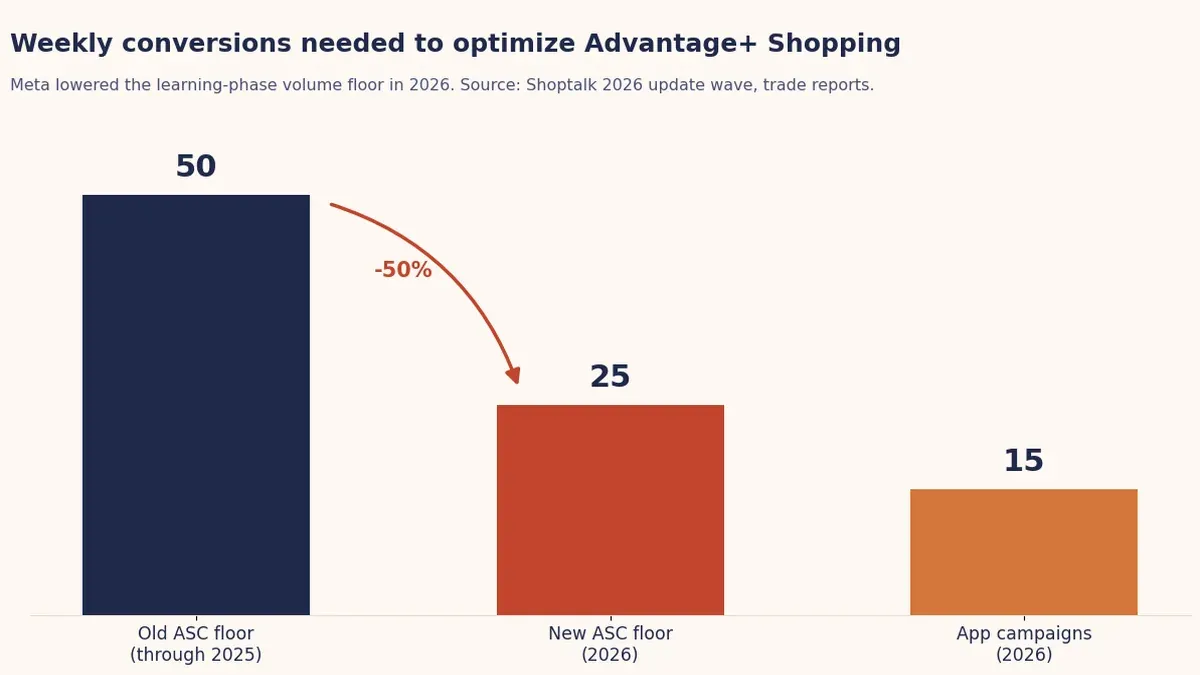
Here is what moved. The weekly conversion threshold, the number of purchases the algorithm wants before it settles into stable delivery, went from about 50 down to about 25. Twenty-five a week. Three or four sales a day, a number a real small store can actually hit. Under the old floor a brand doing four sales a day was feeding the machine on fumes, stalling in learning, then crawling back to manual campaigns. Different math now.
What actually changed in 2026
ASC was always Meta's pitch for sellers who would rather not babysit ad sets. One campaign, one pile of creative, the system does targeting, placement, budget. Volume was the catch, and that is what the Shoptalk wave in March went after. Better signal processing, a stronger ranking model, and the learning requirement drops to about 25 conversions a week for Shopping, 15 or so for app campaigns. Qualifying versus not qualifying, basically.
It did not come alone. The same wave gave you SKU-level budget control inside a single campaign, and split caps for new versus existing customers. That second one quietly saves money, no more overpaying to re-reach people who already buy from you. A few smaller adds rounded it out: a Buy Now button for in-app checkout, WhatsApp Status as a placement, creator commissions on Instagram feeding straight into shopping attribution. Meta's own framing, for what it is worth, is that roughly two in three advertisers already touch some Advantage+ tool. For the full rundown of the announcement, Marketing Dive has a clean breakdown.
Why 25 is the number that matters
Twenty-five a week is the number that matters, so sit with it. An account selling a $40 product on $100 a day can plausibly clear it. Under the old floor that same account spent weeks stuck in learning, burning budget while the algorithm guessed. Now the door opens at a spend level a Creator-tier seller can sustain. The $100-a-day guidance still holds as a practical minimum, because the system needs enough daily events to make stable calls instead of thrashing.
Who this opens the door for
The clear winners are the sellers who were one tier too small for the automation story. You know the profile, because across Coinis accounts it is everywhere: one or two solid products, a modest daily budget, nobody on payroll buying media. Those accounts could never feed ASC enough to bother. Now they can. And because it learns on less, the campaign also steadies faster after you launch something new or swap your creative out.
There is a quieter benefit. Lower volume to learn means you can run ASC next to a small manual test campaign instead of forcing every dollar through one structure. Room to experiment without starving the main campaign, which smaller advertisers rarely got on Meta. It also lowers the cost of being wrong. When a campaign needed 50 weekly sales just to stabilize, a failed test ate a week before you learned anything. At 25 you get a read faster and reallocate sooner.
The new bottleneck is creative, not access
Here is the part most sellers miss. Once getting in is easy, the bottleneck just moves. ASC throws everything into one ad set that holds up to 150 creatives, and the ranking model behind it, the one that rolled across ASC late last year, openly rewards deep creative libraries and clean Conversions API data. It wants variety to test. Leave a winner running and it over-delivers until the cost spikes and the ad goes stale, usually inside two weeks, which is why the refresh advice lands around every 10 to 14 days.
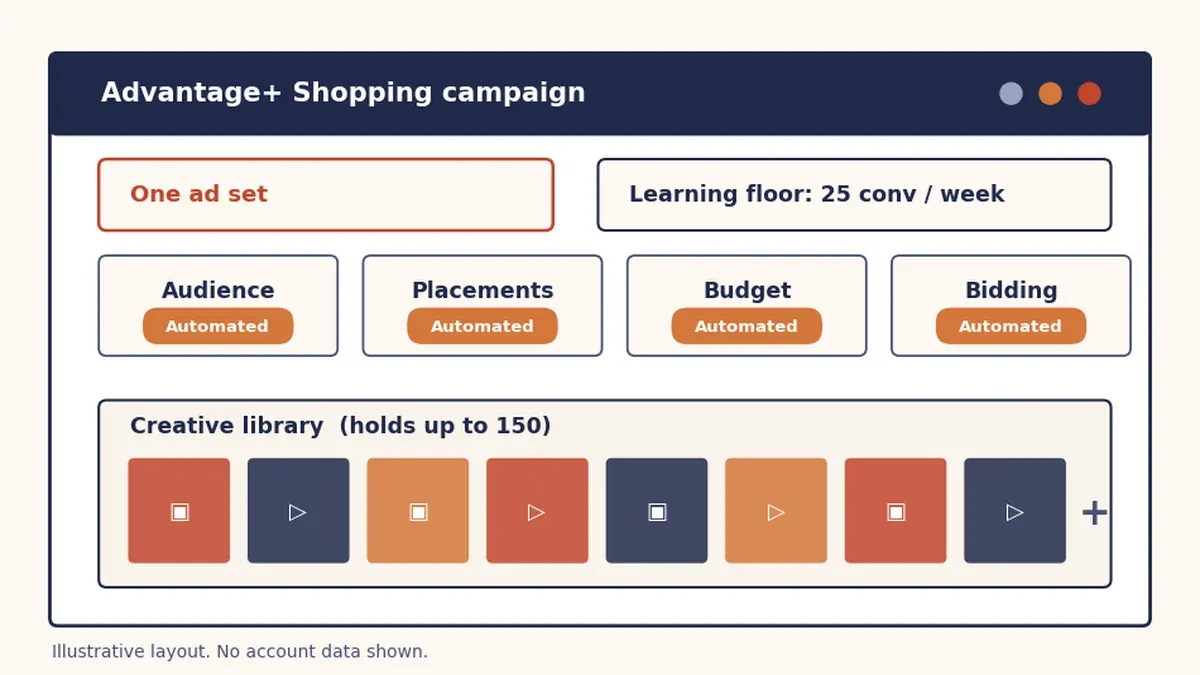
So the question stops being can I get into ASC and becomes can I keep it fed. A brand shipping two new ads a week runs dry. A brand shipping ten or more keeps the algorithm in fresh material to rank. That is a production problem, not a media-buying one, and it is exactly where most small teams hit the wall.
How to test ASC now without torching budget
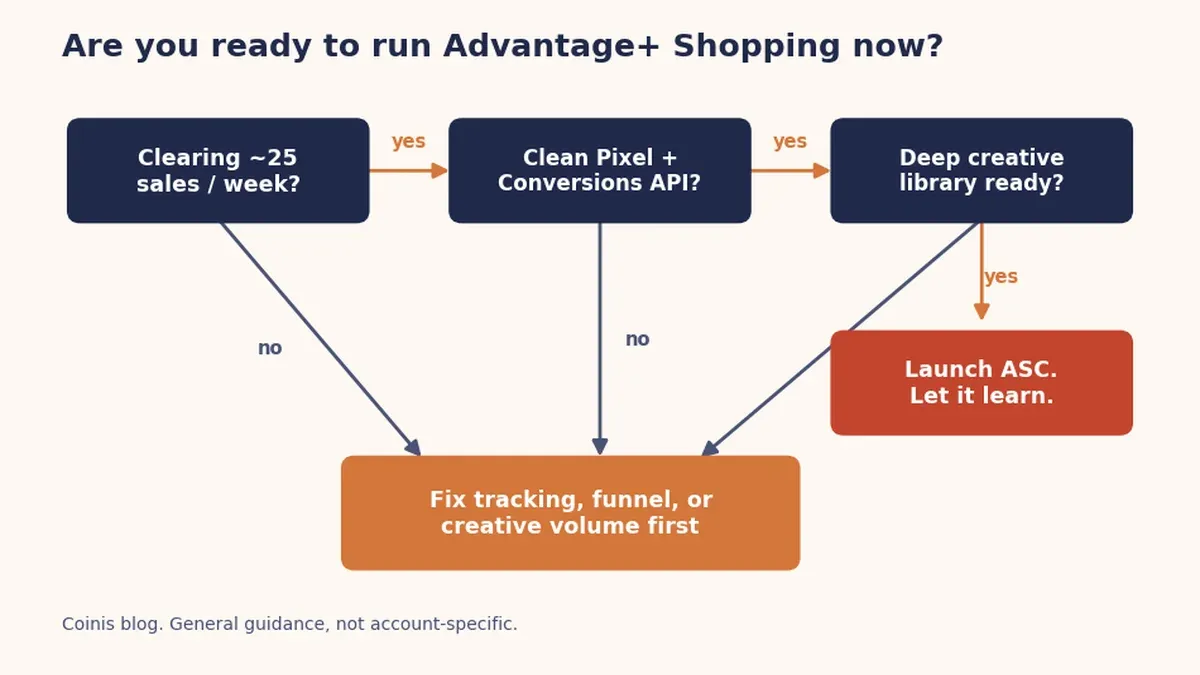
If the new threshold makes you eligible, do not flip it on and walk away. Get conversion tracking right before you spend a cent. Clean Pixel and Conversions API events are what the lower threshold actually rewards, and Meta now has a near one-click CAPI setup that kills most of the old technical friction. Brand-new ad account? The rules are a little different, and our survival guide for new Meta ad accounts covers the traps worth avoiding.
Then check your honest weekly conversion count. Clearing 25 or close, ASC has enough to work with. Well under, fix the funnel or wait, because no threshold change saves a campaign with no data. Budget around $100 a day to start, feed it a real creative set rather than a token two ads, and give it the full learning window without editing. Every edit resets the clock. Watch the new-versus-existing customer split too, so you can see if the spend is finding fresh buyers or recycling your list. For the mechanics of the campaign type, the ASC glossary entry is a quick reference, and our earlier rundown of Meta's Advantage+ and AI updates shows how the creative tools have been moving.
Feed the machine without a design team
So that is the trade. Meta opened the door, and on the way in handed you a creative quota you may not be staffed for. ASC runs best on a steady stream of fresh ads to rank, and that is the part Coinis was built to solve. Paste a product URL, get image, video, and UGC-style variations, push them straight to Meta the same afternoon. Brands using it report ten times the creative variations and production around 90% faster than the old brief-designer-revise loop. The difference between feeding ASC two ads a week and feeding it ten.
The barrier to Meta's smartest campaign type just dropped. The brands that win the quarter are the ones who keep it fed, not the ones with the lowest CPMs. If ten fresh ads a week sounds impossible by hand, Try Coinis AI and put a real pipeline behind your Advantage+ campaigns before your competitors do.