

Your install ad worked in March. By June it's dead weight in the account. Same targeting, same budget, same creative -- and CPI keeps climbing anyway.
That's not a targeting problem. That's creative fatigue, and mobile gaming gets hit by it harder than almost any other vertical.
What creative fatigue actually looks like in a gaming account
Creative fatigue is what happens when the same players see the same ad enough times that they stop responding to it, even though nothing about the ad itself changed. Meta and TikTok's algorithms don't feel tired. Your audience does. The system keeps serving the ad because it has historical performance data attached to it, right up until the moment the CTR curve breaks.
Business of Apps' 2026 Mobile Gaming Marketing Trends whitepaper, produced with SocialPeta, Singular, and Aarki, put a number on how fast that break happens: CTR can drop by up to 45% after four exposures without a creative refresh. Four. Not forty. In a category where short-form video already burns through impressions at speed -- the same report found video creatives now make up 74.1% of all mobile game ad inventory, with sub-30-second clips accounting for 58% of that -- four exposures can happen inside a single day of spend on a mid-size account. The mechanics of rotating creative before that curve breaks are the same ones covered in how to combat creative fatigue on Instagram ads and on TikTok ads -- the gaming-specific twist is just how much faster the clock runs.
The same report tracked how advertisers are responding: 82.5% of mobile game advertisers now launch new creative every month, up 14.6% year over year. Refresh isn't optional anymore. It's the baseline cost of staying in the auction.
Motion's Creative Benchmarks 2026 report, built from an analysis of more than 550,000 Meta and Instagram ads and $1.3 billion in tracked spend between September 2025 and January 2026, backs this from a different angle. Only around 5% of ads in any given account become genuine "winners" -- spending at least 10x the account median. The advertisers who consistently find those winners aren't the ones with sharper creative instincts. They're the ones launching more variations, more often, because volume is what gives a winning combination the chance to surface at all.
Put those two data points together and the gaming-specific problem is obvious: this is a category with an unusually short creative half-life, competing against advertisers who win by shipping volume, and most studios still brief, shoot, and edit install ads like it's a quarterly production cycle.
Why gaming ad creative decays faster than other verticals
Three things compound against game studios specifically:
The hook has to match the genre in the first frame. A mismatched hook doesn't just underperform, it actively recruits the wrong installs. Someone who installs expecting a shooter and opens a match-3 puzzle uninstalls within the hour, and that churn drags down every retention metric the ad's own performance gets measured against.
Gameplay capture is a production bottleneck. Every creative test needs a fresh clip pulled from an actual build, which means someone on the team has to play the game, screen-record a clean take, and hand it to whoever's cutting the ad. That pipeline is slow by nature, and it's exactly the kind of task studios defer when the roadmap gets busy -- which is precisely when creative should be refreshing fastest.
Volume compounds against a slow pipeline. If winning is a numbers game, as Motion's data suggests, then a studio that can only turn around two new creatives a month is playing a fundamentally different game than one that can ship ten. The gap isn't creative talent. It's throughput.
What you can generate on Coinis instead
Coinis turns a single gameplay clip or product screenshot into launch-ready ad variations without a shoot day, an editor, or a capture bottleneck, the same way a single product photo becomes a scroll-stopping video ad for any other vertical. Two formats do most of the heavy lifting for install campaigns specifically, and both build on the same Ad Studio cinematic presets engine already covered on this blog.
Gameplay loop reels. A tight, six-to-fifteen-second cut built around real gameplay, hook-first, genre cue visible in the opening frame. This is the format built to directly answer the "hook has to match gameplay" problem above: the ad shows what the player actually gets, so install-to-D7 retention holds instead of decaying from mismatched expectations.
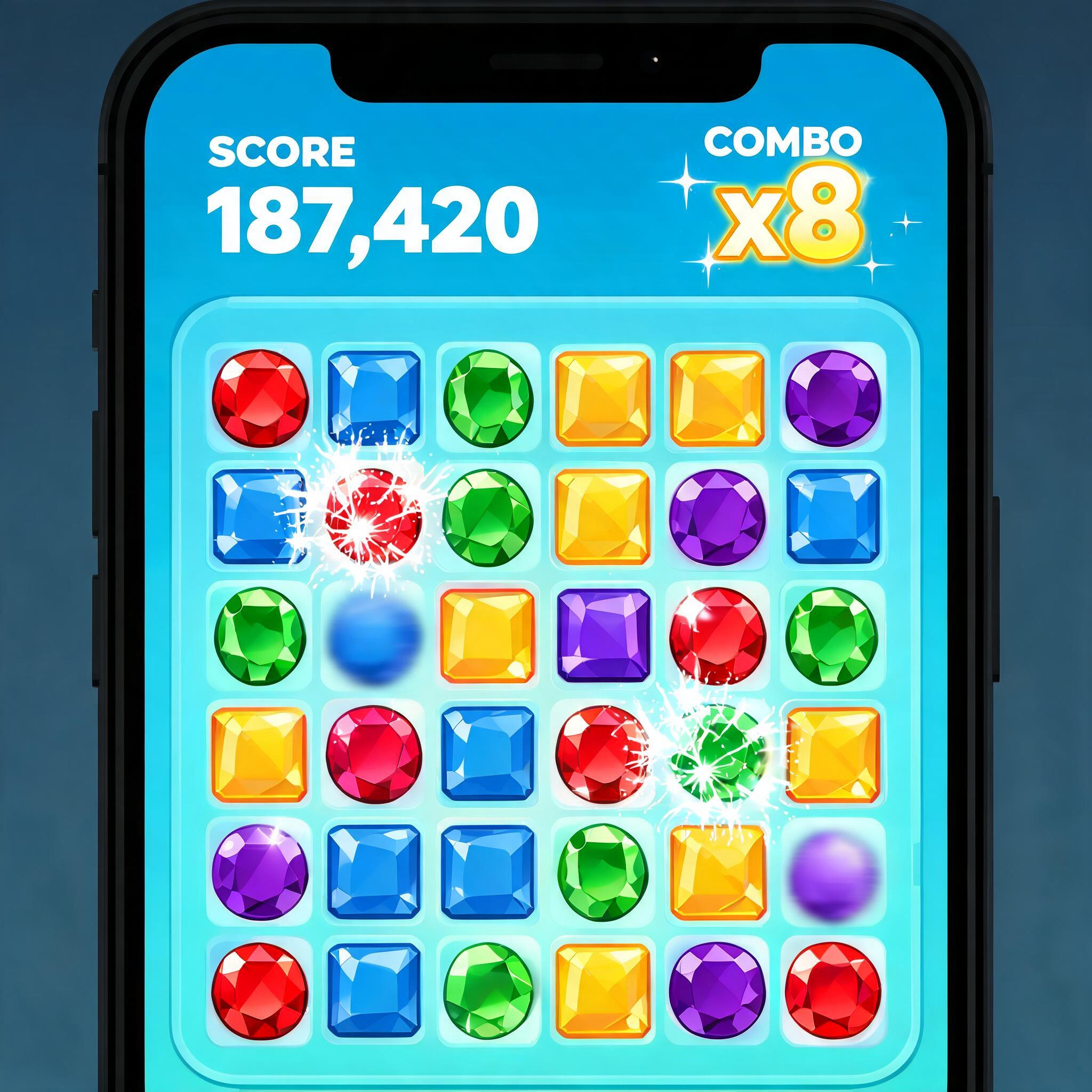
Illustrative still for the gameplay-loop-reel format (not the final video render -- the full motion clip is queued for a future generation pass). Storyboard: hook on a genre-defining action beat with a visible score/combo counter, escalating mid-beat, payoff on a win-state moment with an install-style CTA card.
Prompt direction for this format (to be finalized against the live tool contract next session):
Style: real gameplay capture aesthetic, not a rendered cinematic. Hook: first 1.5 seconds show a genre-defining action beat with a visible score or combo counter. Motion: fast cuts on beat, no dead frames. Payoff: win-state moment, app icon overlay, "Play now" style CTA card in the final second. Avoid: generic B-roll unrelated to the actual game loop, slow builds before the hook.
UGC-style reaction ads. A synthetic creator reacting to gameplay footage, framed as a discovery moment rather than a polished trailer. Coinis' own gaming page notes that "synthetic UGC reactions outperform raw gameplay capture" as a tested creative angle -- this format pairs a believable reaction shot with the actual game footage so the ad reads as social proof, not an install pitch.

Illustrative still for the UGC-reaction format (not the final video render -- the full motion clip is queued for a future generation pass). Storyboard: creator reacts to the gameplay beat, cuts to the actual footage, then delivers a one-line recommendation over an app icon card.
Building a refresh cadence, not a one-off ad
A single winning ad doesn't fix creative fatigue. It buys you a few weeks before the same decay curve starts again. The fix is a cadence:
- Pull a fresh gameplay clip every time a build changes materially -- a new level, a balance patch, a visual update. The clip doesn't need to be long. Six to ten seconds of the game's best moment is enough raw material for several ad variants.
- Generate 3-5 variants per clip, not one. Different hook framing, different pacing, one UGC-reaction cut and one straight gameplay-loop cut. This is the volume-creates-winners pattern Motion's data points to -- more shots on goal, not more polish on a single shot.
- Watch the exposure count, not the calendar. The "four exposures" threshold from the Business of Apps whitepaper is a per-user metric, not a weekly one. A high-spend campaign burns through four exposures per user much faster than a modest one. Rotate creative based on frequency reporting in Ads Manager, not a fixed weekly schedule.
- Keep the winners, retire the rest fast. Per Motion's benchmark, roughly half of all ads in a typical account barely spend at all. Don't defend an underperforming creative out of sunk-cost thinking -- cut it and put the next variant in front of the audience instead.
Run this loop through Coinis' Ad Studio and the production bottleneck disappears. Drop in a gameplay clip or a product screenshot, pick a preset, and get launch-ready variants without waiting on an editor or a shoot day -- the same throughput advantage the highest-spending advertisers already have, without needing their budget. If install campaigns are new to your setup, setting the right Facebook ads objective for app installs is the platform-side piece that makes sure this creative actually reaches the right auction.
FAQ
How often should mobile game ads be refreshed? Tie it to exposure frequency, not a calendar. Business of Apps' 2026 data shows CTR can fall as much as 45% after four exposures to the same creative, so high-frequency campaigns need faster rotation than low-spend ones. As a starting cadence, most studios refresh weekly to match the pace of build updates and patch cycles.
Does real gameplay footage outperform rendered cinematic ads for install campaigns? For install-specific creative, yes, generally. An ad that shows the actual gameplay loop sets accurate expectations, which supports D7 retention because the install matches what the player experiences in the first session. Cinematic, trailer-style creative still has a role for brand awareness and pre-registration campaigns, just not as the primary install-driving format.
What's the difference between a gameplay loop reel and a UGC reaction ad? A gameplay loop reel is a direct, hook-first cut of the actual game in motion. A UGC reaction ad wraps that same gameplay footage inside a creator reacting to it, which reads more like a discovery moment or a recommendation than a straight ad. Testing both formats against the same underlying clip is a fast way to find which framing resonates with a given audience.
Can AI-generated gameplay ads pass platform ad review? Yes, when the ad is built around real gameplay capture rather than fully synthetic overlays. Ads that show genuine in-game footage read to reviewers the same way any other gameplay-based creative does. The synthetic layer in a UGC-reaction format is the creator reaction, not the gameplay itself, which keeps the ad's core claim honest and verifiable.
Do I need a big production team to keep up with this cadence? No. The entire point of a generation-based workflow is removing the shoot day and the edit queue from the loop. One clean gameplay clip and a preset choice replace what used to require a videographer, an editor, and a review cycle -- which is exactly why studios that adopt it can match the creative volume of much bigger advertisers.
Sources
- Business of Apps / SocialPeta, "Mobile Gaming Marketing Trends Whitepaper 2026," published February 12, 2026. https://www.businessofapps.com/insights/mobile-gaming-marketing-trends-whitepaper-2026/
- Motion, "Creative Benchmarks 2026," 550,000+ ads / $1.3B spend analyzed September 2025-January 2026. https://motionapp.com/thumbstop-pulse/creative-benchmarks-2026

Isidora Matovic
Author
Social media enthusiast and a full time researcher. She takes digital presence very seriously and that is why you are always in touch in what is going on with us! Follow us for more posts like this.