
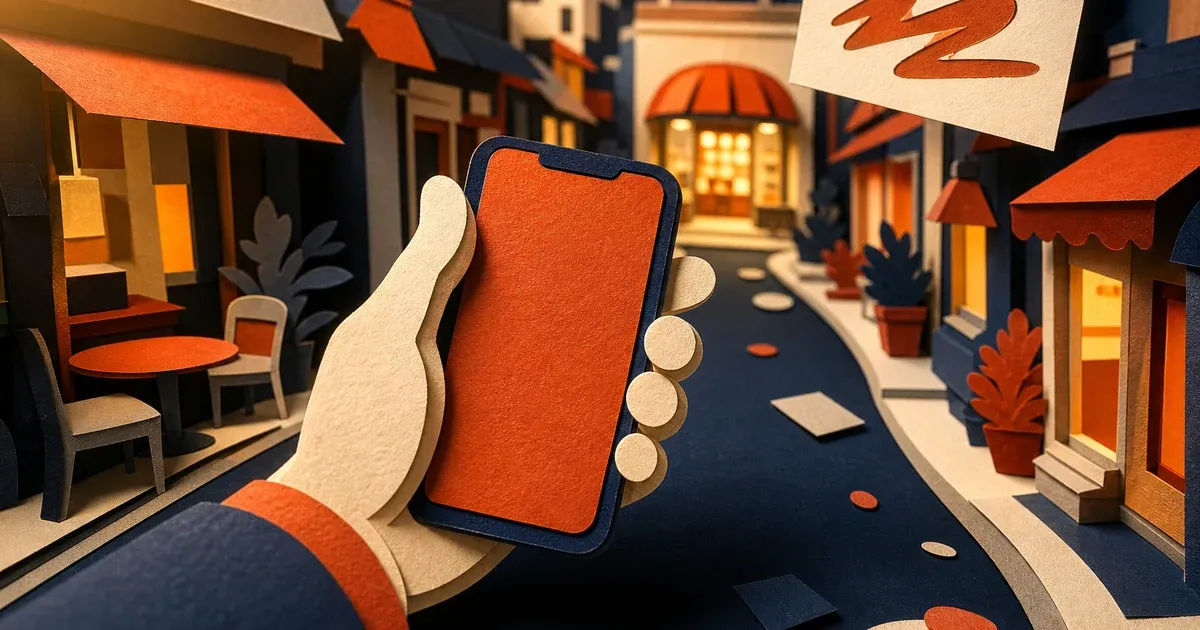
Type "POV:" into a caption and a viewer already knows what happens next. They are not watching a story. They are living one second of it, from inside someone else's eyes. That single framing trick has moved more than 700 billion videos on TikTok alone, and it is now one of the easiest ad structures to generate without ever renting a camera rig.
POV, point of view, puts the viewer behind the eyes of the person in the video instead of in front of them. No narrator. No third-person product shot. The camera is the character, and the caption at the top does the framing work a script normally would. It is one of the most-used trend formats on short-form video, and it is now available as a generation preset instead of a filming technique.
What Happened
POV format ads have quietly built a real, if still low-volume, search footprint. DataForSEO shows "pov ads" carrying commercial search intent with essentially zero competition, a pattern that shows up when a format is already converting in feeds faster than publishers are writing about it. That matches what independent research has already found about the trend itself.
A 2025 peer-reviewed study in the Marketing Management Journal coded 750 short-form branded ads and found trending content elements, POV chief among them, produce a measurable lift in consumer engagement (likes, comments, shares), with the effect holding up even after controlling for caption length and the presence of human faces in the frame. The same paper notes POV had already crossed 700 billion video plays on TikTok and 3.5 million posts under #pov on Instagram by 2023, and cites a clothing brand's single POV ad pulling 7 million views and nearly 1 million likes from the format alone.
Separately, 2026 platform benchmark data backs the mechanism, not just the anecdote: TikTok's own aggregate reporting shows UGC-style, platform-native creative delivering 28% lower cost-per-acquisition than studio-produced ads, and Spark-style creator-voice content converting 44% better than polished in-feed creative. POV framing is one of the clearest ways to signal "this is native content, not an ad" in the first half-second a viewer sees it, before they have consciously registered the caption at all.
Why It Matters
The reason POV ads outperform is structural, not stylistic, and every part of that structure can now be written directly into a generation prompt.
The camera is the character. A regular ad shows a person using a product. A POV ad puts the viewer's own hands, or their own line of sight, in the frame. That single change removes the psychological distance between "watching an ad" and "having an experience," which is exactly why engagement researchers keep finding a lift attached to the format independent of production quality.
The caption carries the setup, the video carries the payoff. POV ads front-load context in three or four words of on-screen text, then let the footage answer the implied question. "POV: you finally found a dripper that doesn't burn the coffee" does more narrative work in four words than a voiceover script would in fifteen seconds, because the viewer's brain fills in the rest.
It reads as native, not produced. The entire aesthetic of POV content, handheld framing, natural light, imperfect focus pulls, is a visual shorthand the platform's own users trained everyone to recognize as "real." An ad that borrows that shorthand borrows the trust that comes with it, which is the same UGC-style authenticity mechanic behind every trust-driven ad format, just executed through camera position instead of a hired creator.
None of those three traits require an actual camera person or a real hand. They require a clear brief: what the viewer is supposedly seeing, what the caption sets up, and what the payoff is when the product enters frame. That is precisely the input a generation preset needs, not a shoot day.
What This Means for Advertisers
Ad Studio's UGC preset family already covers testimonial-style clips, unboxing reveals, calm podcast-style formats, and street-interview ads, each demonstrated in earlier Coinis walkthroughs. The POV preset is the next one worth a dedicated look, because it is built around a framing device rather than a persona: first-person camera position, a short setup caption, and a payoff beat when the product resolves in frame.
POV preset example: first-person handheld shot of a ceramic pour-over coffee dripper, hook to payoff, generated with Coinis Ad Studio's POV UGC preset
The mechanics translate into prompt inputs directly:
- The caption setup is the hook. A vague "POV: buying coffee gear" produces a flat ad. A specific, relatable setup line, one with an implied before-state, produces the pattern interrupt that makes a viewer stop mid-scroll.
- The camera position replaces casting entirely. There is no persona to brief beyond "whose eyes is this," which is the fastest preset in the UGC family to write a prompt for precisely because there is no face, delivery style, or reaction to specify.
- The payoff resolution is the CTA. The product doesn't get introduced, it gets discovered, from the same first-person vantage point the whole clip has held, which is what makes the format feel less like an ad breaking the scroll and more like the scroll continuing.
That reframing is the entire value proposition. The format's advantage was never a specific camera rig or a hired creator's hands. It was the framing decision. Once framing is the input to a generator instead of a shooting instruction on set, any advertiser can test a POV variant the same afternoon they read about it, at whatever volume their testing budget allows.
What to Do Now
Three ways to put this into a testing plan immediately:
- Write the caption setup before touching the preset. Draft five candidate "POV:" setup lines for the product. The one with the most specific implied before-state, not the safest one, is almost always the strongest hook.
- Test POV against your best-performing UGC ad, same product, same week. POV isolates whether framing alone (no persona, no delivery style) can match or beat a persona-led testimonial. That answer changes how you brief every future ad in the set.
- Keep the caption short. Every POV example that works front-loads three to six words of setup text. Longer captions on POV content read as narration, which breaks the "this is your own experience" illusion the format depends on.
Bigger Picture
Formats born as organic trends keep migrating into paid creative once enough advertisers notice the engagement lift: testimonials, unboxing, before-after reveals, street interviews, and now POV. Each migration follows the same pattern, a structure that worked because it looked unproduced gets systematized into something repeatable, without losing the trait that made it work in the first place. The advertisers testing POV now are not waiting for the trend to peak and fade. They are turning a framing decision into a generation input before the format becomes as saturated as the testimonial ad already is.
FAQ
What makes a POV ad different from a regular UGC testimonial? A testimonial is delivered by a visible person talking about the product. A POV ad removes that person from view entirely, the camera stands in for the viewer's own eyes, and a short on-screen caption does the setup work a script or voiceover would normally carry.
Does the POV format work for every product category? It works best where the viewer can plausibly imagine using the product themselves in that exact frame, which covers most consumer goods, food and beverage, beauty, and home products well. Categories that depend on a visible spokesperson or a demonstrated professional skill are a weaker fit.
Can I generate a POV ad without filming any real footage? Yes, through Ad Studio's POV preset. You provide the caption setup and the product-truth details, and the generator produces the first-person framing, the handheld camera feel, and the payoff resolution.
How long should a POV ad run? Most working examples land in the same 10-15 second range as other short-form UGC formats. The caption needs to land in the first couple of seconds and the payoff needs to resolve before viewer attention moves on.
Is this the same as Coinis's existing UGC preset family? It is part of the same Ad Studio UGC preset family already covering testimonial-style, unboxing, podcast-style, and street-interview formats. POV is a distinct preset inside that family, built specifically around first-person camera framing rather than a persona or an interview structure.
Turn This Into a Launch-Ready Ad
Every advertiser who has watched a POV ad outperform their studio creative had the same blocker: no camera rig that shoots convincingly from a viewer's own eyes, no persona to brief, no shoot day. That blocker is gone. Write the setup line, pick the payoff, generate the frame, and turn it into a launch-ready ad with a Coinis Ad Studio template instead of scripting a testimonial you don't need.
Sources
- Dang, A., Saravade, S., Spradlin, J., Nworah, P., Linstead, A., & Munger, R. (2025). "Should Brands Utilize Trending Content Elements for Their Short-Form Advertisements?" Marketing Management Journal, 35(1) -- https://marketingmanagementjournal.scholasticahq.com/article/144766-should-brands-utilize-trending-content-elements-for-their-short-form-advertisements (peer-reviewed, 750-ad content analysis, POV trend volume figures and Cross Angel case example, engagement-lift finding)
- Digital Applied, "TikTok Ads Benchmarks 2026: CPC, CPM, CVR by Industry" -- https://www.digitalapplied.com/blog/tiktok-ads-benchmarks-2026-cpc-cpm-cvr-industry (28% lower CPA for UGC-style vs studio-produced creative, 44% higher conversion for Spark/creator-voice creative vs in-feed, sound-on and creative-length benchmarks)
- DataForSEO keyword_overview data, pulled 2026-07-15 via research.py (see front-matter for full detail)

Isidora Matovic
Author
Social media enthusiast and a full time researcher. She takes digital presence very seriously and that is why you are always in touch in what is going on with us! Follow us for more posts like this.