

A video ad that converts in English does not automatically convert in Spanish, German, or Japanese. Subtitles get skipped. A flat voiceover reads as foreign, not local. The actual fix, dubbing the original speaker into a new language while keeping their own voice and syncing their lips to the new words, used to mean a studio booking, a voice actor, and a second post-production pass for every market. That cost is why most advertisers ship one language and call it done.
That math changed in 2026. Meta, Google, and TikTok all now offer some form of AI dubbing inside their own ad platforms. The capability is no longer the bottleneck. Deciding whether to dub at the platform level or walk in with an already-localized master is.
What Actually Shipped, Across Three Platforms
Meta's AI dubbing started on the creator side in August 2025: Reels could be auto-translated with the speaker's own voice cloned and lips synced to the new audio, launching in English and Spanish before expanding through 2026 to Hindi, Portuguese, French, German, Italian, Japanese, Korean, Arabic, Indonesian, Thai, and Vietnamese (Meta Newsroom, "Discover Reels From Around the World With Meta AI Translation," updated through July 2026). Meta extended the same mechanism to the advertiser side as an Advantage+ feature, announced in October 2025.
Google followed with Video Ads Dubbing inside Ads Manager's Asset Studio, translating and dubbing existing video creative into 33 languages and locales, currently rolling out to select advertisers (Search Engine Land, "Google Ads rolls out AI video dubbing in Asset Studio," September 2026). Google's own promotional figures cite an 86% increase in click-through rate and a 75% reduction in cost per click for dubbed variants, numbers the publication is careful to flag as Google-provided examples rather than a guaranteed outcome. TikTok built dubbing into its Symphony ad suite even earlier, in June 2024, with more than ten languages and dialects at launch.
Three platforms converging on the same feature in roughly eighteen months is not a coincidence. It means the audience expectation shifted: a dubbed, lip-synced ad reads as made for that market, and an ad with mismatched audio and mouth movement reads as an afterthought.
The Catch With Platform-Native Dubbing
Letting Meta or Google dub your video inside their own ad manager is convenient, and for a single platform it works. The limitation shows up the moment a campaign runs across more than one channel. A video dubbed inside Meta's Advantage+ pipeline does not travel to a TikTok Symphony campaign or a YouTube buy. Each platform's dubbing tool only touches creative running inside that platform, which means an advertiser running the same video across three channels in five languages is back to managing fifteen separate dubbing jobs, one per platform per language, with no single master file to hand off.
Meta's own documentation is also specific about where its dubbing quality holds up: clean, direct-to-camera voiceover with minimal background music performs best, while music-led or ambient-audio creative is explicitly flagged as lower suitability. A platform-native tool optimized for its own feed is not built to be a universal localization layer for a creative asset used everywhere.
Dub Once, Before the Media Buy, Not Per Platform
The alternative is localizing the master video before it ever reaches an ad manager, so the same dubbed, lip-synced file uploads cleanly to Meta, Google, TikTok, or anywhere else, with nothing platform-specific baked in.
Ad Studio's enhance_asset_proxy tool, already demonstrated on this blog for photo repair work like background replacement and upscaling, and for cinematic product video presets, includes a lip-sync model alongside its other repair operations. Applied to video, it takes an existing ad's visual track and a new target-language audio track and resyncs the speaker's mouth movement to match, the same underlying capability Meta and TikTok ship natively, available as a standalone step in a workflow instead of locked to one platform's ad manager.
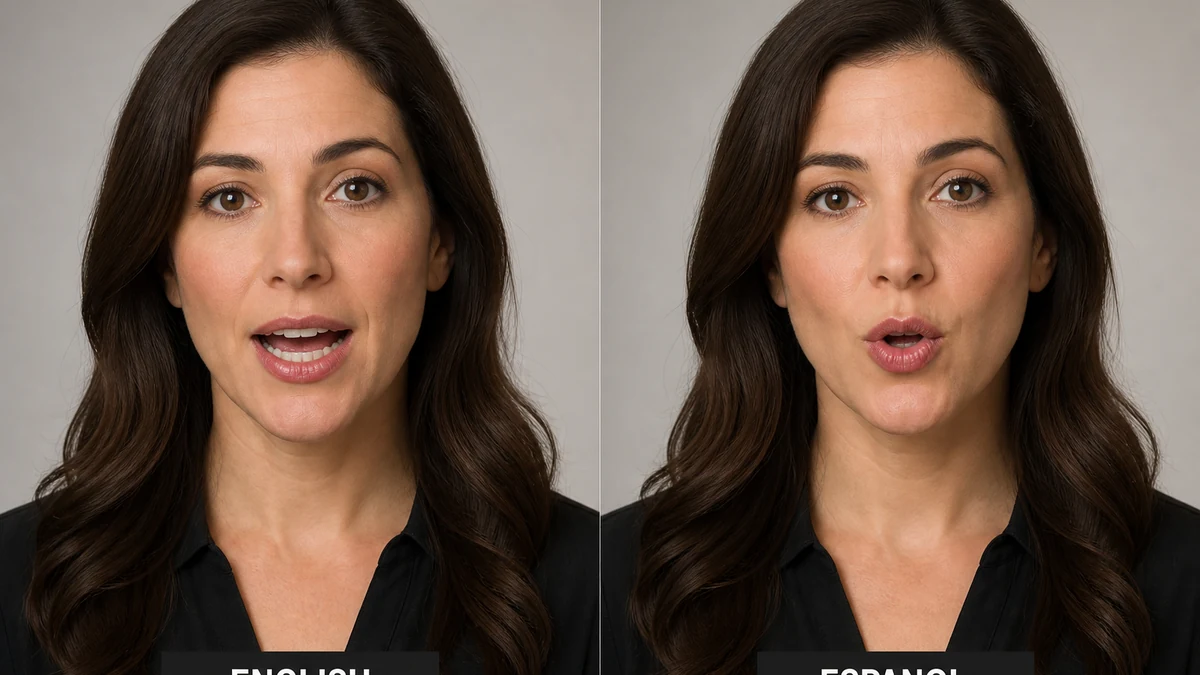
This image is an illustrative stand-in generated while mcp.coinis.dev's generation backend was down (401 on tools/list, confirmed this session). See One Photo, Every Ad Size for a real generate_image_templates render, and check back for the real enhance_asset_proxy lip-sync output once the connection is restored.
The workflow:
- Start with a clean voiceover-driven ad. Direct-to-camera spokesperson reads, product demo narration, or a clear single-voice script. The same audio-quality rule that applies to Meta's own dubbing applies here: minimal background music, one dominant voice track.
- Translate and generate the target-language audio. A new voice track carries the translated script, matched in tone and pacing to the original.
- Run
enhance_asset_proxy's lip-sync op against the original video and the new audio track. The visual content stays untouched except for the mouth region, which resyncs frame by frame to the new dialogue. - Vision-check the output for the same defect classes any AI-video output needs checking against: garbled or dropped frames around the jaw, audio drift against the rest of the clip, and any artifact around facial hair or accessories near the mouth.
- Export the single localized file and upload it as-is to every platform running the campaign, no per-platform dubbing step required.
Pair this with the resize and translate workflow already covered in One Ad, Every Market for the static-image side of a multi-market launch, and a single source asset, photo or video, now reaches every language and every placement from one Ad Studio pass.
Where Platform-Native Dubbing Still Wins
This is not an argument against Meta's or Google's own dubbing tools. If a campaign genuinely lives inside one platform start to finish, letting that platform dub it natively is one less step and it's free where available. The dub-before-the-buy approach earns its keep specifically when a creative needs to run identically across multiple platforms, when the source audio has more texture than a clean studio voiceover, or when a team wants one approved master file instead of reviewing a separate dubbed variant inside every ad manager.
FAQ
Does AI lip-sync dubbing work on any video, or only spokesperson-style ads? Both Meta's own guidance and general dubbing-model behavior point the same direction: a single clear voice with minimal competing background audio produces the cleanest result. Fast-cut UGC-style content with ambient noise or multiple overlapping voices dubs less reliably.
Does this replace translating the ad copy itself, like captions or a product description? No. Lip-sync dubbing only resyncs spoken audio and mouth movement. Translating on-screen copy, like a Facebook ad translated for a Korean audience, is a separate step that still needs to happen alongside it.
Is a dubbed, lip-synced ad required to disclose it was AI-modified? Meta labels AI-translated Reels with a visible "Translated with Meta AI" tag on the platform itself. Advertisers should check each platform's current AI-content disclosure policy before running dubbed creative, since these requirements are still evolving through 2026.
How is this different from just adding subtitles? Subtitles are faster and cheaper, but they ask the viewer to read while watching, and read-through rates on sound-off or distracted viewing drop. A dubbed, lip-synced version keeps the ad watchable the same way the original was, in the viewer's own language.
Does the original speaker need to re-record anything for each language? No. The lip-sync step works from the existing video and a new audio track. The person in the ad never re-shoots.
Stop Choosing One Market Per Video
A video ad that only speaks one language is leaving every other market to read subtitles or skip the ad outright. Dub it once, sync the lips to match, and the same creative that works in English now works everywhere the campaign runs. Build the localized version in Coinis Ad Studio and stop treating language as a reason to leave a market off the media plan.
Sources
- Meta Newsroom, "Discover Reels From Around the World With Meta AI Translation," updated July 2026: https://about.fb.com/news/2025/10/discover-reels-around-world-meta-ai-translation/
- Search Engine Land, "Google Ads rolls out AI video dubbing in Asset Studio," September 2026: https://searchengineland.com/google-ads-rolls-out-ai-video-dubbing-in-asset-studio-489693

Isidora Matovic
Author
Social media enthusiast and a full time researcher. She takes digital presence very seriously and that is why you are always in touch in what is going on with us! Follow us for more posts like this.