
A pure white packshot proves a product exists. It does not prove how big it is, how it feels, or what it looks like outside a lightbox. That gap is exactly why so many of the highest-converting product photos on Amazon, Etsy, and Instagram feature one unglamorous, low-tech addition: a human hand.
The problem a perfect studio shot can't solve
Strip a product down to pure white on a seamless background and something gets lost along with the clutter: scale. A phone case, a candle, a protein scoop, and a water bottle can all look roughly the same size floating alone on white. A shopper scrolling on their phone has no visual anchor to judge whether an item is palm-sized or forearm-length, until a hand enters the frame and gives their eye something familiar to measure against.
Scale is only half of it. A hand holding a product also signals texture, weight, and grip. Does the surface look soft or hard? Does the fingers curl naturally around it, or does it look awkward to hold? Shoppers read these cues instinctively, the same way they'd judge an item by picking it up in a physical store. A photo with zero human presence leaves all of that unanswered.

What the in-hand preset actually does
generate_image_preset_agent's ecommerce-in-hand preset takes an existing product photo and composites it into a believable hand-holding shot, adding the one context cue a bare packshot deliberately leaves out. It sits in the same ecommerce preset family as the packshot preset, but does the opposite job: where packshot strips a photo down to a compliant, context-free base image, in-hand adds back exactly one piece of real-world context, scale and grip, without introducing a review quote, a comparison, or a persuasion overlay of any kind.
That distinction matters for where each preset belongs in a listing. The packshot is the mandatory main image a marketplace's own rules require. The in-hand shot is typically the second or third gallery image, the one a shopper taps through to answer "how big is this, really?" after the main image has already caught their eye.
Worked example: from a bare product render to a held, scaled shot
Take a compact product with genuinely ambiguous scale at a glance, a stainless steel tumbler that could read as a travel mug or a full-size bottle depending on what's next to it. The brief for the preset:
Preset: ecommerce-in-hand
Product: [source product photo URL]
Context: a single hand holding the product naturally at a believable grip point, palm and fingers visible, product unobstructed and legible
Background: simple, uncluttered, neutral tone (a plain wall, a light table surface), nothing that competes with the product
Avoid: any added text, logo, watermark, second hand, or visible second person
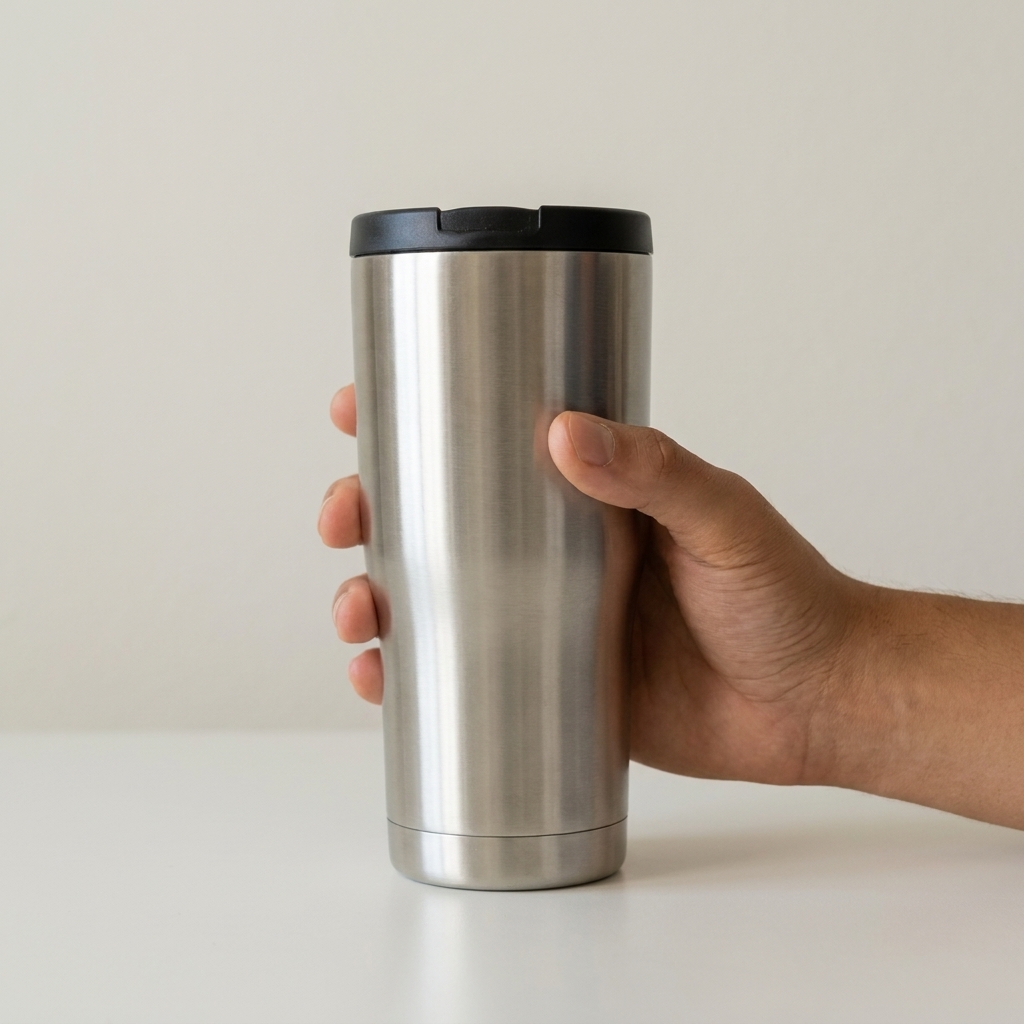
A real worked example, generated via generate_image_preset_agent with preset='ecommerce-in-hand': the same stainless steel tumbler, previously shown alone on a bare render, held naturally in one hand against a plain light background, fingers wrapped at a believable grip point, the product's true scale now legible at a glance against the hand holding it.
Why this preset earns a spot before the lifestyle shoot
A full lifestyle photoshoot, a hand reaching for a product on a kitchen counter, a shopper trying on an item in natural light, still has real value for brand storytelling. But it is slow and expensive to produce for every SKU a catalog carries, and most of that value comes from one specific detail: the presence of a human hand establishing scale. The in-hand preset isolates that one detail and makes it available for any product photo, without a shoot, a model, or a studio booking.
This matters most for categories where size is genuinely hard to judge from a flat photo: jewelry, cookware, electronics accessories, skincare bottles, anything small enough that "inches" in a spec sheet doesn't land the same way a hand holding it does. A seller running a Facebook ad built from a product photo can add this one scale cue without reshooting the product from scratch.
When to reach for this preset (and when not to)
Reach for ecommerce-in-hand any time a product's size, texture, or grip is a genuine point of shopper hesitation, anything small enough to be ambiguous in a flat photo, or tactile enough that feel matters to the buying decision. It's a weaker fit for products where scale is already obvious from context (a car part next to its vehicle, furniture shown in a room) or where a hand in frame would look odd rather than helpful (something clearly too large or too small to hold naturally). Pair it with the packshot preset as the main image and the knolling preset for a full-kit overview, three different context answers to the same product, built from the same base photo.
FAQ
Does the preset need a real hand-model photo as a reference, or just the product? The preset works from the product photo itself. It generates the hand and grip rather than requiring a separate hand-model reference image. A future session confirming the live input schema should verify whether an optional reference hand photo improves realism, since AI-generated hands are a known failure point worth watching closely in vision-QA.
Why not just hire a hand model for every listing photo? Nothing beats a real photoshoot for brand-defining hero imagery. But most catalogs carry far more SKUs than any photo budget can reshoot regularly, and a scale cue is useful on nearly every one of them. This preset exists for the long tail of products that will never get their own photoshoot otherwise.
Can this replace a packshot as the main listing image? No. Amazon and most marketplaces require a pure white, context-free main image per their own technical rules. The in-hand shot belongs in the gallery images after that requirement is already met, not instead of it.
What products does this preset fit worst? Anything where scale is already obvious from the product's own context, or anything too large, too small, or too impractical to hold naturally in one hand on camera.
Try it on Coinis
A bare product photo proves what something looks like. A hand holding it proves how big it really is. Generate that second cue from the same photo already sitting in your catalog.
Start building scaled, believable product images on Coinis
Sources
- Amazon Seller Central, "Product image guide" (gallery image best practices beyond the main image requirement): https://sellercentral.amazon.com/help/hub/reference/external/G1881?locale=en-US
- Baymard Institute, UX research on ecommerce product page conventions, "Showing Scale and Size Perception" findings referenced in published ecommerce-photography guidance: https://baymard.com/

Isidora Matovic
Author
Social media enthusiast and a full time researcher. She takes digital presence very seriously and that is why you are always in touch in what is going on with us! Follow us for more posts like this.