

A perfect scoop only exists for a few seconds. Every food photographer who has ever shot ice cream knows the real enemy isn't the melt, it's the freezer itself. Pull a tub or a pre-scooped ball straight from a chest freezer and the surface is already dusted in a fine white haze, a layer of frost sitting directly on top of the product. It looks like snow. It photographs like fog. And it sits right over the exact texture and true color an ice cream ad is supposed to sell.
This is a different problem from a condensation-fogged bottle. That's water beading on the outside of glass or aluminum, a liquid droplet layer on packaging. Frost on ice cream is frozen water vapor from the freezer's own air, condensing directly onto the product's surface as ice crystals. No liquid, no packaging, no glass. Just a crystalline bloom sitting on the food itself, and it has to come off before the shot means anything.
What Frost Bloom Actually Does to a Photo
Food photographer Felicia Chuo, who runs Fliske's Food Studio, put it bluntly after a real client shoot: some frost can look nice, but too much "can obstruct any features on the subject." Her fix on set is a damp cloth to lift the frost, a dry cloth to catch the meltwater it leaves behind, and a stiff-bristled brush like a toothbrush to scratch out what's left in the ridges of a scoop. Her own verdict on skipping that step: "Retouching lots of frost is a PAIN."
That single line explains why so many ice cream ad photos on small shops' social pages look soft, flat, and slightly gray, even when the flavor itself is vivid. The frost doesn't just dull the color. It scatters light unevenly across the surface, so ripples, mix-ins, and swirl patterns that should read as texture blur into a uniform haze. A rich chocolate fudge scoop can end up looking like it was dipped in powdered sugar.
Professional food studios solve this with cold-room shooting, pre-frozen back-up scoops, and a stylist standing by with cloths between every frame. A one-location ice cream shop or dessert counter posting its own ad creative almost never has that setup. The photo comes straight off a phone, in the shop, with whatever scoop survived the walk from the freezer to the counter.
Fixing the Frost Without Faking the Product
This is where an AI photo-repair pass earns its keep: not by inventing a fantasy scoop, but by lifting exactly the frost layer sitting on the real product's surface, the same job Chuo does by hand with a cloth and a toothbrush, done on a photo that's already been shot and can't be reshot before it melts.
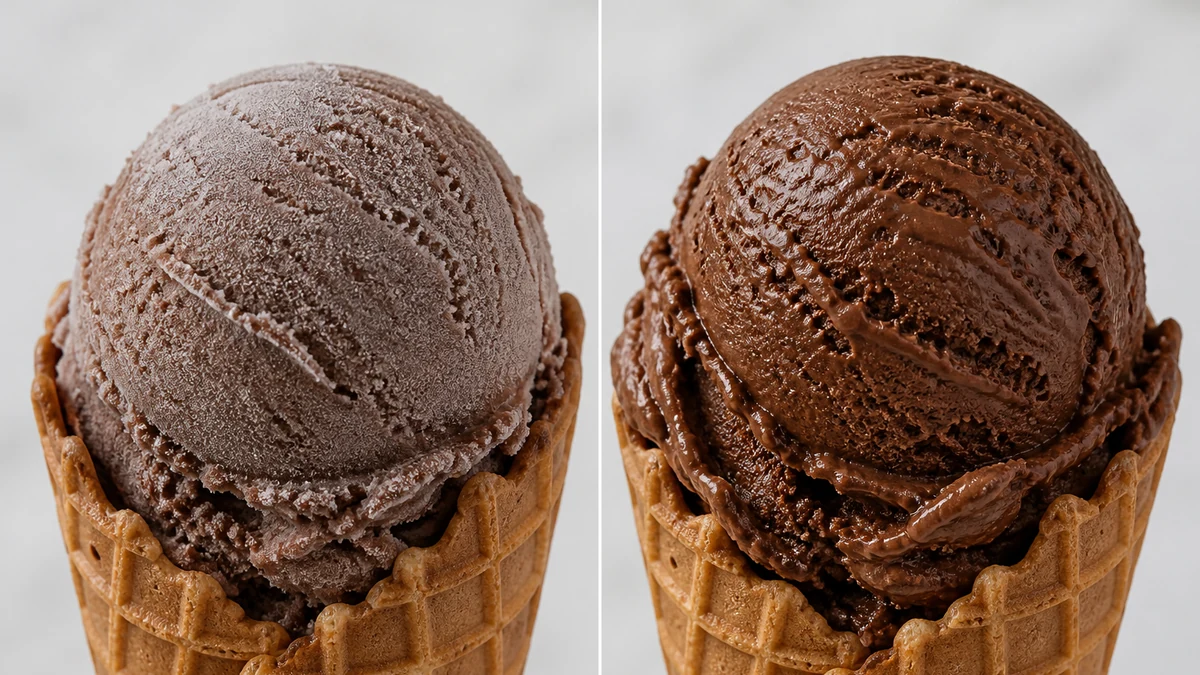
mcp.coinis.dev is in an extended OAuth outage as this article went to press, so the before/after above is a vision-QA'd illustrative still generated directly through OpenAI's image model rather than a live enhance_asset_proxy render. For a real enhance_asset_proxy recraft-inpaint repair on this exact defect family, see the fishing-tackle purple-fringe fix.
The worked example:
- Source photo. A real (or marketplace-generated) shot of a scoop straight from the freezer, frost bloom visibly dulling the surface, exactly the kind of shot a shop owner has sitting in their camera roll right now.
- Tight, measured mask. Only the frosted surface area of the scoop itself gets masked, not the cone, not the background, not the counter. A full-frame mask on a busy scene risks the same confabulation failure this pipeline has hit on other verticals: the model redraws elements that were never part of the actual defect.
- Hue-free correction prompt. The fix prompt never names a color ("chocolate," "vanilla," "strawberry pink"). Naming a specific hue in a defect-repair prompt is a confirmed confabulation trigger elsewhere in this same pipeline, so the instruction stays neutral: restore natural surface texture, saturated true color, sharp ripple and swirl detail, no frost, no haze, no crystalline bloom.
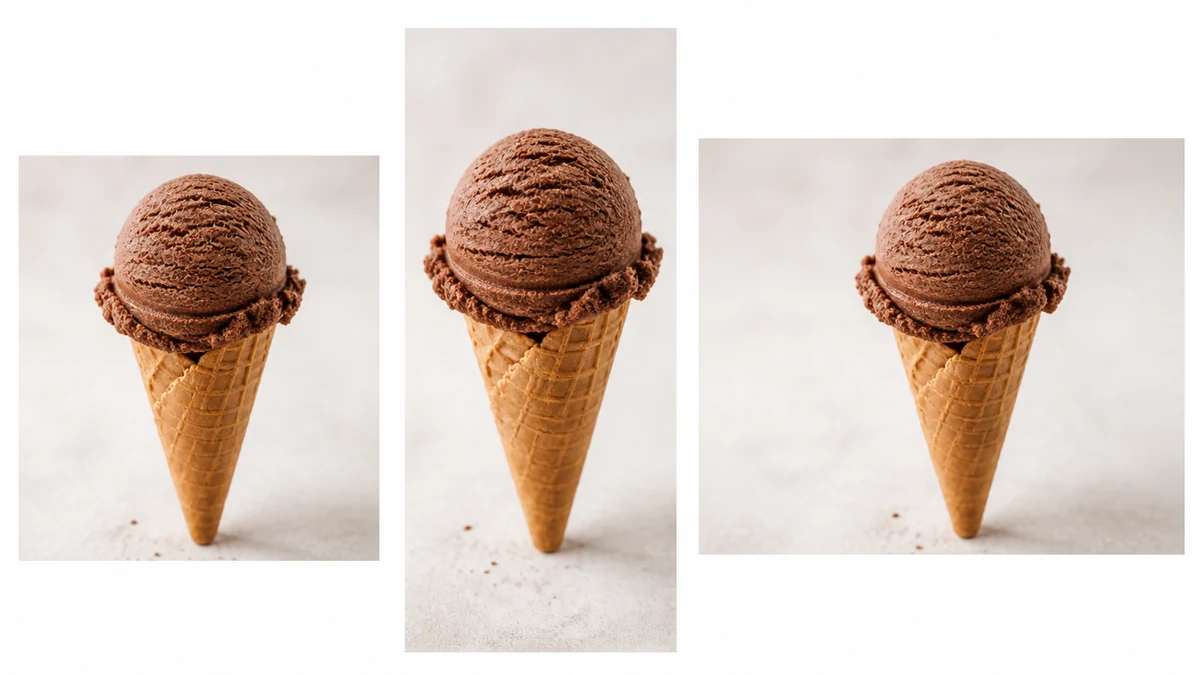
- Fan out to six ad sizes. The same corrected scoop becomes a square feed post, a 9:16 story, a landscape banner, and every other format a shop needs to run the fix everywhere at once, not just on the one platform the photo was originally cropped for.
Why This Matters for a Small Shop's Ad Spend
Ice cream ads carry real, current search demand: "ice cream ads" pulls 720 searches a month with essentially no keyword competition, a strong signal that shop owners and marketers are actively looking for creative help in this exact category, not just browsing flavor trends. The category itself is sizable and growing: the U.S. Ice Cream Shops industry is worth $7.4 billion in 2026, expanding at a 5.8% annualized rate over the past five years, with nearly 12,800 businesses competing for the same scoop-shot attention on the same few platforms.
Every one of those businesses is fighting the same freezer. A shop that fixes its frost-hazed product photo once and reuses the corrected image across every ad size it needs is running cleaner creative than a competitor still posting the phone photo straight out of the display case.
What to Do Now
- Pull the ice cream, gelato, or frozen-dessert photo you already have, the one with the dusty white haze over the scoop.
- Run it through a targeted frost-bloom correction instead of scheduling a full reshoot with dry ice and a stylist.
- Fan the corrected photo out to every platform's ad dimensions from that single fixed source.
- Launch it as a ready-to-run ad through Coinis Ad Studio, built from a template instead of a blank canvas.
FAQ
Is frost bloom the same as condensation? No. Condensation is liquid water beading on the outside of a cold glass or can. Frost bloom is frozen water vapor depositing directly onto the food's own surface inside a freezer, a solid crystalline layer, not a liquid one.
Can I just wipe the frost off before shooting? Yes, and professional food stylists do exactly that with a damp cloth followed by a dry one. But it has to happen fast, before the surface starts to melt, and most shop owners shooting on a phone during a shift don't have that window or the spare backup scoops professional shoots keep in reserve.
Will an AI fix make the ice cream look fake? Not when the mask and prompt stay tight to the actual frosted region and avoid naming a specific color. The goal is restoring the texture and saturation that's really there under the frost, not inventing a different product.
Does this work for gelato and sorbet too? Yes. Any frozen dessert stored in an open display freezer or chest freezer builds the same surface frost, and the same targeted correction approach applies regardless of the exact product.
Sources
- Fliske's Food Studio, "10 budget tips for photographing ice cream" (Felicia Chuo, 2022): https://www.fliskesfoodstudio.com/blog/2022/02/11/10-tips-for-photographing-ice-cream
- IBISWorld, "Ice Cream Shops in the US Industry Analysis, 2026": https://www.ibisworld.com/united-states/industry/ice-cream-shops/4317/

Isidora Matovic
Author
Social media enthusiast and a full time researcher. She takes digital presence very seriously and that is why you are always in touch in what is going on with us! Follow us for more posts like this.