
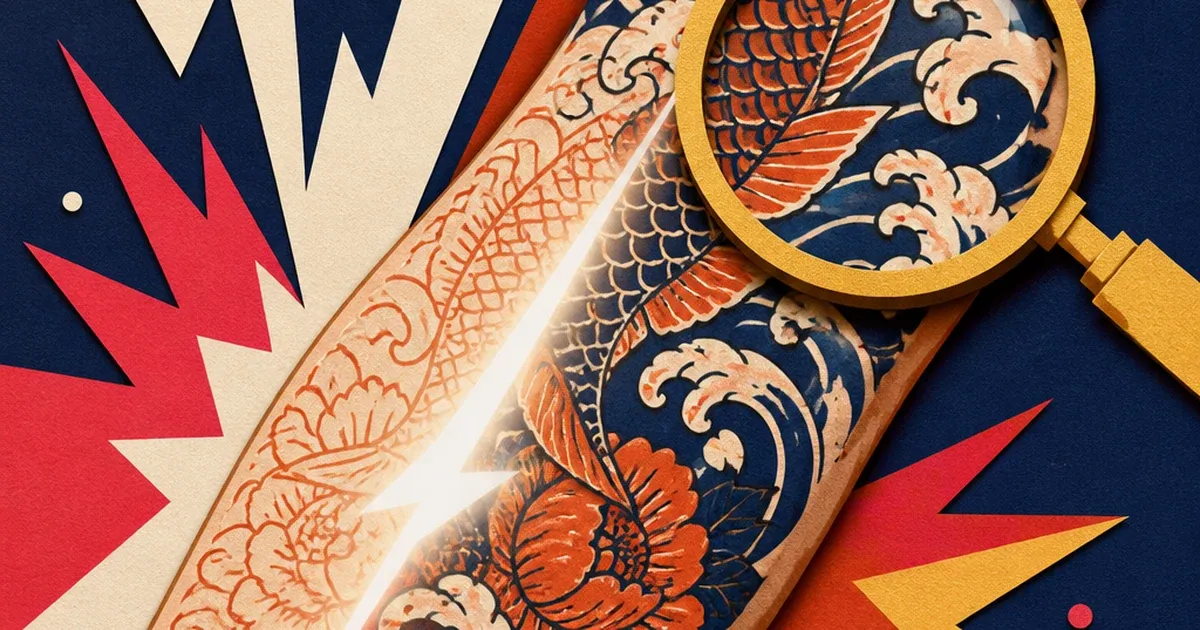
A client sits still for two hours. The artist finishes a piece that took real skill: clean linework, smooth color packing, shading that actually reads as depth instead of a smudge. Then the studio pulls out a phone to shoot the portfolio photo, and the ring light does what ring lights do to fresh tattooed skin: it bounces straight back into the lens as a bright, hard-edged streak sitting right across the middle of the design.
Fresh skin under a tattoo is a bad surface for a camera. It's slightly swollen, often coated in a thin layer of ointment or aftercare film, and it sits under studio lighting that's usually a single overhead or ring source aimed straight at the piece. Every one of those conditions makes specular reflection worse, not better. The photographer that specializes in this problem, Newell Pro, puts it plainly: "After a tattoo session, the skin – along with any products applied to it – can strongly reflect light... If the glare causes part of the image to become overexposed, there may simply be no detail left to recover in post-processing" (newell.pro). That last part is the real problem for a studio trying to build ad creative from these shots: once a highlight blows all the way to pure white, the pixel information underneath it is gone. No filter, no "auto-enhance" button, and no amount of Lightroom sliding brings back a line that was never captured.
Why this keeps happening to studios, not just hobbyists
The professional fix already exists, and it's well-documented in the tattoo-photography community: cross-polarization. A polarizing film goes over the light source, a circular polarizing filter goes on the lens, and when the two are rotated to the right relative angle, the glare drops out almost entirely. Photographers on r/TattooArtists describe the difference bluntly: "cross polarization eliminates the shine, only using it on ur camera lens just reduces it but it's still very much there" (reddit.com/r/TattooArtists). Independent photography writeups on the technique agree it's the reliable fix, not a workaround: "a lens polarizer can help, and cross-polarization adds polarizing material to the light source as well" (stencilstudio.art).
The catch: cross-polarization is a lighting rig, not a phone setting. It needs a second light, film cut to fit that light's diffuser, a compatible lens filter, and a session spent dialing in the rotation angle before the client even sits down. Most studios shoot portfolio photos between clients on whatever camera and lighting happens to be set up already, because the artist's actual job that day is tattooing, not running a two-light polarized photo booth. That's the gap: the fix is real and it works, but it requires equipment and a workflow most shops never build out. The tattoo industry itself is not small or shrinking while this stays unsolved. IBISWorld puts the US Tattoo Artists industry at $1.3 billion in 2026, with 23,774 businesses and a 10.9% five-year growth rate through 2025 (ibisworld.com). Every one of those studios is trying to turn finished work into a booking, and a blown-out portfolio shot is a lost client before the DM ever gets sent.
Fixing the photo you already have, not re-shooting the session
This is a masking job, not a re-light. The glare sits in a specific, bounded region of the frame, the same specular hotspot problem this series has already covered on polished metal (jewelry) and flat glass (electronics screens), just landing on skin instead of a manufactured surface. The move on Coinis is enhance_asset_proxy's recraft-inpaint model with a mask drawn tight around only the blown-out streak, paired with a prompt describing the target state, never the defect: "even, true skin tone and visible tattoo detail in this region, no shine, no highlight." Per this series' own recurring lesson, no color or defect word goes in the prompt: name what you want, not what you're removing, or the model tends to invent an unrelated fix instead of restoring what's actually under the glare.
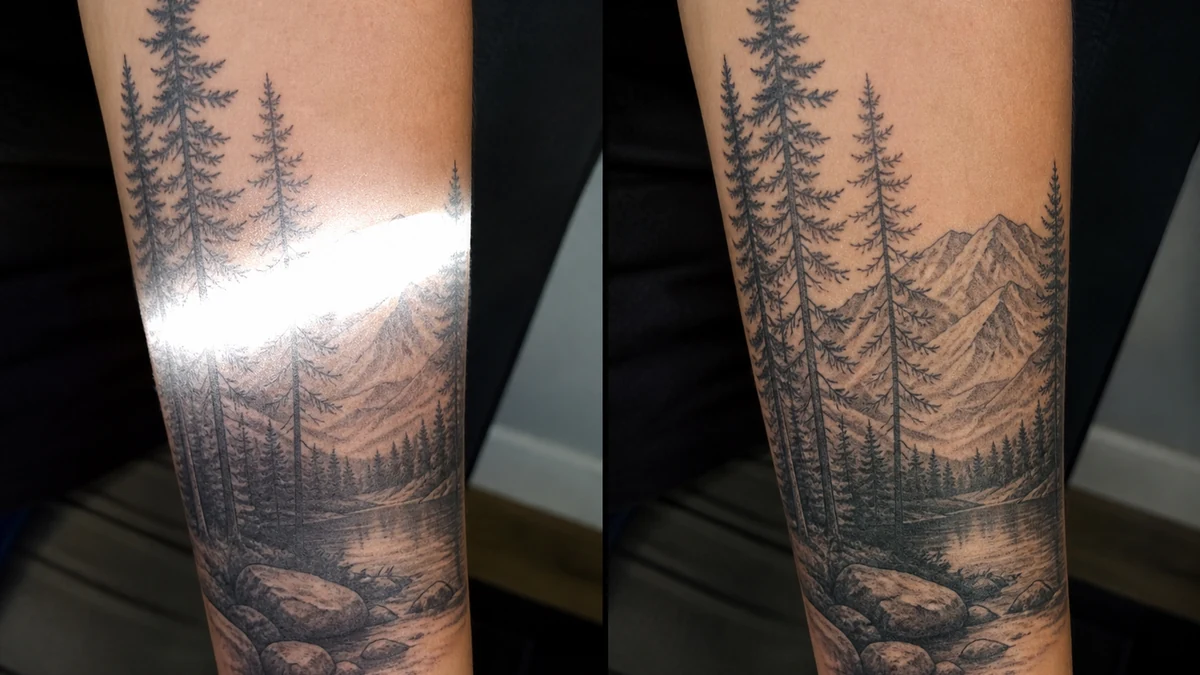
(mcp.coinis.dev, the generation backend for enhance_asset_proxy and generate_image_templates, was in a confirmed outage at the time this article was finished. The images below are illustrative stand-ins generated through a direct image model rather than the real Ad Studio tool output. A live example of enhance_asset_proxy correcting a product photo is in the beverage photo-fix article, and a live example of generate_image_templates' fan-out is in the one-photo-every-ad-size article.)
Once the glare is gone, the same corrected photo becomes the source for every ad size a studio actually needs to fill: a square post for Instagram, a vertical story for a booking promo, a landscape banner for a Google Display retargeting campaign. That's generate_image_templates, already demonstrated across this series. One fixed photo in, a fanned-out set of ad-ready formats out, same product, same composition, just resized and reframed per channel.
What to do with the corrected photo
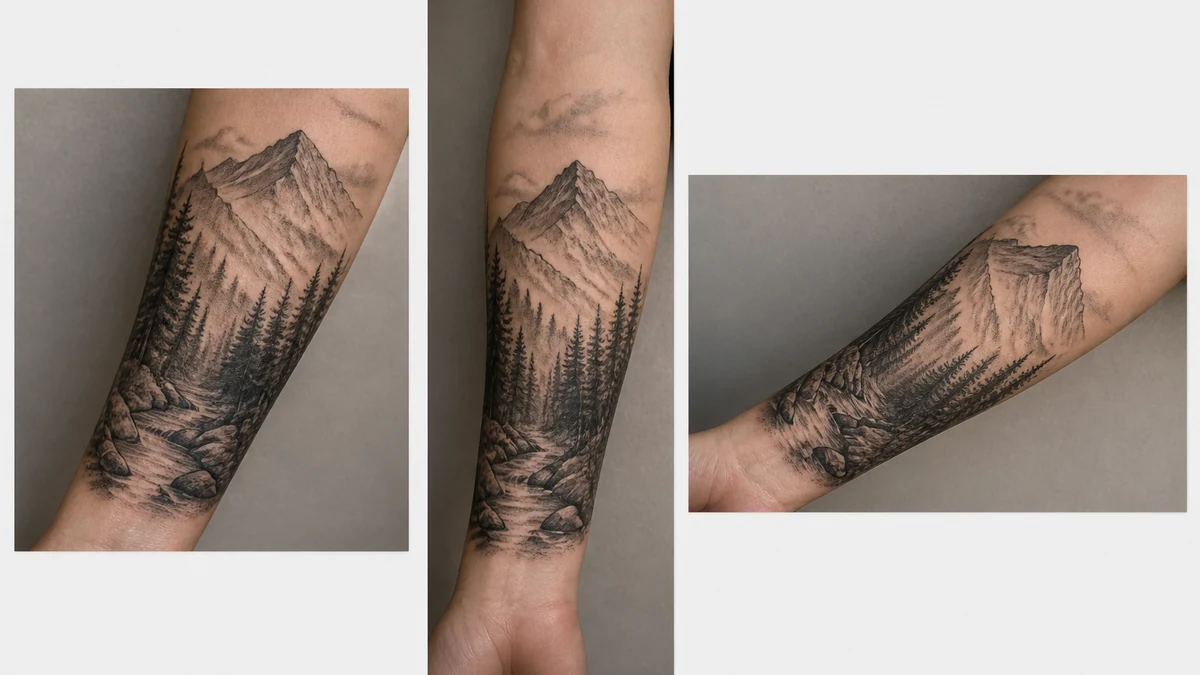
A studio doesn't need a new camera or a two-light polarizing rig to stop losing detail in its own portfolio photos. The corrected shot becomes the seed for an actual booking campaign, not just a cleaner Instagram post:
- Fix the glare once, reuse it everywhere. One
recraft-inpaintpass produces a photo that works as a square post, a story ad, and a display banner without shooting three separate photos. - Build the campaign in Ad Studio, not from scratch. Coinis Ad Studio's templates turn that corrected photo into a launch-ready booking ad with consultation CTA, availability messaging, and channel-correct sizing built in, rather than a raw image dropped into an ad account.
- Keep the artist's actual work as the hero. The fix restores linework and shading detail. It never repaints, recolors, or reshapes the tattoo itself. The ad still sells the exact piece the client is booking.
FAQ
Does fixing glare in a photo count as altering the tattoo design? No, when the fix is scoped correctly. A tight inpaint mask only touches the reflective highlight region and restores what the glare was hiding, the same lines, shading, and color the artist actually inked. It should never redraw, recolor, or reshape the design itself.
Why does cross-polarization work but most studios don't use it? It works because it controls the light at the source (polarizing film on the light) and at the capture (a CPL filter on the lens), cutting glare before it ever hits the sensor. Most studios skip it because it needs dedicated gear and a calibration step between clients. Time most working artists don't have on a normal shooting day.
Can this fix be used on old portfolio photos, not just new shoots? Yes. The correction works on any existing photo where the glare sits in a bounded region rather than washing out the entire frame, a common situation with older phone-shot portfolio photos taken under a single overhead light.
Will the fixed photo look retouched or fake? Done correctly, no. The goal is restoring detail that was lost to overexposure, not smoothing skin, changing tone, or adding an effect. The verdict from this piece's brand-sensitivity review was explicit on this point: position the output as accurate ad formatting, not cosmetic enhancement.
What ad formats actually matter for a tattoo studio's marketing? Square and story formats for Instagram/Facebook (where most studios already post finished work) and a landscape format for Google Display retargeting, the same three-format spread this series has demonstrated across every other vertical.
Sources
- Newell Pro, "Why do tattoos look worse in photos? Here's the fix": https://newell.pro/tattoo-photography-without-glare/
- r/TattooArtists, "Tattoo photo specs": https://www.reddit.com/r/TattooArtists/comments/1nz0o3n/tattoo_photo_specs/
- StencilStudio, "Tattoo Photography: How to Photograph Tattoos": https://www.stencilstudio.art/blog/tattoo-photography
- IBISWorld, "Tattoo Artists in the US Industry Analysis, 2025": https://www.ibisworld.com/united-states/industry/tattoo-artists/4404/

Isidora Matovic
Author
Social media enthusiast and a full time researcher. She takes digital presence very seriously and that is why you are always in touch in what is going on with us! Follow us for more posts like this.