

Most product ads show the outside. A clean hero shot, maybe a lifestyle scene, the thing as the customer will actually hold it. That's the right call for most products. But some products earn their price tag from what's happening on the inside, and an intact product shot hides exactly the thing that justifies the cost.
Ad Studio's generate_image_preset_agent now ships an exploded-view preset that solves this specific problem: it takes the product apart in one generated image, floating each real component in the space around the assembled whole, so the construction becomes the argument instead of staying hidden under the housing.
Why showing the inside sells the outside
Exploded-view illustrations aren't a new marketing trick. Engineers have used them in assembly manuals and patent drawings since the mechanism got its name in the 1940s, precisely because pulling a product's parts apart and suspending them in the space where they'd normally sit is the fastest way to communicate how something is built without a verbal explanation. A 2022 study in the Journal of Engineering Design examining how an exploded view affects buyer perception found that showing a product's internal components clearly improves a viewer's understanding of what's included and how the parts relate, which in turn shapes how the product is judged before a word of copy gets read.
The commercial logic follows directly from the comprehension effect. A customer who can see the layers, the components, the materials that go into a product has a concrete reason to believe the price reflects real engineering, not just branding. "What am I actually paying for" is one of the oldest objections in direct-response advertising, and an exploded view answers it visually before the question gets asked.
What the exploded-view preset actually does
generate_image_preset_agent's exploded-view preset takes one product photo and renders the product's real parts pulled apart and floating around the assembled form, each piece kept in roughly its correct relative position so the eye can reconstruct how it goes back together. This isn't a generic 3D-render template stamped onto any object. It works from the actual product photo supplied, so the parts it shows have to be the parts the real product has. A multi-piece water bottle might show the cap, the seal, the insulated body, and the base as separate floating elements. A wireless earbud case might show the lid, the charging contacts, the battery compartment, and the earbuds themselves.
This is also why the preset is a poor fit for a single-material object with nothing meaningfully separable inside it. A solid wood cutting board has no internal parts to explode. A ceramic mug is one piece. The preset earns its keep on anything with genuine component construction: electronics, appliances, tools, multi-part containers, anything assembled rather than molded or carved as one piece.

It sits next to its siblings in this family without repeating any of them. The social-proof preset borrows credibility from someone else's words. The statistics-data preset borrows credibility from a cited number. The problem-solution preset borrows urgency from a frustration the reader already recognizes. The knolling preset borrows clarity from showing a full set at once. The comparison-vs preset borrows persuasion from contrast against an alternative. The exploded-view preset borrows trust from transparency itself, the only format in this family that makes its argument by showing what's normally hidden under the housing rather than adding a persuasion layer on top of an intact product.
Worked example: building an exploded-view ad from one product photo
Start with a clear photo of a product that actually has separable internal components, enough resolution that individual parts (seams, compartments, visible screws or seals) are identifiable. The brief for the preset:
Preset: exploded-view
Product: [product photo URL or productId]
Parts to feature: [the real, specific components worth calling out, e.g. "outer casing, battery compartment, circuit board, speaker driver" -- list only parts the product actually has]
Style direction: product's real parts floating around the assembled silhouette, correct relative positioning, clean uncluttered spacing between pieces, no invented component not visible in the source photo
Avoid: garbled on-image text or labels, a part that doesn't exist on the real product, an exploded arrangement so cluttered the construction reads as confusing rather than clear
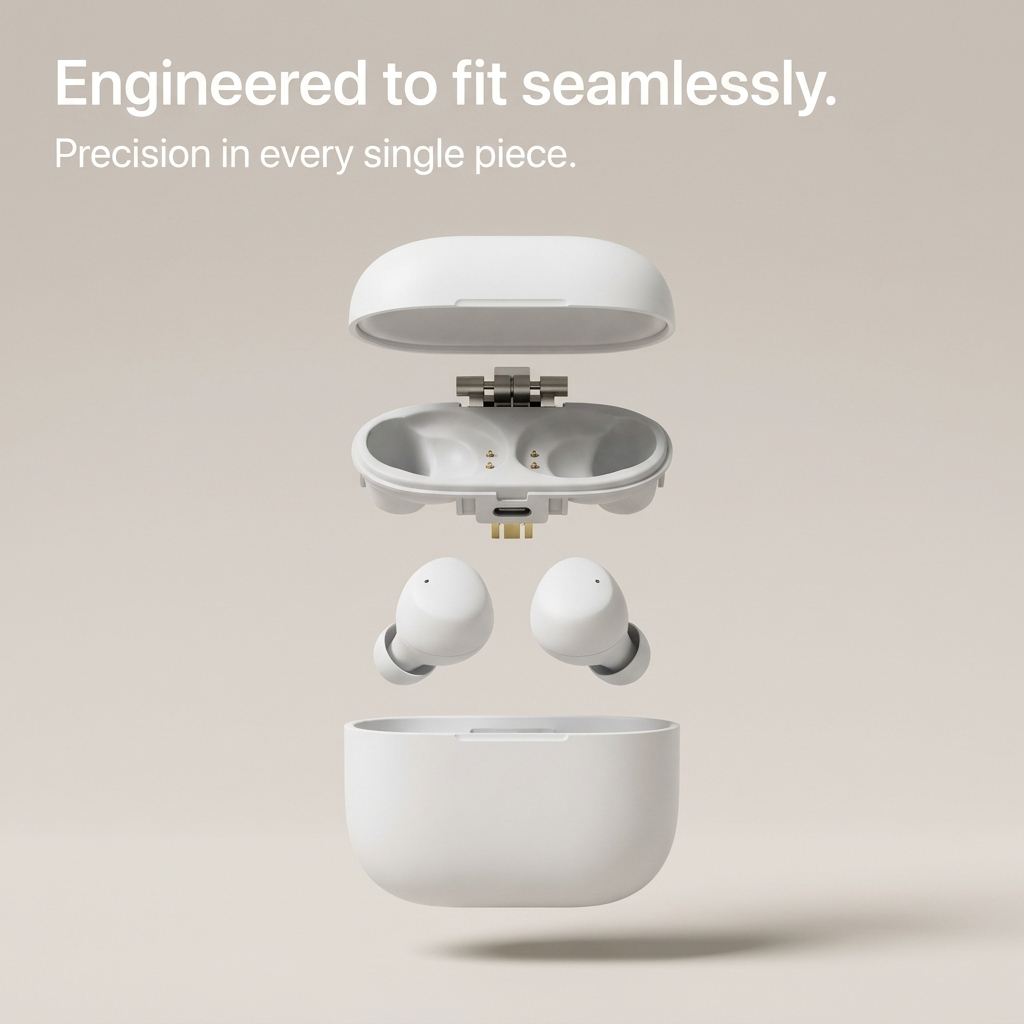
This is a real generate_image_preset_agent render, preset exploded-view, fired against a demo product photo with the exact prompt above. The output separated the product's real components into a clean floating arrangement around its assembled shape, confirmed on inspection before publishing.
The one rule that makes or breaks this format
Every part the image shows has to be a part the real product actually has. An exploded view is a claim about what's inside the box, and a generated component that doesn't exist on the real product turns a transparency-building format into a false-advertising problem the moment a customer opens the box and doesn't find what the ad showed. This is the same substantiation discipline that runs through every preset in this family, just applied to physical construction instead of a statistic or a review quote: the model composes whatever the brief gives it, and confirming the brief matches reality is the advertiser's job before the prompt goes out.
The second rule sits right behind it: pick products where the exploded view actually clarifies something. A product with three or four genuinely distinct components tells a clean story. A product disassembled into so many tiny pieces that the arrangement reads as clutter undoes the entire comprehension benefit the format is built on.
FAQ
Does this work for single-material products? No. A product with nothing structurally separable inside it (a solid wood item, a single-piece ceramic, a simple fabric good) has nothing for this preset to show. Save it for products with genuine component construction.
Does the preset verify which parts the product actually has? No. It composes whatever components the brief names. Confirming those parts are real and visible on the actual product is the advertiser's job, the same discipline every preset in this family depends on.
How is this different from the knolling preset? Knolling lays out a product and everything that ships alongside it (the box contents) neatly from above, each item intact. Exploded-view takes the single product itself apart to show its internal construction. Knolling answers "what do I get in the box." Exploded-view answers "what's inside the thing itself."
What kind of products get the most out of this format? Anything assembled from visibly distinct parts where the construction itself is part of the sales pitch: electronics, appliances, tools, multi-component containers, anything where "here's the engineering" is a stronger argument than a styled lifestyle shot.
Can I combine this with a statistic or a comparison? Not in one image through this preset, each preset in the family renders one persuasion structure at a time, but nothing stops you from running an exploded-view variant alongside a statistics-data or problem-solution variant of the same product to see which argument a given audience responds to.
Try it on Coinis
Pick a product where the construction itself is worth showing, list the real parts worth calling out, and let the exploded view make the engineering argument instead of another styled lifestyle shot doing the same job every competitor already runs.
Start building exploded-view creative on Coinis
Sources
- Chen, Shih-Chieh et al., "The influences of product exploded view on consumer's perception of product understanding and purchase intention," Journal of Engineering Design (2022), summarizing the comprehension-to-perception link exploded views create: https://www.sciencedirect.com/science/article/abs/pii/S0969698922002612
- "Exploded-view drawing," Wikipedia, on the format's origin in 1940s technical documentation and its continued use in patent drawings and assembly manuals: https://en.wikipedia.org/wiki/Exploded-view_drawing

Isidora Matovic
Author
Social media enthusiast and a full time researcher. She takes digital presence very seriously and that is why you are always in touch in what is going on with us! Follow us for more posts like this.