

A wall of mirrors is the default backdrop for most gym and studio photography. It is also the hardest surface in the building to shoot cleanly. Overhead lights bounce straight back into the lens as a hot white patch across the middle of the frame. A second gym-goer, a rack of dumbbells, or the photographer's own phone shows up doubled in the reflection behind the subject. The seam where two mirror panels meet cuts a hard vertical line through someone's shoulder or the equipment they are using. None of that is a lighting mistake. It is what a mirror does to a camera in a room built for training, not for photography.
That photo, hotspot and all, is usually what ends up in the ad account anyway. Whatever the mirror wrecked gets carried into every size and platform the campaign needs: a Facebook feed square, an Instagram Story, a Google Display banner, all built from the same flawed source instead of a fixed one.
The photo is doing the selling before anyone walks through the door
A record 81 million Americans belonged to a gym, studio, or other fitness facility in 2025, pushing membership penetration to 26.1% of the US population age 6 and older (Health & Fitness Association, "2026 US Health & Fitness Consumer Report: Headline Trends," April 2026). That is a large, still-growing market, and it means more gyms competing for the same scroll, mostly on the same handful of ad platforms.
Local consumers decide fast and rarely dig deep before deciding. BrightLocal's Local Consumer Review Survey 2026 found that consumers who feel positive about a local business point to an appealing accompanying photo or video as one of the deciding factors, and that most consumers (66%) do further research, most often visiting the business's own website (54%), after a first positive impression (BrightLocal, "Local Consumer Review Survey 2026," February 2026). A gym ad with a glare-blown mirror or a stranger caught mid-reflection is not the appealing photo that survey is describing. It reads as unfinished before a single word of copy gets read.
Peer-reviewed research on fitness centers backs the same point from a different angle. A 2024 study in Behavioral Sciences testing what drives consumer satisfaction and loyalty at fitness centers found that the physical servicescape, the visual, physical environment a member sees and experiences, meaningfully shapes satisfaction independent of the actual training service (Kim & Kim, "Exploring the Psychological Mechanism of How the Multidimensional Service Quality of Fitness Centers Affects Consumer Satisfaction and Loyalty," Behavioral Sciences, 2024). An ad photo is a prospective member's first exposure to that physical environment. A mirror hotspot or a distorted reflection is the environment looking worse than it actually is, before anyone has set foot inside.
Why the exact feature gyms photograph most often is the one that breaks the shot
Most product-photo advice assumes a matte, non-reflective subject. A supplement tub sits under diffused light with no glare to manage. A gym floor does not work that way: the mirror wall that makes a training room look larger and lets members check their form is also a mirror, and a mirror reflects whatever light and whatever is standing nearby, including the person taking the picture. Photographers who shoot gyms for a living know this well enough to have a standing rule of thumb, shoot at an angle to the mirror rather than head-on, but a gym marketing a class schedule or a new equipment drop rarely has a professional photographer on staff to apply it every time. The photo gets taken on a phone between sessions, mirror included, hotspot included.
That means the flaw shows up on a predictable cadence: new equipment arrives, a new class launches, a member consents to a testimonial shot, and the fastest available photo is whatever came out of the mirror-lined room. Fixing that photo once, after the fact, is far faster than re-lighting and reshooting the room every time a new ad needs a fresh image.
Fix the reflection before you multiply the photo
Ad Studio's repair layer, enhance_asset_proxy, exists for exactly this step. One tool covers the full set of repair operations, upscaling, sharpening, denoising, lighting correction, background and object removal, chosen through a single model field that pairs the specific fix to the specific flaw. For a mirror hotspot or a distracting reflection (another person, a rack of equipment, a stray phone) sitting in the background of an otherwise usable shot, the right approach is a tight, masked repair: recraft-inpaint with a mask drawn around just the reflection or the blown-out patch, paired with a prompt describing what should be there instead (a clean mirror surface, or the training-room wall continuing naturally). The mask stays narrow, so the subject, the equipment, and the rest of the room are never touched.
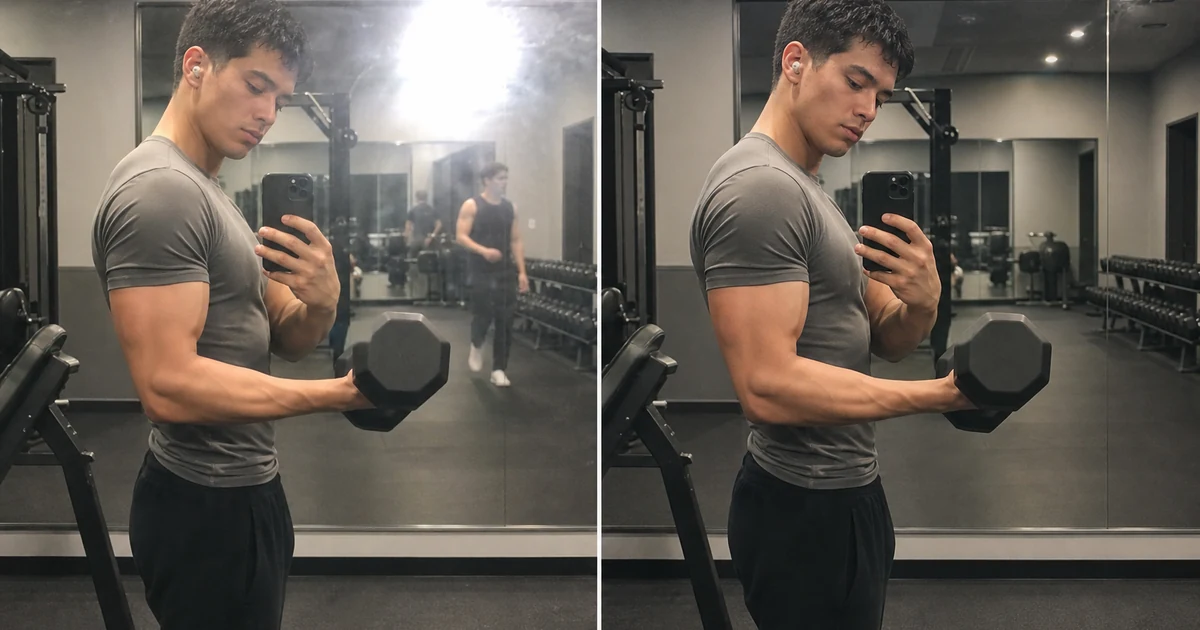
Illustrative before/after. mcp.coinis.dev (the Ad Studio connection) was down for this session's generation window (refresh token invalid, confirmed outage), so this composite was generated directly via OpenAI's image model rather than a real enhance_asset_proxy call. It shows the same repair this article describes: mirror hotspot and background reflection removed, subject and equipment unchanged. A future session should replace this with the actual enhance_asset_proxy output once the connection is back.
Once the source photo is clean, the fan-out step is generate_image_templates, Ad Studio's primary image-ad generator. One corrected gym photo becomes a square Facebook post, a 9:16 Story, and a horizontal Display banner in one pass, sized to what each placement actually expects, without a second shoot in the mirror room and without re-fixing the same hotspot on five separate files.
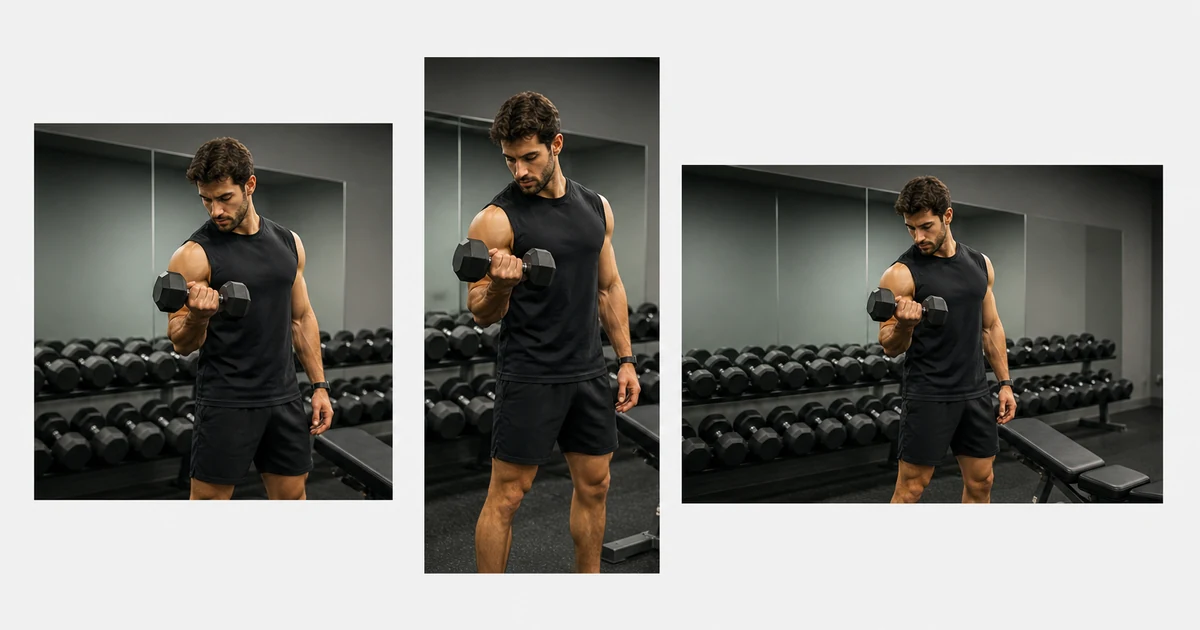
Illustrative fan-out, same MCP-outage substitution as above (OpenAI image model, not a real generate_image_templates call). It shows the same corrected gym scene reformatted for a square feed post, a vertical Story, and a wide banner. A future session should replace this with the actual generate_image_templates output once the connection is back.
Building this into a gym's actual content calendar
A gym's photo needs do not stop after one campaign. New class formats launch, new equipment arrives, member testimonials get captured between sets, and nearly all of it happens in the same mirror-lined rooms. The order matters every time: repair the photo first with enhance_asset_proxy (hotspot, distracting reflection, uneven exposure), and only then hand the clean file to generate_image_templates for the ad-size fan-out. Doing it in the other order just resizes or restyles a photo that still has the flaw baked in, producing five flawed variants instead of one clean set.
This is the same creative-fatigue problem covered in mobile game ad creative fatigue: a business running the same one usable photo past the point where an audience has already seen it, because there is no second clean angle to rotate in. A gym is exposed to that risk constantly, since most usable photography happens in the same few rooms. A corrected shot that can survive a background swap and a full ad-size fan-out gives a gym the same rotation without a second visit from a photographer, the same fix already applied to a car dealership's reflective-surface problem and a beverage brand's glare-and-condensation problem.
FAQ
Does enhance_asset_proxy remove the mirror itself, or change how the room looks? No. The mask is drawn only around the specific hotspot or distracting reflection, not the whole mirror. The room, the equipment, and the rest of the reflection stay exactly as photographed. What changes is the one element that was pulling attention away from the ad's actual subject.
Will the fixed photo still look like it was shot in a real gym? Yes. The repair targets a specific glare patch or an unwanted reflected object, not the presence of the mirror wall or the lighting style of the room. A corrected photo still reads as shot in a working training space, just without the one distracting artifact.
Do I need a different photo for every ad platform, or does one corrected shot cover all sizes? One corrected shot covers all sizes. generate_image_templates handles the resizing and cropping into each platform's spec from that single clean source, which is the entire point of fixing the photo once instead of five times.
What if the photo also has a member visible who should not be in a public ad? That is a masked background or object removal, the same enhance_asset_proxy tool, a different model selection than the reflection fix. A gym should always confirm it has consent to use any recognizable member in a public ad regardless of what repair work happens to the photo.
The Coinis angle
A gym does not need a dedicated photo shoot every time a class schedule changes or a new machine arrives. Repair the mirror-room photo already on a phone with Ad Studio's enhance_asset_proxy, then turn it into a full ad-ready set with generate_image_templates, and land the whole thing as a launch-ready ad through Ad Studio's templates instead of exporting raw images and building the ad by hand.
Sources
- Health & Fitness Association, "2026 US Health & Fitness Consumer Report: Headline Trends," April 9, 2026. https://www.healthandfitness.org/2026-us-health-fitness-consumer-report-headline-trends/
- BrightLocal, "Local Consumer Review Survey 2026: Star Ratings Keep Rising, Old Reviews Don't Cut It," February 11, 2026. https://www.brightlocal.com/research/local-consumer-review-survey/
- Kim, M. and Kim, D., "Exploring the Psychological Mechanism of How the Multidimensional Service Quality of Fitness Centers Affects Consumer Satisfaction and Loyalty Depending on the Level of Exercise Involvement," Behavioral Sciences (Basel), 14(11):1049, November 2024. https://pmc.ncbi.nlm.nih.gov/articles/PMC11591003/

Isidora Matovic
Author
Social media enthusiast and a full time researcher. She takes digital presence very seriously and that is why you are always in touch in what is going on with us! Follow us for more posts like this.