If you have a public Instagram account, there is a setting buried a few screens into your profile that is switched on right now, and you almost certainly did not switch it on yourself. What it does is let anyone else feed your face into an AI image generator using the photos you have already posted. Meta did not put it near the top of your settings, did not name it anything you would recognize, and did not tell you it was there, so unless you go looking you would never find it on your own. The version of this making the rounds online is scarier than what actually shipped, so here is the plain read on what Meta launched, what it means if you run a public presence, and the one place to go to turn it off.
What Meta quietly turned on
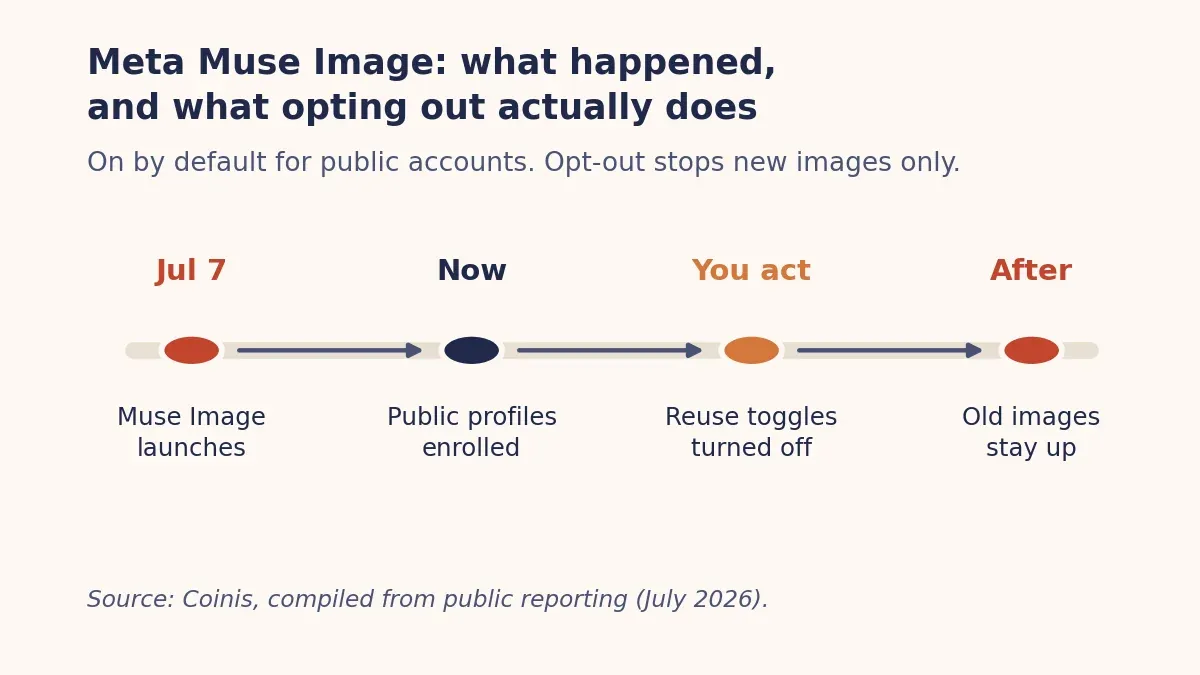
Muse Image, the first image model out of Meta's Superintelligence Labs, went live on July 7. It runs in the Meta AI app, in a browser, inside WhatsApp, and straight into Instagram Stories. The headline trick is personalization. You reference a public Instagram handle inside a text prompt, and the system pulls recent photos from that profile and generates an image built on that person's likeness. The result drops into a Meta AI chat, a Story, or the main feed.
Making images of yourself, that is a toy. The problem is the other direction. Anyone can point it at your account. Tag your public handle in a prompt and Meta AI will generate something off your face and your photos, without asking you and without telling you it happened. Every public profile got enrolled by default. Private accounts and anyone under 18 sit outside it, which is the one part Meta got right. Everyone else is in, and the switch to leave was not flipped for you. No pop-up, no "turn this on if you want it," no email.
Why this is worse than a normal feature drop
The catch that matters is everything Meta leaves out. It never tells you when your profile has been used. There is no activity log to open, so after the fact you cannot even confirm whether your own face has been run through the generator. The opt-out does not reach backward, either. It covers you from the moment you flip it and not one image before it, which means whatever was made of you up to that point stays in circulation. Meta has given no sign it plans to pull any of that down.
The uglier angle is abuse. Pulling someone's public photos to fake a verification shot or bait a phishing victim was already possible, but it took some effort, and that friction kept the numbers down. Muse Image turns it into one tap. Great for a creator goofing around with their own face, and just as great for whoever wants to impersonate them. That is why CAA, the talent agency, went at Meta publicly over the opt-out, and why Meta's own Oversight Board keeps telling the company its AI detection and labeling are too thin. When the agency for the faces and Meta's own review board are annoyed about the same thing, I pay attention. Worth flagging that this started in the US and is still rolling out, so the setting might not have reached your app yet.
The two-minute opt-out
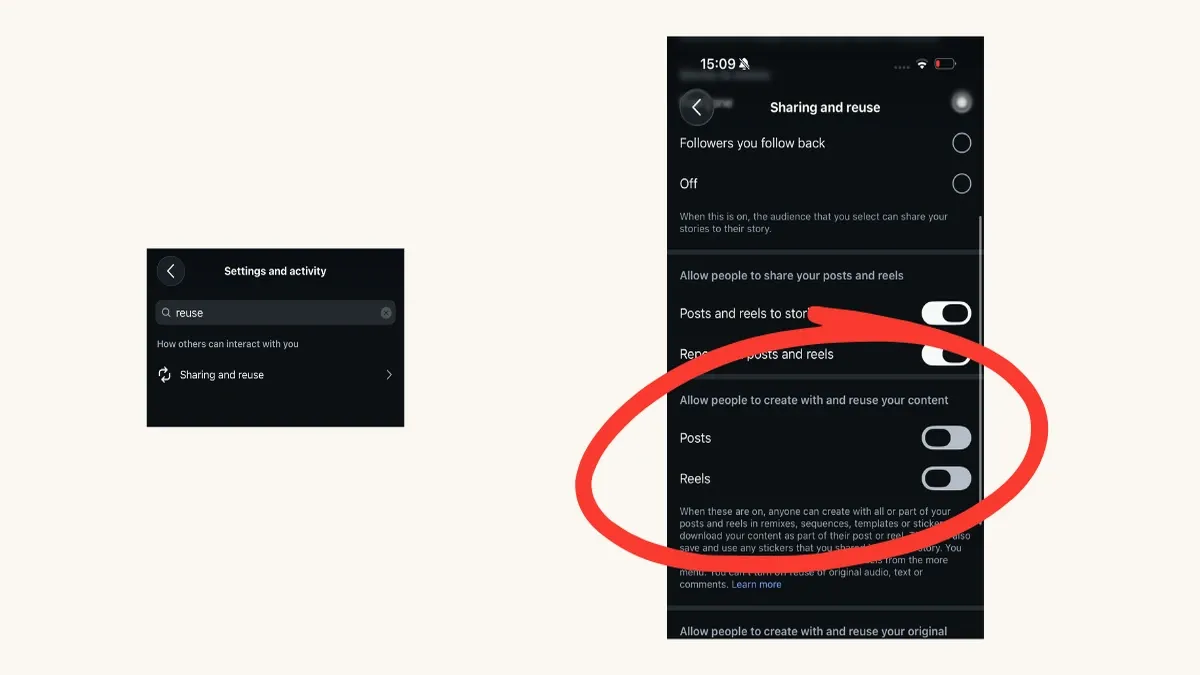
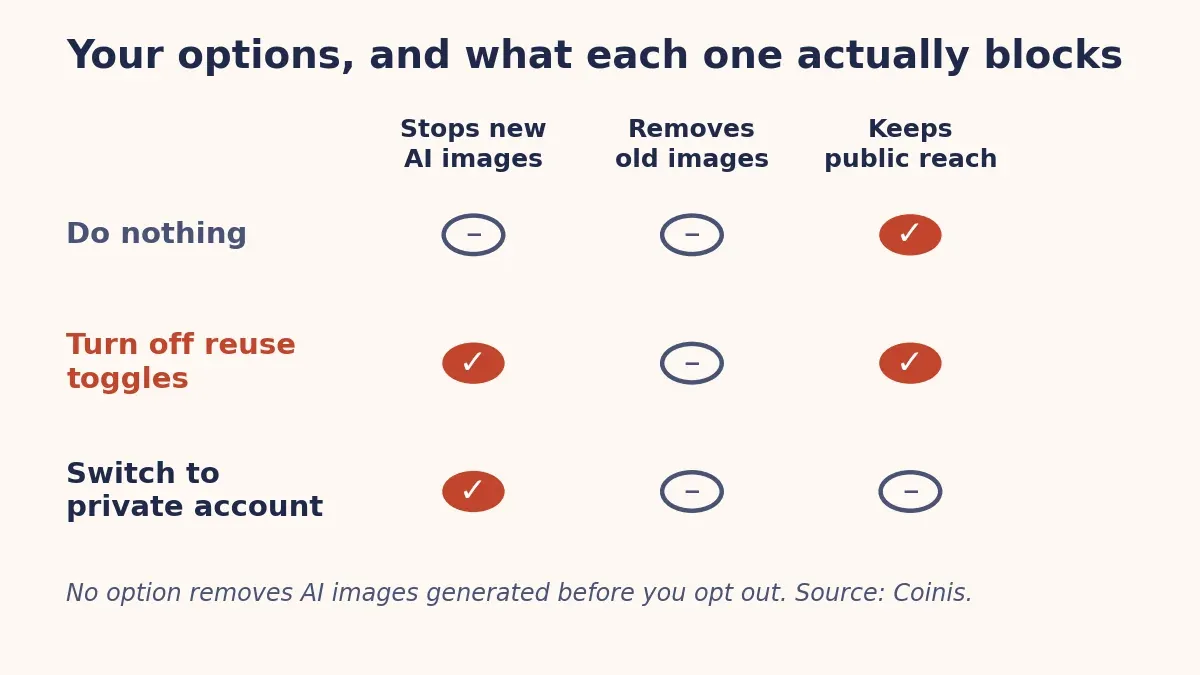
Here is the path on the Instagram app. Wording shifts slightly by version, so if the labels read a little differently, search "reuse" in Settings and you will land in the right place. Open Instagram and go to your Profile. Tap the menu, the three lines top right. Under "How others can interact with you," open Sharing and reuse. Find "Allow people to create with and reuse your content," and turn off the toggles for both Posts and Reels. That is it. Future AI reuse and image generation from your content is now blocked. It does not remove anything already generated.
Want the strongest lever Meta currently hands you? Switch the account to private. It is blunt, you lose the reach a public account gives you, but it stops strangers from using your profile as source material at all. While you are in the settings, turn on multi-factor authentication across every Meta account you own. It will not fix Muse Image, but account takeover is the more common way people lose control of their images, and MFA is the cheapest insurance you have.
What it means if you run brand or creator accounts
If you manage social for a company, a public figure, or a roster of creators, this is not a personal-privacy footnote. It is a brand-safety and content-governance problem. Your brand's likeness is raw material now. Any public brand account, founder profile, or talent handle can be fed into Muse Image by a competitor, a troll, or a well-meaning fan who makes something badly off-brand. You cannot stop it after the fact and you will not be told when it happens. The realistic move is to decide, account by account, if the reach of "public" is worth the exposure, and to opt the ones that do not need it out today.
When the launch hit, I went through every public account we run and flipped the toggles off one by one. Took maybe a minute each. Now it is just part of my setup checklist, right after two-factor and the recovery email, and honestly it should have been there already. The accounts I worry about most are the founders and the creators whose face is basically the logo. One bad AI image of them in the wrong place is the kind of thing you spend a week cleaning up. Those I would rather keep private if they do not need the reach, and for the rest I keep a rough watch with the usual manual searches and mention alerts, because Meta is not going to ping you when something appears.
It also helps to be clear-eyed about where Meta is taking this. Muse Image is aimed deliberately at creators and advertisers, which makes it a revenue play rather than a novelty, and personalized AI-generated creative is going to take up a steadily larger share of the Meta ads ecosystem. That is genuinely useful if you need to produce creative at volume, but it also means your audience will have a harder time telling what is real from what was generated, which puts more weight on how clearly you label your own AI-assisted work. If you are already producing ad creative with AI optimization, the underlying discipline does not change: know what you have published, understand what the platform is allowed to do with it afterwards, and keep the source material somewhere you actually control.
The pattern underneath it
We have seen this movie from Meta before. Flip a feature on for everyone, call the exit an opt-out so nobody had to say yes, hide the switch a few taps deep, and let the sheer number of accounts do the work. Same thing they pulled training AI on public posts under the GDPR legitimate interests line, which privacy folks challenged on paper. I am not telling you to delete Instagram, I still spend half my day in it. The defaults just keep drifting against you, and cleaning them up always ends up being our job. So do the two-minute thing first, then when you want to make ad creative somewhere the rules are actually yours, that is what Coinis AI is for.
Two minutes of settings hygiene shuts one of the easier doors, so turn the Sharing and reuse toggles off before anything else. And when you would rather build, launch and optimize ad creative on ground where you set the rules, from a product URL to a live Meta ad in minutes, that is what Coinis AI is built for. By practitioners, for practitioners.
Labels vary by region and app version. Check Instagram's current settings before acting.

Isidora Matovic
Author
Social media enthusiast and a full time researcher. She takes digital presence very seriously and that is why you are always in touch in what is going on with us! Follow us for more posts like this.