

A livestream conversion rate of 28 percent sounds like a typo next to the 2 to 3 percent most online stores settle for. It is not. It is what happens when a chat window, a scrolling comment feed, and a countdown clock sit on top of a product demo instead of a static photo. That format just got a lot easier to test, because you no longer need an actual live broadcast to make an ad that looks and feels like one.
Live-shopping-style creative borrows the exact visual cues of a real broadcast, a viewer count ticking in the corner, comments scrolling past, reactions popping up, and layers them over a product video that was never actually live. The composited result reads as urgent and social in a way a normal product ad does not, and it is now available as a generation preset instead of a production crew and a streaming setup, the same shift Coinis walked through for turning one product photo into a video ad and for cinematic-grade product spots.
What Happened
Live commerce has spent five years proving itself as a conversion channel, first in China, now everywhere a platform has a checkout button. McKinsey's live-commerce research found companies reporting conversion rates approaching 30 percent on live sessions, roughly ten times higher than conventional e-commerce, with a German beauty retailer, Douglas, reporting up to 40 percent on its own livestreamed shows. That is not a niche result. It is the ceiling advertisers have been chasing since live shopping crossed from Alibaba's Taobao into Western feeds.
The format has now been built directly into ad platforms rather than left as an organic feature. Meta expanded Live Video Ads from Facebook to Instagram in June 2026, timed to the Cannes Lions festival, letting sellers turn an active broadcast into a promotable ad unit that reaches audiences beyond their own followers, not just existing fans watching a stream they already follow. The stated conversion range Meta and its launch partners point to, 9 to 30 percent for live shopping against 2 to 3 percent for standard e-commerce, lines up with TikTok Shop's own aggregate LIVE benchmark data showing a 7.8 percent conversion rate on LIVE sessions versus 2.1 percent on feed ads, a nearly 4x lift from the chat-and-urgency format alone.
Two different platforms, two different measurement methods, the same structural gap. That is the signal worth acting on, not the specific launch mechanics of either platform's rollout.
Why It Matters
The lift is not coming from better lighting or a more polished host. It is coming from three specific visual signals a static product ad cannot carry.
A visible audience implies social proof in real time. A viewer count ticking upward, even a modest one, tells a scrolling viewer that other people are watching this exact thing right now. That is a different psychological trigger than a review count sitting quietly under a product photo, because it is happening in the present tense.
Scrolling comments do the persuasion work a script would otherwise carry. A real live chat is full of questions, reactions, and other buyers talking themselves into a purchase in public. An ad that shows that texture, even a simulated one, borrows the same crowd-persuasion effect without needing an actual crowd typing in real time.
Urgency reads differently inside a "live" frame than inside a countdown banner. A discount code with an expiration date is common enough to be ignored. A "live now" visual cue paired with the same discount reads as something happening at this moment, not a recurring promotion, which is exactly the framing McKinsey's research ties to accelerated purchase decisions.
None of those three signals require an actual broadcast. They require a product demo shot with the same energy a live seller would bring, plus a composited overlay carrying the viewer count, the comments, and the reactions. That is a rendering job, not a scheduling problem.
What This Means for Advertisers
Coinis Ad Studio's UGC preset family has already covered testimonial-style clips, unboxing reveals, calm podcast formats, street-interview vox-pops, and POV framing in earlier walkthroughs. The live-simulator preset is the format that closes the loop on all of them, because it takes the same underlying product demo structure and composites a live-broadcast overlay directly on top.
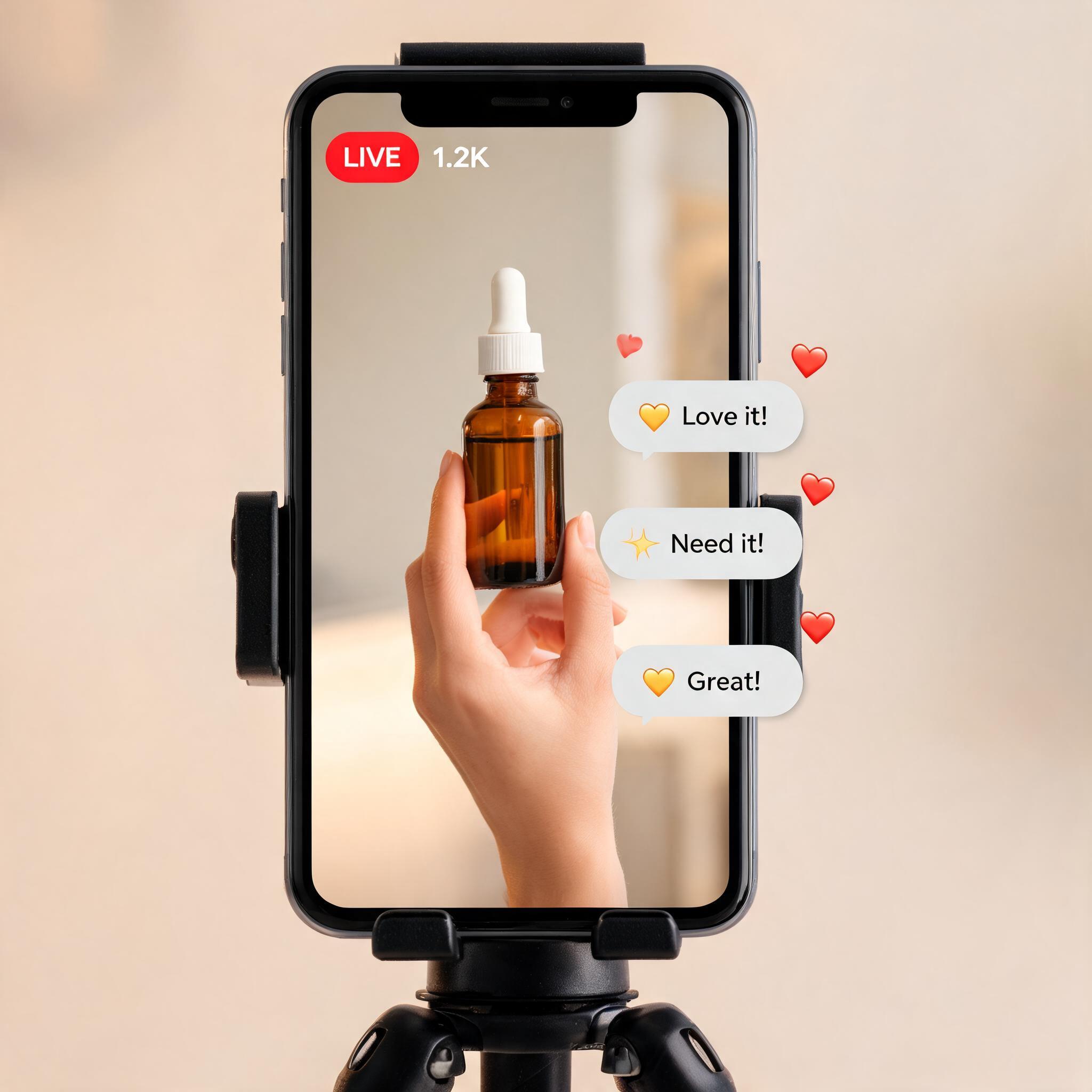
Illustrative still of the live-simulator overlay look (LIVE badge, viewer count, scrolling comments), generated via seedream-5.0-lite. The full live-simulator video render is queued for a future generation pass.
The mechanics translate into prompt inputs directly:
- The host energy is the hook. A flat, produced-feeling delivery breaks the illusion before the overlay even loads. The
personaNotefield is where every bit of "this feels like a real seller mid-broadcast" direction belongs, delivery pace, informal phrasing, a slightly unpolished camera angle. - The chat overlay is the social proof. It is composited automatically once the preset renders, viewer count, scrolling comments, and reactions layered onto the clean master, so the creative work is entirely in briefing a demo that gives the overlay something worth reacting to.
- The urgency beat is the CTA. A live-style close, tied to a visible spike in comment activity, does the persuasion work a discount banner alone cannot, because it borrows the "happening right now" framing the whole format depends on.
That reframing is the entire value proposition. The format's advantage was never the fact that a broadcast happened to be live. It was the visual grammar of a live audience reacting in public. Once that grammar is composited onto a rendered demo instead of scheduled as an actual broadcast, any advertiser can test a live-shopping-style variant without booking a streaming slot, hiring a host, or hoping viewers show up at the right hour.
What to Do Now
Three ways to put this into a testing plan immediately:
- Brief the demo like a seller, not a spokesperson. The
personaNoteshould read like a mid-broadcast pitch, direct, a little informal, product benefit stated fast, not a polished ad script. That energy is what makes the composited chat overlay feel earned rather than pasted on. - Test the live-style version against your best-performing UGC ad, same product, same week. The live-simulator format isolates whether the overlay's social-proof signal, on top of an otherwise similar demo, moves conversion the way McKinsey's and TikTok's benchmark data suggest it should for your specific audience.
- Pair it with an actual limited-time offer. The urgency cue in the overlay reads as hollow if the offer behind it is evergreen. Match the "live now" framing to a real deadline, even a short one, and the two signals reinforce each other instead of one undercutting the other.
Bigger Picture
Every UGC preset in this family started as something that required a real person doing a real thing on camera, testimonials, unboxings, street interviews, POV footage. Live shopping is the format that most directly required an actual live event, a scheduled broadcast, a host standing by, viewers showing up at the right time. Compositing the broadcast's visual signature onto a rendered demo removes the single hardest constraint in that list, timing, and leaves the part that actually drives the conversion lift: the sense that something is happening now, in front of other people, that they might miss.
FAQ
Is this an actual live broadcast, or a simulated one? It is simulated. The live-simulator preset renders a standard product demo, then composites a chat overlay, viewer count, scrolling comments, reactions, onto the finished video. No real broadcast, no real live audience, is required.
Why would a simulated live ad convert better than a normal product video? Because the composited overlay carries the same social-proof and urgency signals a real live audience creates, without requiring a viewer to catch an actual broadcast at a specific time. The visual grammar, not the literal live event, is doing the work.
Does this replace running real live shopping streams? No. A real live stream still lets viewers ask questions and get answered in the moment, something a rendered ad cannot do. This format is for the ad placements where a real broadcast was never going to run anyway, feed ads, product pages, retargeting, where the live-shopping visual signal can still be borrowed.
What has to be true about the product demo itself? It needs the same energy a real seller would bring, direct delivery, a clear benefit stated fast, because the overlay only amplifies what is already in the underlying footage. A flat demo with a lively chat overlay pasted on top still reads as flat.
How long does a live-simulator ad run? The preset is fixed at 30 seconds, long enough for the host beat, the demo, and the urgency close to each land without feeling rushed, short enough to hold attention through a scrolling feed.
Turn This Into a Launch-Ready Ad
Every advertiser who has looked at a 28 percent live-commerce conversion number and thought "we don't have the team to run live streams" had the right instinct and the wrong constraint. The visual signal that drives that number is compositable, not scheduling-dependent. Brief the demo, let the live-simulator preset build the chat overlay, and turn it into a launch-ready ad with a Coinis Ad Studio template instead of booking a broadcast slot you don't need. If you already run UGC-style Facebook ads or need to combat creative fatigue on Instagram, a live-simulator variant is the next test to slot into that same rotation.
Sources
- McKinsey & Company, "It's showtime! How live commerce is transforming the shopping experience" -- https://www.mckinsey.com/capabilities/tech-and-ai/our-insights/its-showtime-how-live-commerce-is-transforming-the-shopping-experience (conversion rates approaching 30% on live sessions, Douglas beauty retailer up to 40%, Taobao 28% session conversion rate, November 2020 benchmark data)
- Digital Applied, "Meta Brings Live Video Ads to Instagram: 2026 Playbook" -- https://www.digitalapplied.com/blog/meta-live-video-ads-instagram-live-shopping-playbook-2026 (Meta Live Video Ads expanded to Instagram June 18, 2026, 9-30% live-shopping conversion vs 2-3% standard e-commerce, industry benchmark cited in Meta's own launch coverage)
- Dashboardly, "TikTok Shop LIVE Shopping Statistics & Benchmarks (2026)" -- https://www.dashboardly.io/statistics/tiktok-shop-live-shopping-statistics (7.8% LIVE conversion rate vs 2.1% feed ads, 3.7x lift, aggregate TikTok LIVE analytics/Kalodata/FastMoss data, April 2026)
- DataForSEO keyword_overview data, pulled 2026-07-16 via research.py (see front-matter for full detail)

Isidora Matovic
Author
Social media enthusiast and a full time researcher. She takes digital presence very seriously and that is why you are always in touch in what is going on with us! Follow us for more posts like this.