

Ask a stranger a question on the sidewalk. Point a phone at their face. Keep the first three seconds of their real reaction. That is the entire format, and it is quietly one of the strongest-converting ad structures running on Meta and TikTok right now.
No script. No studio. No hired creator reading lines. Just an unscripted question, a real answer, and a brand that shows up in the last five seconds as the reason the conversation started. It is called a street interview ad, sometimes "vox pop," and it works for a reason that has nothing to do with production value.
What Happened
Street interview ads have moved from a niche man-on-the-street gimmick to a recognized paid-social format with its own conventions: a punchy on-screen question, a stranger who clearly was not primed with a script, a beat of hesitation before the real answer, and a brand reveal at the end that reframes everything that came before it. DataForSEO shows real, high-intent search volume forming around the term, with "street interview ads" carrying a CPC north of $46 and effectively zero keyword difficulty, a combination that almost never happens together. Low competition and high commercial intent at the same time usually means a format that advertisers already know converts but that most publishers have not written about yet.
The core reason it works is not mysterious. General UGC-versus-brand-content data already backs the wider pattern: UGC-style content drives 4x higher click-through rates and roughly 50% lower cost-per-click than standard brand creative, and UGC featuring a brand sees close to 7x higher engagement than brand-produced content, according to a widely cited UGC-marketing breakdown from Taggbox. Street interviews push that same "this looks real, not like an ad" effect further than almost any other UGC subtype, because the person on camera was not hired, was not briefed, and clearly did not know the question was coming.
The obstacle has always been production. Getting a real street interview ad meant sending a crew outside, stopping strangers, collecting releases, and hoping enough usable footage came back from a single shoot day. That cost and friction kept the format out of reach for most small and mid-size advertisers, even after they saw it working in a competitor's feed.
Why It Matters
A format converting on paid social while staying out of reach for most advertisers is exactly the kind of gap a generation tool is built to close. Street interview ads succeed because of three structural traits, and every one of them can now be engineered directly into a generation prompt instead of hoped for on a shoot day.
A pattern interrupt in the first second. Feeds are full of polished brand footage. A handheld street shot with a passerby mid-reaction looks nothing like the content around it, and that visual mismatch is what stops the scroll before the viewer even processes the question being asked.
A real reaction to an unscripted moment. The hesitation, the half-laugh, the "wait, what?" beat before an honest answer, none of that reads as performance. It reads as something the viewer stumbled onto, which is the entire authenticity engine behind the format.
A hook built before the camera rolls. The strongest street interview ads do not ask a generic question. They ask something specific enough that the answer itself becomes the hook, whether that is a blunt opinion, a surprising number, or a confession most people would not say to a brand directly.
None of those three traits require an actual sidewalk. They require a clear creative brief: the question, the persona answering it, the setting, and the brand reveal at the end. That is precisely the input a generation preset needs.
What This Means for Advertisers
Ad Studio's UGC preset family already covers hook-led testimonial ads, POV-style reveals, and calm testimonial-style clips, each one demonstrated in earlier Coinis walkthroughs. The street-interview preset sits alongside the street-sale preset in that family and is the next one worth a dedicated look, because it is built specifically around the man-on-the-street structure: a persona, a location, an interviewer-style question, and a real-feeling answer, generated end to end instead of filmed on location.
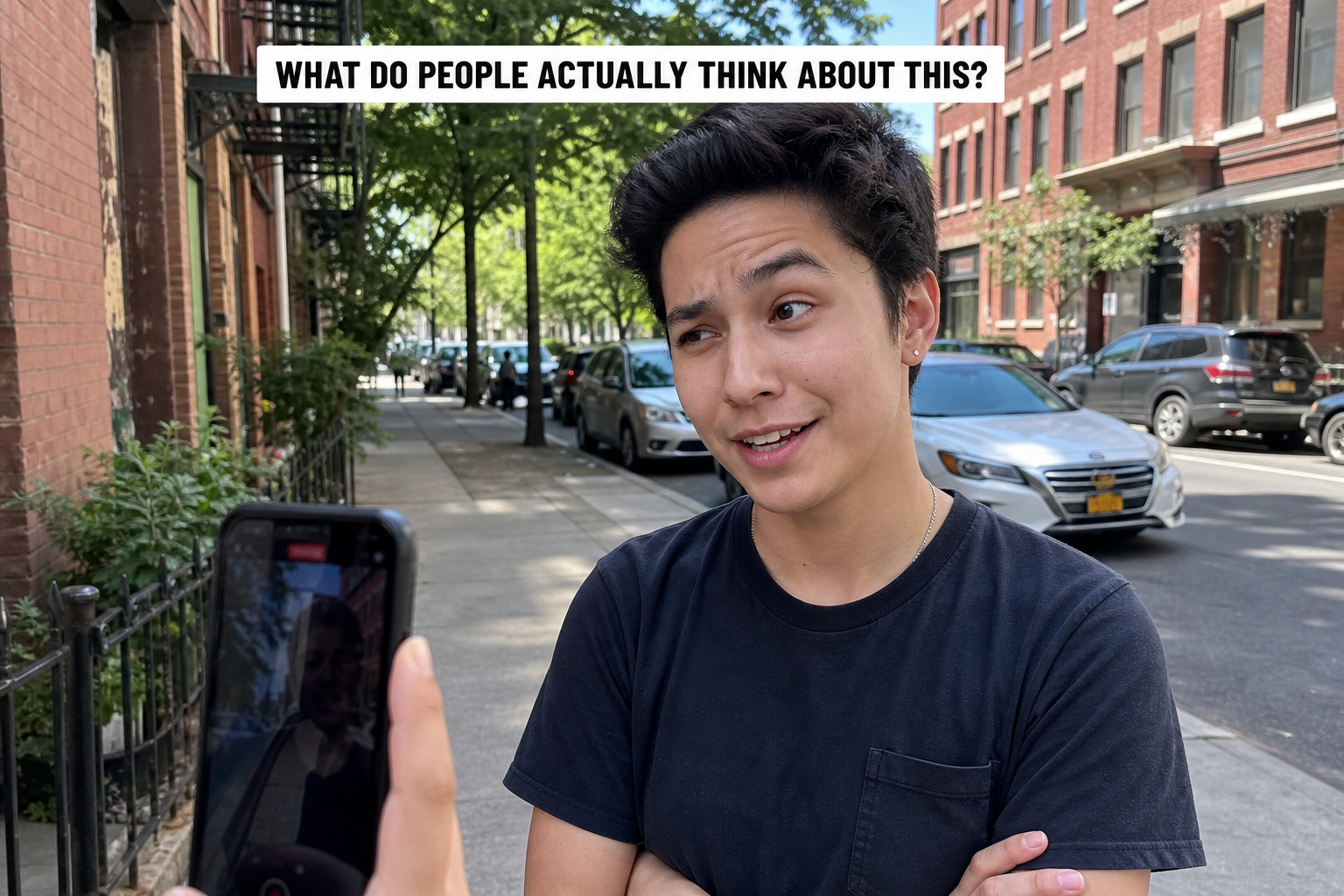
Illustrative example. mcp.coinis.dev generation backend is currently down (token refresh failure, ongoing outage since 2026-08-09). This still is a static illustrative image generated directly via OpenAI gpt-image-2, standing in for a real generate_ugc_video street-interview preset render. See the Ad Studio UGC preset family articles already published for real generate_ugc_video renders of sibling presets.
The mechanics that make this work in a generator are the same three traits above, just rewritten as prompt inputs instead of shoot-day instructions:
- The question becomes the hook. A flat "what do you think of this product" produces a flat ad. A sharp, specific question, one that assumes some context and invites a real opinion, produces the pattern interrupt that stops a scroll.
- The persona brief replaces casting. Age, energy, setting, and delivery style are creative-direction inputs now, not a casting call and a release form.
- The brand reveal is the CTA. The product shows up as the payoff to a conversation the viewer already leaned into, which is a fundamentally different entry point than a cold product shot at second zero.
That reframing is the whole value proposition. The format's advantage was never the sidewalk. It was the structure. Once the structure is the input to a generator instead of a film shoot, any advertiser can test it the same afternoon they read about it, at whatever volume their testing budget allows, without waiting on crew availability or location scouting.
What to Do Now
Three ways to put this into a testing plan immediately:
- Write the question first, everything else second. Before touching a generation preset, write five candidate interview questions for the product. The sharpest one, not the safest one, is almost always the one that produces the strongest hook.
- Generate three personas against the same question. Different apparent age, different apparent setting, same question and same brand reveal. This isolates whether the question itself is doing the work, which is the fastest way to find a winning creative direction before spending on media.
- Pair it with an existing funnel stage, do not replace one. Street interview ads are a top-of-funnel attention format. Route the winning variant into the same retargeting and landing-page flow already built for other UGC creative rather than treating it as a standalone campaign.
Bigger Picture
Every UGC subtype eventually gets systematized once enough advertisers notice it converting: testimonials, unboxing, before-and-after. Street interviews are at that same inflection point now, with search demand and CPC data both pointing at real, current advertiser interest. The advertisers who move first are not the ones who send a crew outside fastest. They are the ones who turn the format's structure into a repeatable generation workflow before everyone else catches up and the novelty wears thin.
FAQ
What makes a street interview ad different from a regular UGC testimonial? A testimonial is delivered by someone who agreed in advance to talk about the product. A street interview ad is built around the illusion, or the reality, of an unscripted moment: a stranger reacting to a question they did not expect, with the brand only entering the frame at the end.
Do street interview ads work outside beauty and lifestyle products? Yes. The format depends on the question and the reaction, not the product category. A sharp, specific question works for almost any product because the hook is the conversation, not a visual demo.
Can I generate a street interview ad without any real footage? Yes, through Ad Studio's street-interview preset. You provide the question, the persona, and the product-truth details, and the generator handles the setting, delivery, and reaction.
How long should a street interview ad run? Most winning examples of the format land in the 10-15 second range, matching general short-form ad-length guidance. The hook and the answer need to land before a viewer's attention moves on.
Is this the same as Coinis's existing UGC Style workflow? It is part of the same Ad Studio UGC preset family already covering testimonial-style, unboxing, and podcast-style formats. Street interview is a distinct preset inside that family, built specifically around the interview-question structure rather than a straight product testimonial.
Turn This Into a Launch-Ready Ad
Every advertiser watching street interview ads convert in someone else's feed had the same blocker: no crew, no sidewalk, no time. That blocker is gone. Write the question, pick the persona, generate the reaction, and turn it into a launch-ready ad with a Coinis Ad Studio template instead of booking a shoot day you don't have.
Sources
- Taggbox, "UGC Facebook Ads: What They Are and Why They Work in 2025" -- https://taggbox.com/blog/ugc-facebook-ads/ (4x CTR, 50% lower CPC, 6.9x engagement stats for UGC vs. brand-produced content. Already cited in existing Coinis how-to-guides ai-ugc-facebook-ad and ugc-style-facebook-ad-without-creator)
- Promo.com, "Pattern Interrupts In Marketing Videos: How To Stop Scroll Instantly" -- https://promo.com/blog/pattern-interrupts-marketing-videos-stop-scroll
- Yume.video, "The 3-Second Rule: How to Write Video Ad Hooks That Stop the Scroll" -- https://yume.video/blog/write-video-ad-hooks-that-stop-the-scroll
- DataForSEO keyword_overview data, pulled 2026-07-14 via research.py (see front-matter for full detail)

Isidora Matovic
Author
Social media enthusiast and a full time researcher. She takes digital presence very seriously and that is why you are always in touch in what is going on with us! Follow us for more posts like this.