

If you’re a performance advertiser, media buyer, or an e-commerce brand scaling internationally, brace yourself: Meta is introducing “Location Fees” on Facebook/Instagram ads starting spring 2026. In plain terms, Meta will charge extra fees on ads delivered in certain countries,on top of your normal ad spend, to offset local taxes like Digital Services Taxes (DST).
These fees don’t depend on your business location; they’re based entirely on where your ad impressions are served, meaning every qualifying impression carries an extra cost, no matter where you are. Below, we break down which countries are affected, how much more you’ll pay, and how to adjust your strategy to keep campaigns profitable.
What Are Meta’s New Location Fees?
Location Fees are additional charges Meta will tack onto your advertising costs when your ads deliver in specific countries. Think of it as Meta passing along the bill for certain government taxes and fees it faces in those jurisdictions, especially Digital Services Taxes that target big tech companies’ ad revenues. Instead of absorbing these costs, Meta is adding a surcharge to advertisers’ bills for ads shown in those countries. Importantly, this is not based on your billing address or ad account country, it’s purely determined by where the ad impression happens. For example, if you run an ad that reaches someone in Austria, you’ll pay for Austria’s location fee percentage on that portion of spend, whether your business is based in the U.S., the U.K., or anywhere else. In short, if your ads reach users in these taxed markets, you’ll pay extra, even if you’re not physically operating there.
Meta is implementing these fees to offset part of the “Digital Services” levies and similar location-based costs imposed by governments. Many countries have introduced DSTs ranging roughly from 2–5% of ad revenues, and now Meta is transferring a portion of that cost to advertisers via the new location fees. This is similar to what other ad platforms (like Google Ads) have done in recent years when governments rolled out these taxes. Your invoice gets a line item for an extra few percent in affected countries. The bottom line: Meta’s own platform changes mean higher effective ad costs in certain regions, even though your base bid and budgeting process in Ads Manager remains the same.
Where Do Location Fees Apply? (Country List and Rates)
As of this announcement, Meta’s location fees will apply to impressions delivered in the following countries, with the corresponding surcharge rate for each:
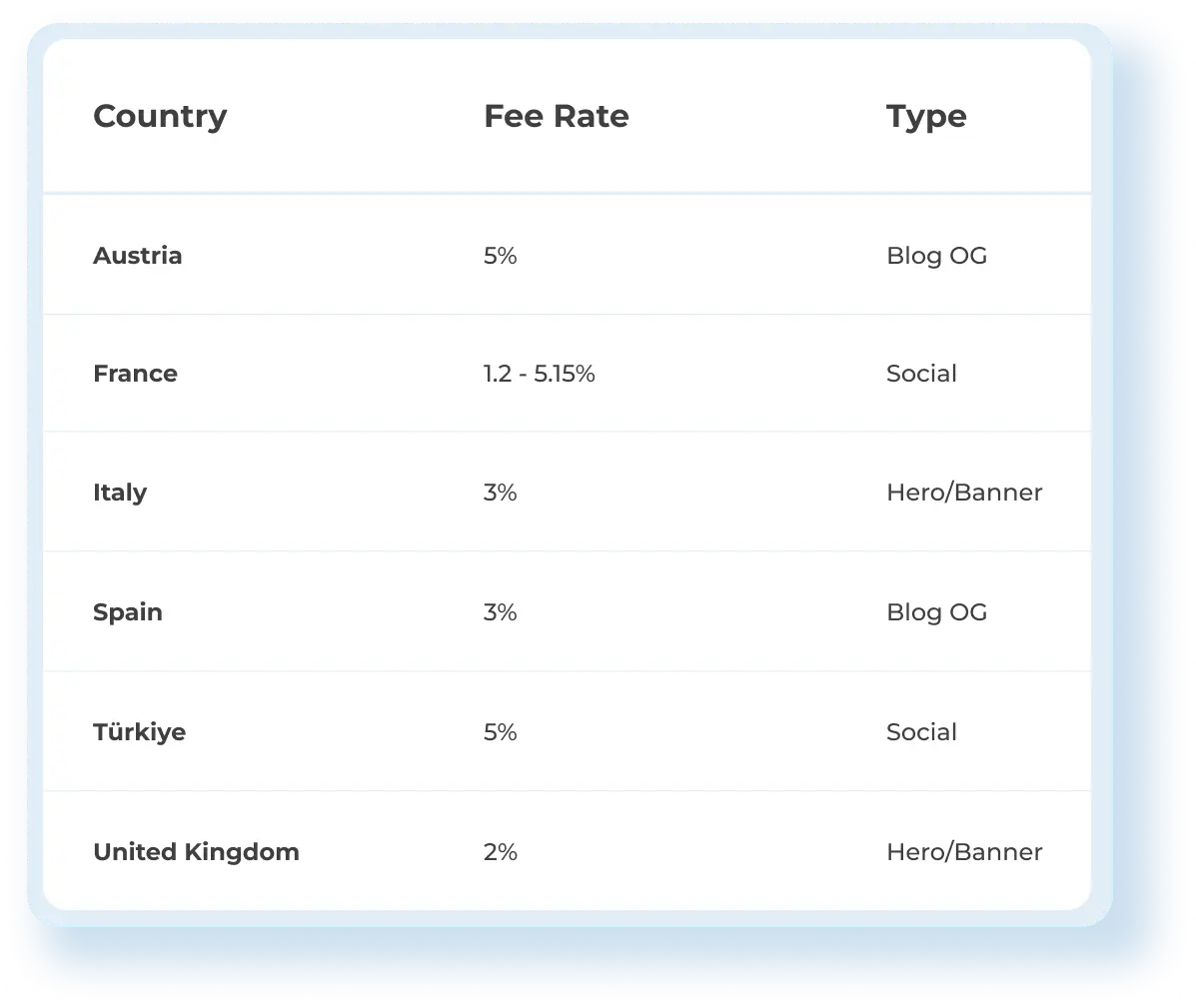
- Austria – 5% (adds 5% to ad spend delivered in Austria)
- Turkey – 5% (adds 5% to ad spend delivered in Turkey)
- France – 3% (adds 3% to ad spend delivered in France; France imposes a 3% DST)
- Italy – 3% (adds 3% to ad spend delivered in Italy)
- Spain – 3% (adds 3% to ad spend delivered in Spain)
- United Kingdom – 2% (adds 2% to ad spend delivered in the U.K.)
These rates are based on current digital services tax policies in each country, and could change over time if governments adjust their taxes or new fees emerge. (For instance, some countries have discussed lowering or phasing these taxes in the future.) Meta’s location fees are essentially matching those percentages.
Note: It doesn’t matter where your ad account is registered or billed. Its only important where the ad impressions go. So even a UK-based advertiser will pay the 2% fee on UK impressions, just like an international advertiser would. If you advertise to multiple countries, the relevant fee will be applied separately to the spend in each of those countries.
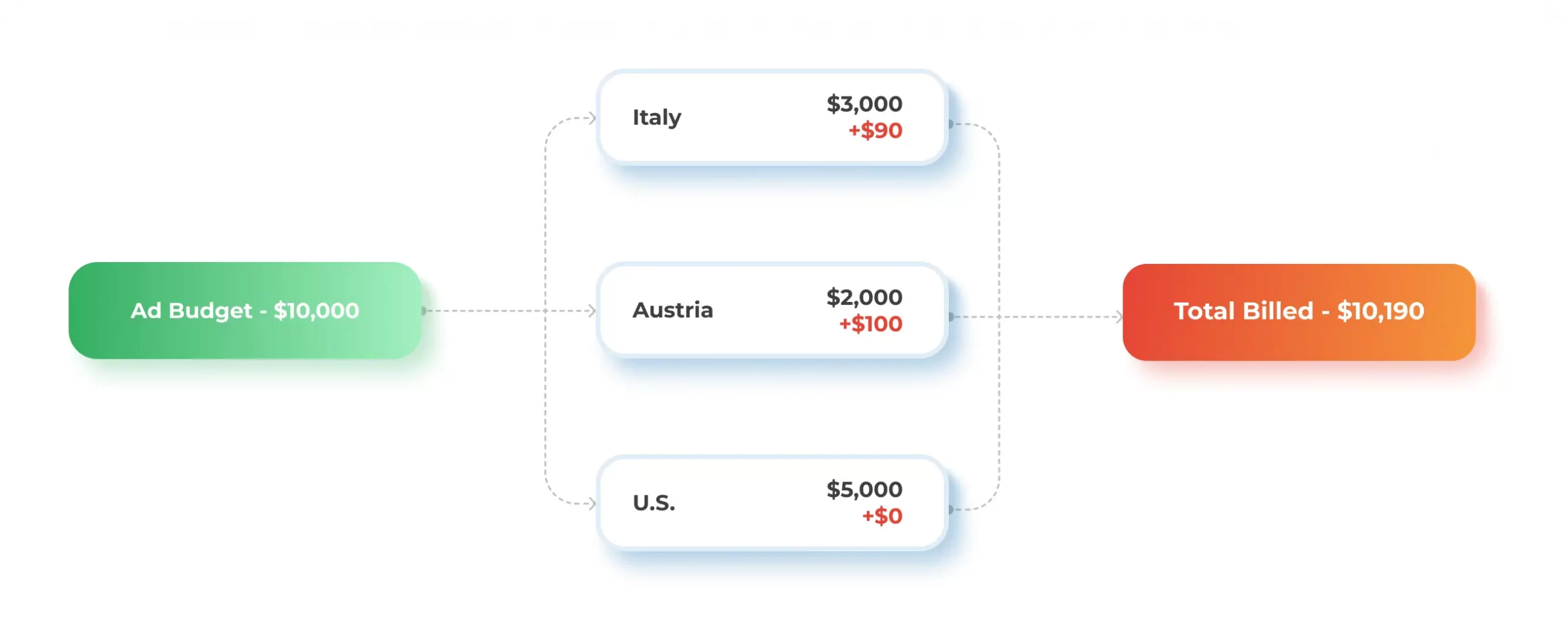
Example: Suppose you run a campaign that spends $10,000 total, with $2,000 worth of impressions delivered to Austria, $3,000 to the UK, and the rest elsewhere. Meta will add a 5% charge on the $2,000 for Austria (i.e. an extra $100) and 2% on the $3,000 for the UK (an extra $60). Your final bill would include those surcharges, meaning you’d pay $10,160 instead of the $10,000 shown in Ads Manager. The fees will appear on your invoices once this policy kicks in (expected around May 2026). It’s essentially an increase in effective CPM/CPC in those regions – your cost to reach those audiences just went up by a few percentage points.
Why Is Meta Adding Location Fees?
In a word: taxes. Many governments, particularly in Europe, have implemented Digital Services Taxes targeting large digital advertising platforms. These DSTs typically charge big tech firms a percentage of their revenue from ads shown to users in that country. For example, the UK and Denmark levy a 2% tax on digital advertising revenue, France/Spain/Italy charge 3%, and Austria and Turkey charge 5%. Rather than eating that cost entirely, Meta (like other platforms) is choosing to pass some of it to advertisers as a separate fee. Essentially, the government taxes Meta, Meta taxes your ad account. It’s a chain reaction now built into the advertising ecosystem.
Meta frames these as fees to cover “the costs of doing business in those jurisdictions.” In practice, it means advertisers are footing part of Meta’s tax bill for serving ads in certain countries. This approach isn’t new – Google implemented similar surcharges for ads in the UK, Austria, Turkey, etc., when DSTs were introduced. By introducing location fees, Meta ensures its billing aligns with local regulations without outright raising base ad prices globally. From Meta’s perspective, it keeps the playing field level: advertisers who benefit from audiences in, say, Austria will bear Austria’s extra tax cost, rather than spreading that cost across all advertisers.
For advertisers, though, it’s effectively a stealth increase in ad costs in those markets. If you’re running campaigns internationally, you need to be aware that a chunk of your budget will now go toward taxes and fees rather than pure media spend. This is why understanding location fees is crucial for forecasting and measurement – it can explain why your invoice is bigger than your planned spend, and why certain countries yield higher costs per result moving forward.
Impact on Key Metrics: CPA, Margins, MER, and Budgets
Even a 2-5% fee can meaningfully impact performance metrics and profitability at scale. Here’s how these new fees will ripple through your numbers:
- Higher Cost Per Acquisition (CPA): Since every impression or click in a taxed country costs slightly more now, your cost per acquisition (CPA) in those regions will naturally creep up. For example, if your average CPA in the UK was $50, adding a 2% fee might effectively push it to ~$51 (assuming all else equal). In Austria or Turkey, a 5% fee could turn a $50 CPA into $52.50. Over thousands of conversions, that adds up. Advertisers will either see CPAs rise or need to spend more to maintain the same volume of conversions, putting pressure on return on ad spend (ROAS).
- Margin Compression: If you have tight profit margins, an extra 2-5% ad cost can eat into those margins directly. Let’s say you’re an eCommerce brand with a 20% profit margin on each sale after ad costs. If your ads suddenly cost 5% more in a key market, your margin on those sales might drop to 15%. In other words, advertising in these countries will deliver slightly less profit per dollar of revenue unless you adjust your pricing or marketing mix. Brands will feel this especially in markets where they can’t easily raise product prices to compensate.
- Marketing Efficiency Ratio (MER) Impact: MER (total revenue divided by total marketing spend, sometimes called blended ROAS) will also dip for campaigns with significant spend in affected countries. Since your marketing spend denominator now includes these fees, the same amount of revenue will yield a lower MER. For instance, if you generate $10 in revenue for every $1 of Facebook ad spend, a 5% fee on that spend means you’re actually spending $1.05 to get $10 revenue – effectively reducing efficiency. It might seem small, but when reporting to finance teams or evaluating campaigns, those fees can turn a 4:1 ROAS into a 3.8:1, which might be the difference between scaling a campaign or pausing it.
- Budget Forecasts & Spend Pacing: Advertisers need to account for these fees in their media plans. If you have a fixed budget cap (say $100,000 for a quarter), failing to account for location fees means you’ll hit that cap sooner than expected because the fees consume part of it. Conversely, if you aim for a certain number of conversions or impressions, you’ll now need a slightly higher budget to achieve them in fee-affected regions. Forecasting models should bake in an extra 2-5% cost for affected geos, or you risk under-delivering on goals. Month-end billing might surprise you if you didn’t factor in, for example, that 5% Austrian surcharge on your big campaign – it’s essentially unplanned spend if not budgeted.
To sum up, Meta’s location fees act like an across-the-board bump in CPM/CPC for specific countries. Advertisers will notice performance metrics in those countries looking a bit worse (higher CPA, lower ROI) unless adjustments are made. It’s crucial not to panic at the dashboard numbers without recognizing that part of the “performance drop” is simply a billing change – but either way, your actual costs are higher, so it must be addressed.
Adjusting Targets and Strategy for the New Fees
How should advertisers respond? Here are some tactical steps to adjust for location fees in your targets, forecasts, and reporting:
- Recalculate CPA/ROAS Targets: Update your target CPA or ROAS for affected countries by factoring in the fee. For example, if your target CPA in France was $30, you might aim for ~$29 now to account for the 3% fee (so that after the fee the effective CPA is $30). Similarly, lower your ROAS target slightly (e.g. if you needed a 2.0 ROAS, you may need ~2.06 ROAS in-platform to net out a 2% fee). In practice, this could mean tightening your bids or conversion goals in those geographies to maintain profitability.
- Segment Campaigns by Region: It might be wise to separate campaigns (or ad set targeting) for fee-impacted countries versus others. By isolating, say, UK-targeted ads in their own campaign, you can more clearly measure the impact and adjust budgets/bids for the UK specifically. This segmentation makes it easier to optimize knowing that one campaign’s metrics will consistently include a 2% surcharge, rather than blending it with non-fee countries. It also simplifies reporting the true cost per result per country.
- Adjust Budget Forecasts: Explicitly include a line for location fees in your media plans. For example, if you plan $50,000 in spend in Turkey next quarter, note that actual spend will be $52,500 with the 5% fee. If you use automated budget pacing tools or share budgets with clients/finance, incorporate these markups to avoid mid-flight budget overruns. It’s better to plan for a slightly higher spend than to be caught off guard when the invoice arrives.
- Optimize Creative and Targeting per Country: With costs rising a bit, it’s even more important to maximize performance in those markets. This could mean tailoring creatives to each locale to boost conversion rates (offsetting higher cost with better CTR/CR), or tightening your targeting to the highest-value audiences in fee markets. The goal is to squeeze more results out of each dollar since each dollar is now taxed extra. For instance, you might focus on top-performing interest groups or lookalikes in Austria rather than broad campaigns – if that yields a better CPA to counter the +5% cost.
- Consider Pricing and Margins: For eCommerce brands, evaluate if you need to adjust product pricing or offers in certain countries. If your ad costs in a country just went up 5%, could you slightly raise product prices by a small percentage in that market to compensate? This isn’t always feasible due to competition, but it’s worth a conversation with your team. Alternatively, you might accept a slightly lower margin in those countries but plan for higher volume to make up for it – if the market size justifies it.
- Communicate with Stakeholders: Make sure your clients, finance department, or bosses are aware of this change. Explain that starting in Q2 2026, ad spend in specific countries will incur additional fees, which will make the advertising appear less efficient unless we account for it. Managing expectations is key. It may also be an opportunity to revisit budgets (“We may need a 2-5% budget increase to hit the same results in these markets due to Meta’s new fees”) – having the data to back this up is helpful.
By proactively adjusting your targets and plans, you can absorb the impact of location fees with minimal disruption. The worst move would be to continue as normal and then be surprised by higher CPAs or blown budgets. Instead, bake these fees into your strategy now so you’re effectively playing on hard mode with a game plan, rather than getting blindsided.
Harder Reporting Across Multiple Accounts & Regions
One side effect of these fees is that reporting just got more complicated, especially for advertisers running campaigns across multiple ad accounts or regions. Here’s why:
- Invoice vs Dashboard Mismatch: The spending shown in your Meta Ads Manager will not include the location fees – it will only show base ad spend. The fees are added on billing. This means if you pull raw spend data from the dashboard (or via API) to calculate metrics, it’ll understate your actual costs. For a single account, you might manually reconcile this. But across many accounts, the gap grows. For example, imagine running separate ad accounts for the UK, France, and the US. Each of the European accounts will have actual costs ~2-5% higher than the dashboard indicates. Simply summing the “Amount Spent” from each account will no longer equal what you actually paid. Your finance team might ask why the Facebook invoice is higher than the numbers in your report – you’ll need to attribute those differences to location fees per country.
- Multi-Currency and Regional Accounts: Many large advertisers use different currency ad accounts (e.g. a Euro-denominated account for EU campaigns, a USD account for US/global campaigns, etc.). The location fees will be charged in the billing currency of each account for the impressions in the fee jurisdictions. Comparing performance across accounts was already tricky with exchange rates. Now each account may have a different effective cost uplift depending on where its impressions went. An EU account targeting multiple European countries might have a blended fee if, say, 50% of spend went to France (3%) and 50% to Austria (5%). Your U.K. account will have a flat 2% on everything. Reconciling all this by hand is a headache, as you’d have to break down spend by country and apply the right fee to truly understand cost and ROI per account.
- Cross-Channel or Agency Reporting: If you report on Meta ads alongside other channels, the concept of “ad spend” needs clarification. For instance, your Google Ads spend might not include such fees (Google’s DST surcharges are separate line items too), whereas Meta’s spend now has these surcharges. When aggregating total marketing spend or calculating blended metrics, you have to ensure you include these extras, otherwise you’re not comparing apples to apples. Agencies managing clients with global campaigns will also need to update their reporting templates and possibly their contracts (e.g. if an agency charges a fee based on ad spend, does it include or exclude Meta’s location fees?). These are finer details, but they matter.
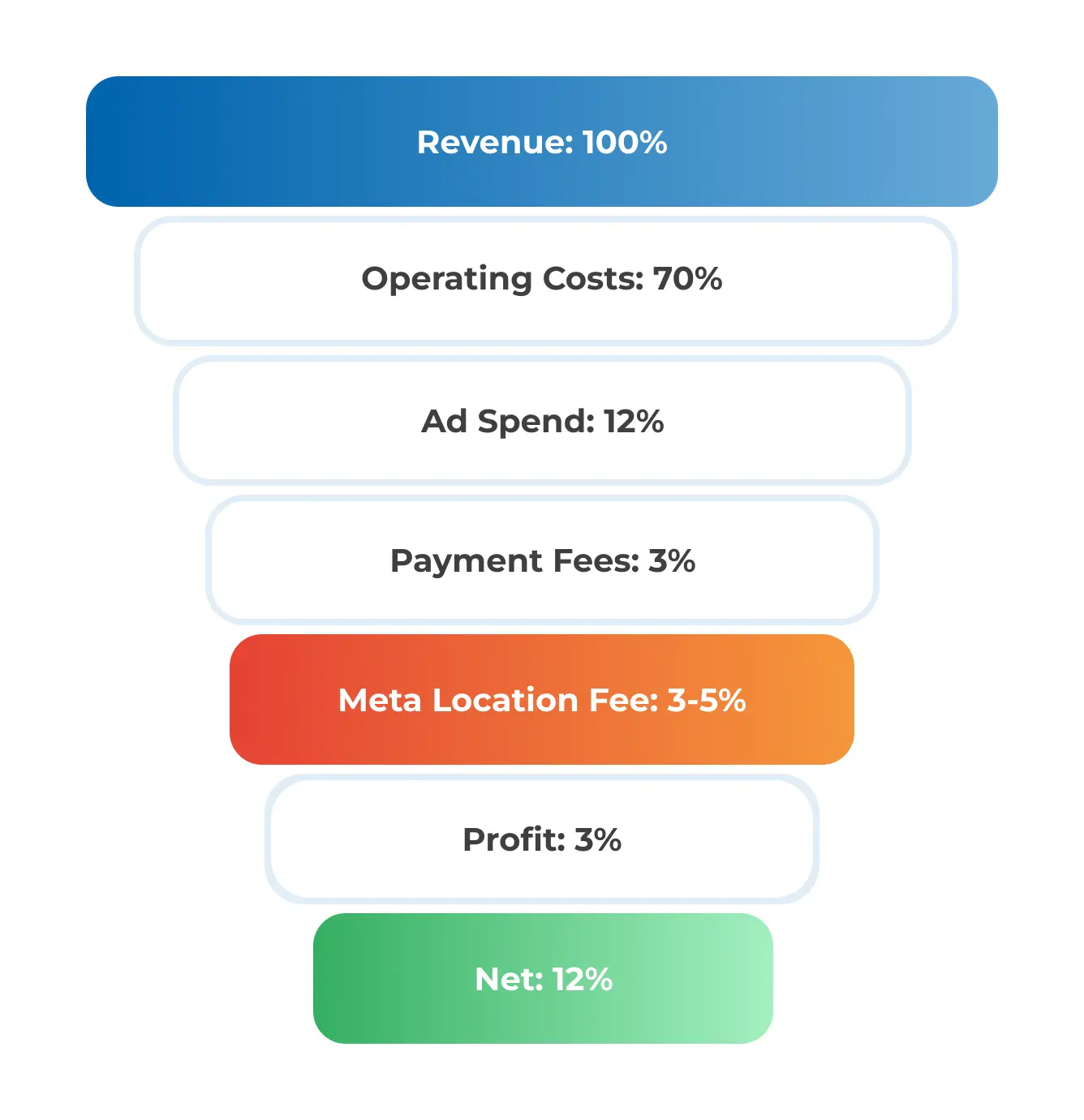
In short, the introduction of location fees means advertisers must track two versions of ad spend: the platform-reported spend and the actual billed spend. The delta is the location fees. Without proper reporting processes, you risk confusing discrepancies (like ROI reports that look better than they actually are if fees are ignored, or budget trackers that overshoot when invoices come in).
Using AdForce to Reconcile and Mitigate Confusion
Keeping on top of these fees manually can be a burden, especially for those managing many campaigns or clients. This is where advertising management platforms like AdForce come in handy. AdForce (our example here) is designed to help you consolidate ad data and reconcile it with real billing. When Meta rolls out location fees, a tool like AdForce can automatically pull in your billed costs versus the in-platform reported costs and highlight the differences.
For instance, AdForce’s dashboard could show: “Ad Spend = $50,000; Meta Location Fees = $1,500; Total Cost = $51,500.” This way, you get a clear breakdown of why your billed amount is higher. It can attribute those fees back to the country or campaign level, so you know, say, $500 of that was from Austria, $300 from UK, etc. This reconciliation of billed totals vs. dashboard data spares you from having to manually cross-reference invoices and performance reports each month. It also ensures your ROI calculations are accurate. You can choose to include the fees as part of your cost in the reporting tool, so your CPA and ROAS reflect true spend.
Beyond just reporting, platforms like AdForce help centralize multi-account data, which is especially useful now. If you run Meta ads in different regions, AdForce pulls everything together and shows all fees in one clear view. This removes a lot of confusion when justifying results to stakeholders. Essentially, the tool acts as a translator between Meta’s billing quirks and your business’s need for clarity.
While you can certainly manage without such a platform (spreadsheets and careful bookkeeping can do the job), as these advertising ecosystems get more complex, new fees, multiple currencies, various taxes, leveraging technology saves time and reduces errors. The key point is: don’t ignore the fees in your analysis. Whether via a tool or manually, make sure your “ad spend” in reports includes those location fees. On the other hand you can explicitly call them out, so everyone has an accurate picture of performance.
*Please note that the new start date for location fees is July 1, 2026 (as opposed to May 2026).
Plan Ahead for a Smoother 2026
Meta’s new location fees are yet another reminder that the digital advertising landscape is always shifting. Today it’s privacy changes or algorithm updates; tomorrow it’s taxes being passed down to advertisers. For those running international campaigns, 2026 will require a bit more finesse in planning and reporting. The good news is that the fees (2–5%) are relatively small adjustments. Nothing that real marketers can’t adapt to with some forecasting tweaks and vigilant monitoring. The bad news is that if you ignore them, they can sneak up on your margins and lead to unpleasant surprises in your financials.
To recap, stay ahead by baking in these fees: adjust your bids and targets, communicate changes to your team/clients, and perhaps leverage tools like AdForce to keep your reporting clean. By doing so, you’ll protect your KPIs and profitability even as Meta’s policies evolve. Scaling your eCommerce or performance campaigns globally is still a viable strategy – just account for each country’s true cost. Now that you know Meta location fees are coming, you can respond proactively rather than reactively.
In an industry where a few percentage points can separate winning campaigns from money pits, details like location fees matter. Treat this update as an opportunity to tighten your ops: refine your cost calculations, revisit your international approach, and continue to optimize. Meta may be adding friction with these country-by-country fees, but with the right adjustments, you can keep your growth on track and your Meta ad spend as efficient as possible across all countries.
Also if you want to learn more about AdForce and how to manage multiple things under the same roof, seamlessly book a FREE consult and demo:


Tamara Jelic
Author
Part-time researcher, part-time marketing enthusiast. Wanted to be a teacher, ended up working for the best ad tech company in Eastern Europe.