
Open your phone's Notes app right now. Plain white background. One font. No logo, no filter, no brand colors. It is the least "advertising" looking surface on your entire screen.
That is exactly why it works as an ad.
The notes-app ad format takes a confession, a complaint, or a recommendation, types it out like a real note, screenshots it, and runs it as a static ad. No actor. No product shot. No studio lighting. Just text that looks like something a friend forgot to delete before taking a screenshot. Brands have been running this format for years inside the Meta Ad Library, and Coinis's Ad Studio now has a dedicated preset that builds one from a real product photo in minutes.
Why a fake screenshot beats a real photo shoot
Every format on this list exists to solve one problem: people scroll past things that look like ads. A notes-app screenshot does not look like an ad. It looks like user interface. Your brain files it under "personal," not "promotional," and that single misclassification buys the extra half-second an advertiser needs to land a message.
Funnel's growth team measured this effect directly while testing Facebook video openers. Their thumbstop rate, the share of viewers who stop scrolling for at least three seconds, jumped from a typical 5 to 10 percent up to 55 percent the moment they swapped a conventional opening for something visually unexpected. The lesson generalizes past video: any format the eye does not immediately recognize as "ad" earns disproportionately more attention per impression (funnel.io, 2026).
A notes-app screenshot carries that same unexpectedness into a static image, and it does it cheaply. There is no film crew, no actor release, no editing timeline. There is a product photo, a few typed lines, and an export that looks exactly like what it is pretending to be. It belongs in the same family as other pattern-interrupt formats, like the Teaser preset, that work by hiding the sell behind something that reads as anything but an ad.
This is not a new trick, and that is the point
The notes-app screenshot did not start in an ad account. It started on Twitter in the early 2010s, when the platform's character limit forced anyone with a long statement to type it in their phone's Notes app, screenshot the whole thing, and post the image instead of the text. Celebrities used it for apologies. Companies used it for PR statements. Readers learned the visual grammar: a notes-app screenshot means "this is someone's real, unedited thought."
Political campaigns picked up on exactly that association. Forbes documented a Biden 2024 campaign ad on Facebook built entirely in notes-app styling, right down to a convincingly faked status bar with battery and signal icons, aimed specifically at older voters who associate the format with sincerity rather than marketing copy (Forbes, 2023). The campaign was not selling a product, but it was borrowing the exact same trust signal every advertiser using this format borrows today: this looks like a private thought that became public by accident, not a paid message.
That history matters for one practical reason. The format works because audiences have spent over a decade learning to read a notes-app screenshot as "unscripted." The more a brand's version looks genuinely like a real note (plain text, a believable line break, an imperfect sentence or two) rather than a polished marketing paragraph wrapped in a notes-app frame, the harder it works.
Why "looks unpolished" is winning the format war right now
This is not a nostalgia play for a decade-old internet meme. It lines up with where audience trust actually sits today. A UGC and marketing-research roundup citing a dcdx report found that 60 percent of consumers overall call user-generated content the most genuine form of advertising they see, and 70 percent of Gen Z say it is directly helpful in their buying decisions. The same report found the opposite reaction to AI-polished advertising: more than 30 percent of U.S. adults said AI-generated ads make them less likely to choose a brand, and nearly two-thirds said AI-generated ads make them uneasy (insideaudiomarketing.com, citing dcdx/Emarketer, 2026).
A notes-app ad sits on the correct side of that line without any of the production cost UGC usually requires. It is not footage of a real customer. It is a single static image. But it borrows the same visual cue, plain, imperfect, screen-captured, that a genuine customer post would carry, and it does it from a single product photo instead of a shoot.
How the Coinis Ad Studio preset builds it
Ad Studio's Notes App preset takes one real product photo and composes it into a screenshot-style image: a plain Notes app background, a typed block of text written like a genuine first-person note, and the product photo inserted the way someone actually does it, dropped in or referenced mid-note, not staged like a studio shot. No camera crew, no UGC creator fee, no waiting on a testimonial.
The brief that drives the preset needs three things to come out right every time: a real product photo so the output does not invent a different item, a short note-style line that reads like something a person would actually type (not ad copy with a notes-app skin on top), and explicit limits on what claims the text is allowed to make. That last point matters more here than on most presets. Because the whole format trades on reading as unscripted and personal, an invented statistic or an exaggerated claim slipped into "note" styling reads as more deceptive than the same claim in an obvious ad, precisely because the format signals authenticity. Every generated note needs a fact-check pass against the brief before it ships, the same way any other Ad Studio output does.
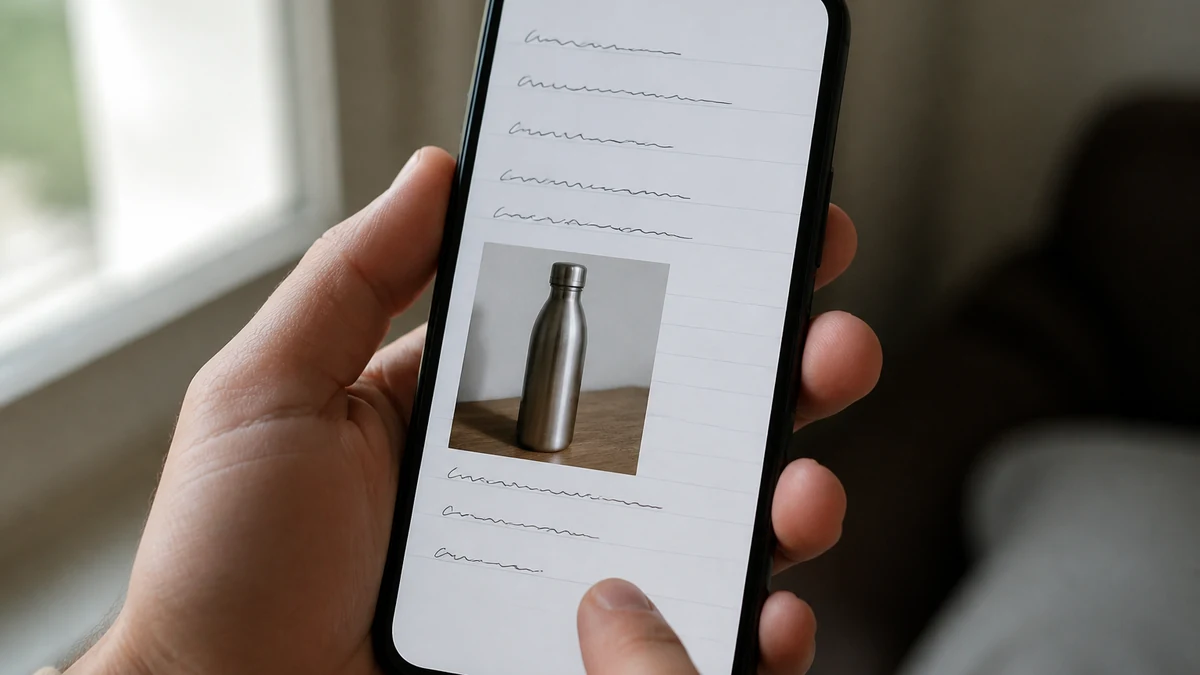
Illustrative still, not a live Ad Studio render. mcp.coinis.dev was down for the entire session this article was finished in (cached-token 401, refresh endpoint returning invalid_grant, the same ongoing outage tracked in next-slots.md), so the real generate_image_preset_agent call for the notes-screenshot preset could not be fired. The image above shows the format's intended layout: a plain Notes app screen with a product photo inserted mid-note. See offer-promo-ad-image-preset-coinis for a worked example of a real generate_image_preset_agent render from this same mini-series. This article will be updated with the actual notes-screenshot preset output once the outage clears.
What to do now
Pick one product with a single, honest, specific thing going for it: a feature, a fix, a reason you personally switched. Write that reason as if you were telling a friend, not pitching a customer. Keep it to two or three sentences. Run it through Ad Studio's Notes App preset with a real photo of the product, check the output for legible text and zero invented claims, and put it into rotation next to your polished creative. It costs one generation, not a shoot, and it is testing a completely different part of a scroller's brain than your product shots are. Testing season or promo angles next to it, like the Gift preset, rounds out a low-cost creative rotation without a single new photo shoot.
Build your next batch of ad creative, including the Notes App preset, inside Coinis Ad Studio and turn it into a launch-ready ad from a template: start free at Coinis Ad Studio.
FAQ
Is a notes-app ad dishonest if it is not a real customer note? No, provided it does not claim to be from a real person and does not state anything false about the product. The format borrows a visual style, not a false attribution. Avoid phrasing like "a customer told us" unless the quote is genuinely sourced. Write it as your own brand voice in note form instead.
Does this format work outside ecommerce? Yes. The format works on any product or service where a plain-spoken first-person statement reads as credible: software, local services, consumer goods. It performs worst on categories where a screenshot reads as implausible, like anything requiring visible packaging or a live demo to be believed.
How is this different from a UGC testimonial video? A UGC video needs a real person, a camera, and usually a fee or outreach to a creator. A notes-app ad is a single static image built from a product photo and a few lines of brand-written text. It borrows the same "unscripted" trust signal a UGC video carries, at a fraction of the production cost and turnaround.
What ruins a notes-app ad? Writing that still sounds like marketing copy. If the "note" reads like a tagline with a notes-app skin pasted over it, the format's entire advantage (looking unscripted) disappears. Write the line the way you would actually type a note to yourself, imperfect sentence structure included.
Sources
- Alexander Billington, "Thumbstop Rate Explained, And How To Hack Facebook Ads To Get Views," Funnel, 2026: https://funnel.io/blog/how-we-hacked-the-facebook-ads-algorithm-by-analyzing-thumbstop-rate
- Matt Novak, "Joe Biden's Latest Facebook Ad Uses Notes App Screenshot To Target Boomers," Forbes, May 15, 2023: https://www.forbes.com/sites/mattnovak/2023/05/15/joe-bidens-latest-facebook-ad-uses-notes-app-screenshot-to-target-boomers/
- "Authenticity Drives Ad Trust As Audiences Turn To User-Generated Content," Inside Audio Marketing, 2026 (citing dcdx / Emarketer report): https://www.insideaudiomarketing.com/post/authenticity-drives-ad-trust-as-audiences-turn-to-user-generated-content

Isidora Matovic
Author
Social media enthusiast and a full time researcher. She takes digital presence very seriously and that is why you are always in touch in what is going on with us! Follow us for more posts like this.