

Most of the presets in this mini-series sell a product on quality, proof, or story. The offer preset sells on one thing: a real number. Ad Studio's generate_image_preset_agent ships an offer preset built to put that number front and center, the price, the percentage, the deal, with the product as proof the offer is real rather than a vague banner that says "Sale" and nothing else.
The preset has a built-in guardrail worth noting before anything else: it needs a real offer in the brief. Feed it nothing specific, and it builds a benefit or brand ad instead of inventing a discount. That is not a limitation. It is the preset doing exactly what good promotional advertising has to do by design.
Why the exact discount format changes how big it looks
A 2016 study in the Journal of Business Research tested something retailers argue about constantly: should a discount read as a dollar amount off or a percentage off? The answer depends on price. Researchers Eva González, Eduardo Esteva, Anne Roggeven, and Dhruv Grewal ran three controlled experiments and found that for products priced over $100, framing the discount as a dollar amount ($145 off a $1,450 jacket) produced higher perceived value and purchase intent than framing the identical discount as a percentage (10% off). For lower-priced items, the pattern reversed, though less decisively. Their explanation: shoppers anchor on the raw number in front of them rather than calculating the real savings, so a big dollar figure reads as a bigger deal on an expensive item even when the percentage is mathematically identical.
That single finding has a direct creative implication. An ad showing "$145 OFF" on a $1,450 product is not interchangeable with one showing "10% OFF," even though they describe the same discount. The preset needs to know which framing the brief wants, because the two versions will not perform the same.

What the offer preset actually does
The preset takes a real product photo and builds a scene around the specific deal in the brief, the price, the percentage or dollar amount off, a limited-time framing if one applies, while keeping the product itself as the visual anchor rather than letting the discount graphic overwhelm the frame. Unlike the teaser preset elsewhere in this mini-series, which withholds information to create curiosity, offer leads with the single most concrete piece of information an ad can carry: what this costs right now, and how much less that is than before.
That concreteness is also a legal constraint, not just a creative one. The FTC's Guides Against Deceptive Pricing set a direct rule for any ad claiming a discount off a former price: the former price has to be a real, bona fide price the item was actually offered at for a reasonably substantial period, not a number invented to make the markdown look bigger. An ad that says "Reduced to $9.99" from a "regular" price that was never actually charged is exactly the kind of claim the FTC guide calls out as misleading, "the consumer... will understand the claim to mean that a much greater, and not merely nominal, reduction was being offered." The offer preset's own "needs a real offer" requirement lines up with that rule by construction: it will not manufacture a discount percentage or a reference price the brief does not supply.
Worked example: a real discount, stated plainly
Start with a product photo of something priced clearly enough that a discount makes obvious sense, apparel, a home good, anything with a visible price point. The brief for the preset:
Preset: offer
Product: [product photo URL or productId]
Offer: 25% off, limited to this week only
Price framing: show the percentage off clearly next to the product, keep the product as the dominant visual element
Avoid: any dollar amount, expiration date, or claim beyond the 25%-off figure actually supplied. Also avoid garbled or illegible price text, and a layout so promo-heavy the product itself gets lost
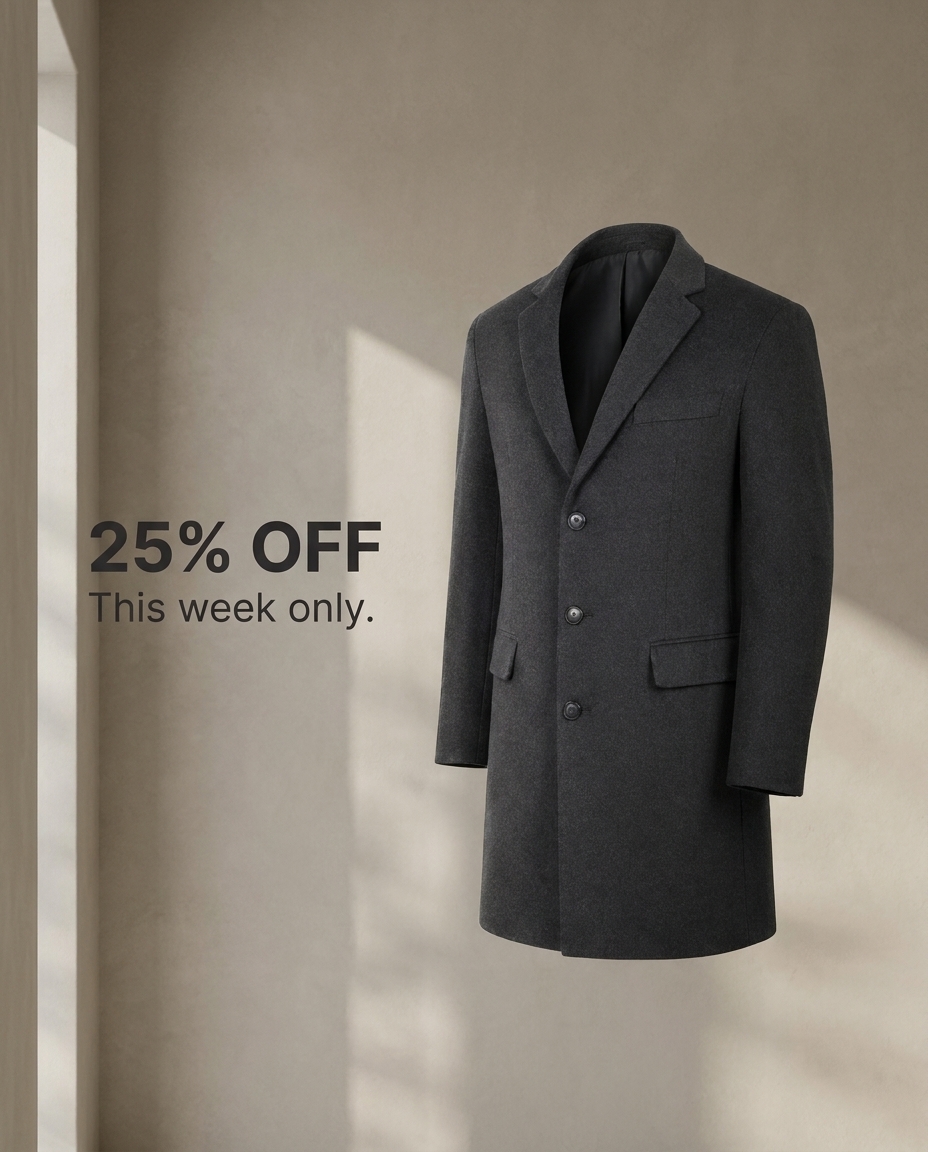
This is a real generate_image_preset_agent render, preset offer, fired against a demo product photo with the exact prompt above. The output should hold a clearly legible, accurately stated 25%-off claim while keeping the product as the dominant subject, with zero invented pricing, currency, or date claims beyond what the brief supplies.
FAQ
Does the offer preset work without a real discount to advertise? No, by design. The preset's own documentation states it needs a real offer in the brief, and without one it builds a benefit or brand ad instead. That is the correct behavior, not a bug, since fabricating a discount figure creates the exact deceptive-pricing risk the FTC guide addresses directly.
Should a discount be shown as a percentage or a dollar amount? The González et al. research found dollar-amount framing worked better for higher-priced items (over $100), while percentage framing held up better, though less decisively, on lower-priced items. The brief should state which framing fits the product's price point rather than defaulting to percentage out of habit.
Is a "was $X, now $Y" claim always safe to generate? Only when the "was" price is real. The FTC's deceptive-pricing guide specifically prohibits a fictitious former price used only to make a markdown look larger. The offer preset should only ever be briefed with a former price that was genuinely charged for a reasonably substantial period.
How is this different from the bundle or gift presets? Bundle sells two or more products as a package deal, and gift frames a single product as a present for an occasion. Offer is narrower: it is built specifically for a price-based promotion on one product, discount-led rather than bundle-led or occasion-led.
Can the offer preset handle a limited-time framing, like a flash sale? Yes, as long as the time window is a real one named in the brief. The same "no inventing a deal" rule applies to urgency language as it does to the discount figure itself.
Try it on Coinis
Pull a real product photo, state the actual discount, and let Ad Studio build the promo creative around it in one generation, no invented numbers, no fictitious former price, just the real deal made visible.
Start building launch creative on Coinis
Sources
- González, E., Esteva, E., Roggeveen, A.L., & Grewal, D., "Amount off versus percentage off, when does it matter?" Journal of Business Research, Volume 69, Issue 3, March 2016: https://www.sciencedirect.com/science/article/abs/pii/S0148296315003513
- Federal Trade Commission, 16 CFR Part 233, "Guides Against Deceptive Pricing," Section 233.1, Former Price Comparisons: https://www.govinfo.gov/content/pkg/CFR-2022-title16-vol1/pdf/CFR-2022-title16-vol1-chapI-subchapB.pdf

Isidora Matovic
Author
Social media enthusiast and a full time researcher. She takes digital presence very seriously and that is why you are always in touch in what is going on with us! Follow us for more posts like this.