
In one two-week stretch this May, every platform you buy ads on quietly handed the controls to AI agents. TikTok shipped an Ads MCP at TikTok World. Meta rolled out connectors that let you run ad accounts straight from Claude or ChatGPT. Google dropped an open-source Ads MCP server. The message is the same across all three: the operational grind of running campaigns is moving off your plate and onto an agent's.
For an e-commerce operator, that lands as either a relief or a threat, depending on how much of your day disappears into Ads Manager. So the real question is not "can AI run my campaigns" anymore. It can. The question is where letting it run them actually lifts ROAS, and where you still need a human in the seat.
The week AI agents took the wheel
At TikTok World on May 12, TikTok launched its Ads Model Context Protocol Server, a connection layer that lets AI agents plan, launch, and optimize campaigns directly on top of the TikTok Ads ecosystem without manual intervention. It paired that with TopReach, a single buy that bundles TopView and TopFeed placements, and integrated Dreamina Seedance 2.0, ByteDance's next-generation AI video model, into its Symphony creative suite. Full details in TikTok's official announcement: TikTok World '26 newsroom post.
Meta moved the same week, releasing AI connectors that let advertisers manage ad accounts through the AI tools they already keep open all day, including Claude and ChatGPT. Google answered with an open-source Google Ads MCP server. Three different companies, one direction: build the plumbing so an agent, not a media buyer, handles the repetitive work of building, launching, and adjusting campaigns.
This is not a science project. Roughly 90% of advertisers now use generative AI somewhere in their creative workflow, up from about 55% at the start of 2025, and AI-generated video already accounts for an estimated 40% of digital ad creative. The agents shipping this month are the layer that ties that creative volume to live campaign execution. For more on the underlying shift, see our explainer on agentic advertising.
Where AI actually moves ROAS
Here is the part the launch hype skips. AI does not win everywhere. It wins in specific, measurable places, and the dividing line is your average order value.
Across a dataset of more than 50,000 ad variations, AI-generated creative pulls about 12% higher click-through rate on Meta, 7% on Google search headlines, and 4% on TikTok. But clicks are not revenue. When you follow those clicks to purchases, AI creative matches or beats human creative on ROAS only below a $100 AOV. Above it, a human still wins, and the gap widens as the price tag climbs.
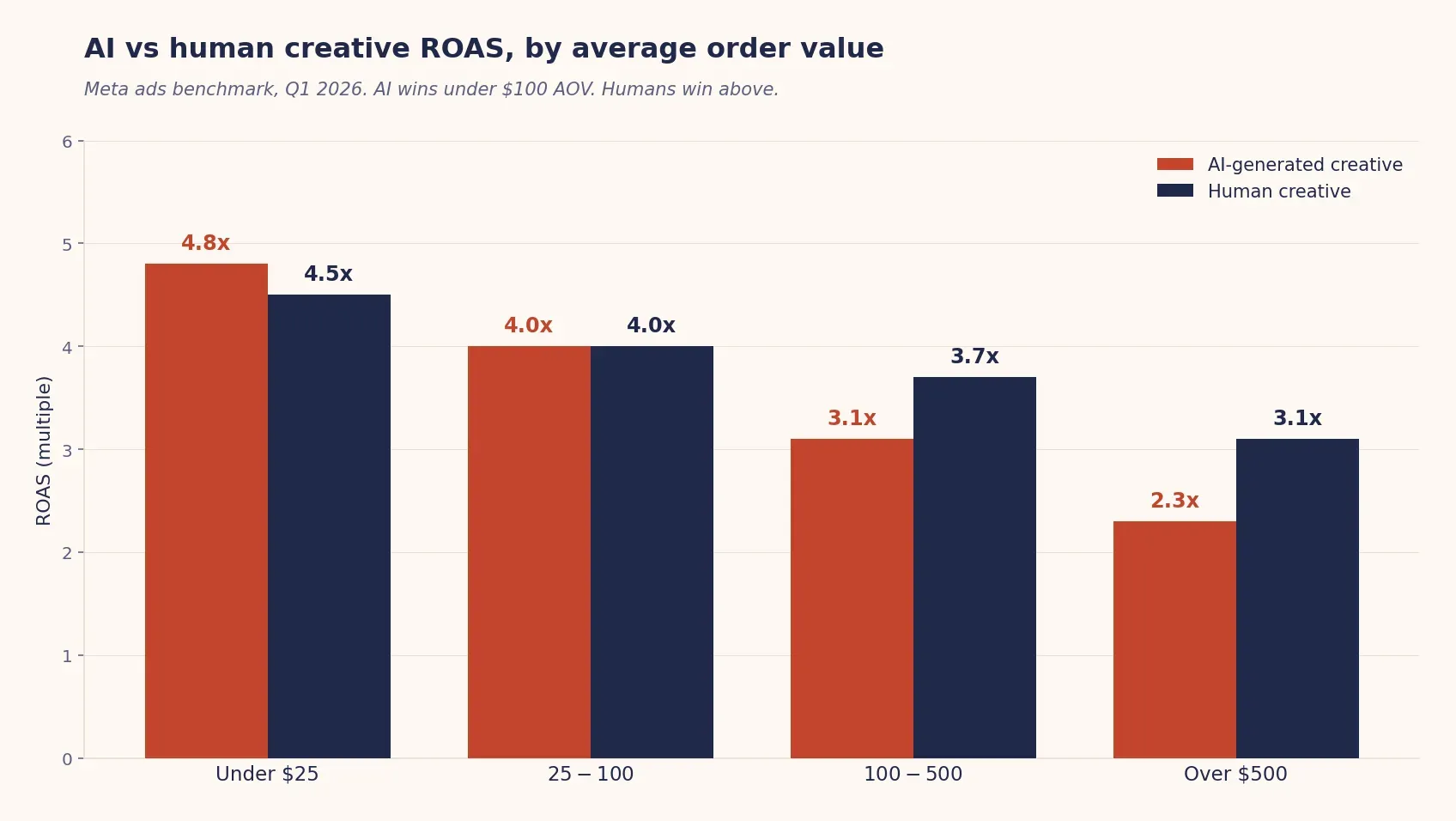
The pattern is clean. Under $25 AOV, AI creative leads at 4.8x versus 4.5x. Between $25 and $100, it is a dead heat. From $100 to $500, human creative pulls ahead 3.7x to 3.1x. Over $500, the gap stretches to 3.1x against 2.3x. That parity line sat at $25 in early 2025 and climbed to $100 by Q1 2026, so the zone where AI runs unsupervised keeps expanding.
For most e-com brands selling impulse and low-consideration products, that is the whole game. If your catalog lives under $100 AOV, an agent generating and rotating creative is not a downgrade, it is the better-performing default at a fraction of the production cost.
Across Coinis beauty and accessories accounts under $100 AOV, we see a recurring pattern: AI-generated creative matches or beats human-led ads on ROAS while collapsing production cost. A typical 10-day creative cycle with freelancers compresses into an afternoon of AI generation, and the volume difference (dozens of variants versus a handful) gives the agent enough signal to find a winner faster. The math gets harder to argue with as the AOV drops.
The catch: clicks do not always convert
The reason high-AOV products resist AI is intent. AI creative is excellent at the hook, the scroll-stopping visual, the curiosity headline. It is weaker at the slow build of trust a shopper needs before dropping $400. AI creative converts about 8% worse above $100 AOV, 14% worse above $500, and that is before you account for perception.
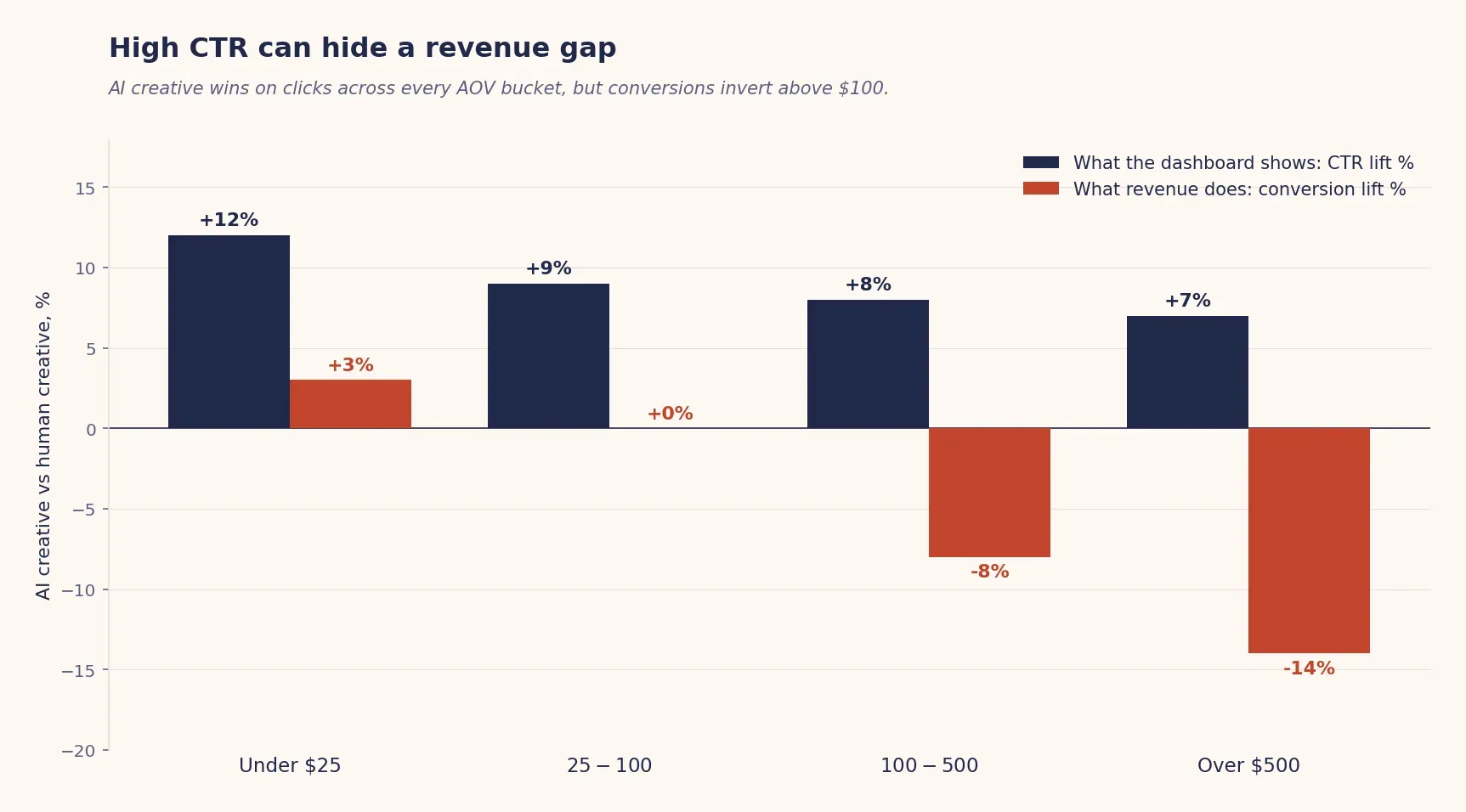
When a shopper clocks an ad as AI-made, premium perception drops 17% and purchase intent falls 14%. For a commodity product at $19, nobody is studying the creative for craftsmanship, so it does not matter. For a $300 considered purchase, it absolutely does. This is also why your dashboard can lie to you: CTR and CPC look great while actual revenue lags, because you bought a pile of cheap clicks instead of qualified ones. If your reporting only goes as deep as CTR, it is worth revisiting how to read your performance dashboard down to the revenue line.
How operators should split the work
The teams getting this right are not picking a side. They are routing each job to whichever resource performs best, and letting the agent own the high-volume end.
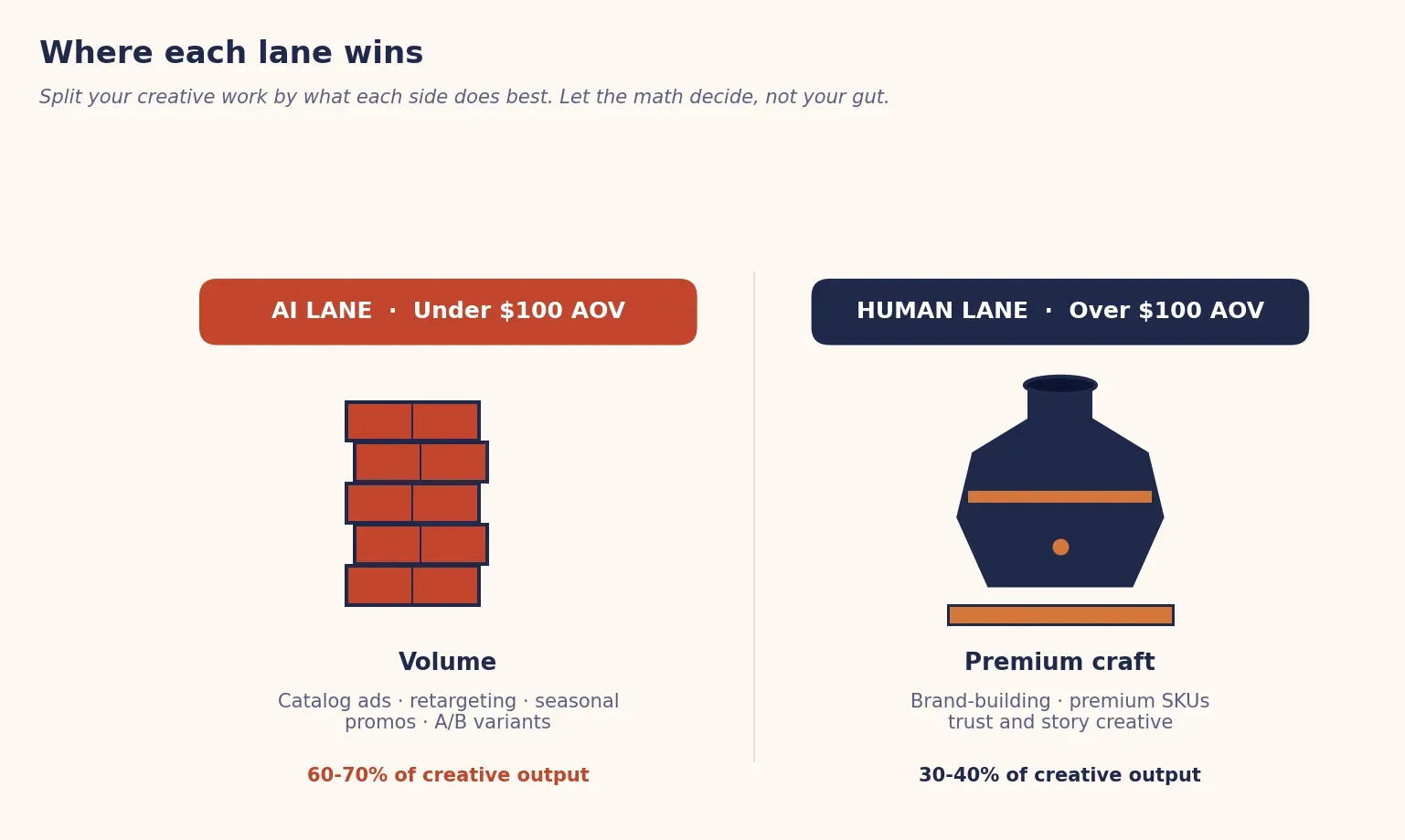
Point AI at the 60 to 70% of your creative that is direct response: catalog ads, retargeting, seasonal promos, A/B variants, anything under $100 AOV. This is where volume and speed compound, and where agents earn back the 20-plus hours a week most teams sink into production. Keep humans on the 30 to 40% that builds brand and sells your premium SKUs, where trust and story decide the sale. For mid-range products, use AI to generate concepts fast, then have a person art-direct the final cut. You can extend that split with structured structured creative testing so the agent learns from real winners, not guesses.
"We went from 2 new ads a week to 10. Same team, same hours. Ad Intelligence alone changed how we test. See what's working in our niche, clone it, ship our version in minutes."
Antonio Kolarek, Head of Partnership, Nabu Global
Creative now drives roughly 70% of campaign performance, so this is not a small operational tweak. It is the single biggest lever you have, and the platforms just made it agent-operable end to end.
If you want to test this without rewiring your stack, start small. Pick your single best-selling sub-$100 SKU and run a one-week AI creative sprint against your current human-led ads. Same budget, same audience, same product page. Compare ROAS and cost per acquisition at the end of the week, not after a day. If the AI lane matches or beats human, expand the split next month. If it loses, the gap tells you exactly which part of the funnel needs work, copy, hook, or offer.
Run the agentic stack without stitching it together
The catch with this month's launches is that an MCP server is plumbing, not a product. You still have to wire up the creative engine, the launch logic, and the optimization loop yourself, across three platforms with three different setups. Coinis already runs that full loop in one place. You paste a product URL, the platform generates AI-generated ads as image, video, UGC, and avatar formats, launches them to Meta, TikTok, and Google, and the AI optimizes spend 24/7. The old way meant briefs, designers, and weeks. This way is paste, review, launch, in about five minutes, with 10x more creative variations per campaign and no dashboard babysitting. Our AI ad optimization handles the part the new MCP servers leave you to build.
"I paste a product URL and the ads are live before my coffee's done. ROAS keeps climbing while I sleep."
Nikola Zec, Founder, Zenic Media LTD
The agents are here, and they are best at exactly the work that drains your week. Point them at your sub-$100 catalog, keep your hands on the premium launches, and let the machine run the rest. Try [Coinis AI](https://auth.coinis.com/register) and watch a live product URL turn into launched, self-optimizing ads before your coffee goes cold.