

Pull up your Meta Ads Manager and check the Tools menu. Manus AI Ads Manager integration is sitting there right now, and it wasn’t there three months ago. Most people have already dismissed the pop-up that announced it, clicked through, hit what looked like a paywall, closed the tab.
It’s live, it works, and there’s enough nonsense circulating about what it does that it’s worth laying out properly. Meta bought Manus in December 2025 for something over $2 billion. By February, Manus AI Ads Manager access was live for every advertiser on the platform. Then the LinkedIn posts started. Bots that automatically pitch UGC creators for you. Creatives that swap out on their own. Campaigns that basically run themselves. Scroll on. None of that is real yet, and here’s what actually is.
What Manus AI Actually Is
Manus was never an ad tool. Before Meta bought it, people were using it for deep research, coding, and multi-step workflow automation, the kind of tasks where you’d normally have to manage each step yourself. Hit $100M in recurring revenue eight months post-launch.
The reason Meta paid $2B for it, instead of building something internally, is that Manus was already designed to take a goal and go execute it without being walked through every step. That’s not how normal AI tools work. You ask ChatGPT to analyze your underperforming ad sets and it gives you a thoughtful explanation of how you’d approach that. Manus goes and does it. Big difference in practice, especially when you’re talking about something that could eventually run inside your ad account.
Also worth knowing: Manus runs on Anthropic’s Claude models. The company Meta spent $2 billion on is powered by one of Meta’s direct AI competitors. Nobody’s making a big deal of this but it’s a strange situation. Anyway.
What’s Live in Manus AI Ads Manager Right Now
Here’s what’s actually live in Manus AI Ads Manager right now, not the roadmap version people are posting about. Tools menu, left nav, desktop only. No mobile yet. You need active campaigns running under Sales objective, Admin or Editor access, and you can’t be in a restricted category: housing, credit, pharma, elections, employment.
You ask it questions, in plain English, and it pulls your account data back.
- “Which ad sets had the biggest CPA increase week over week in the last 14 days.”
- “Show me CPM by placement for the past 30 days.”
- “Which creatives have frequency above 4 right now.”
Stuff that used to take you 20 minutes of clicking around now takes one question.
It also watches passively. CPM spikes 20% in 48 hours, it flags it. Ad set that was at target CPA last week suddenly isn’t, flagged. Frequency creeping past 4 on a narrow audience, flagged. Normally these get caught when someone manually checks, which on a busy week means they don’t get caught until Thursday. This catches them when they happen.
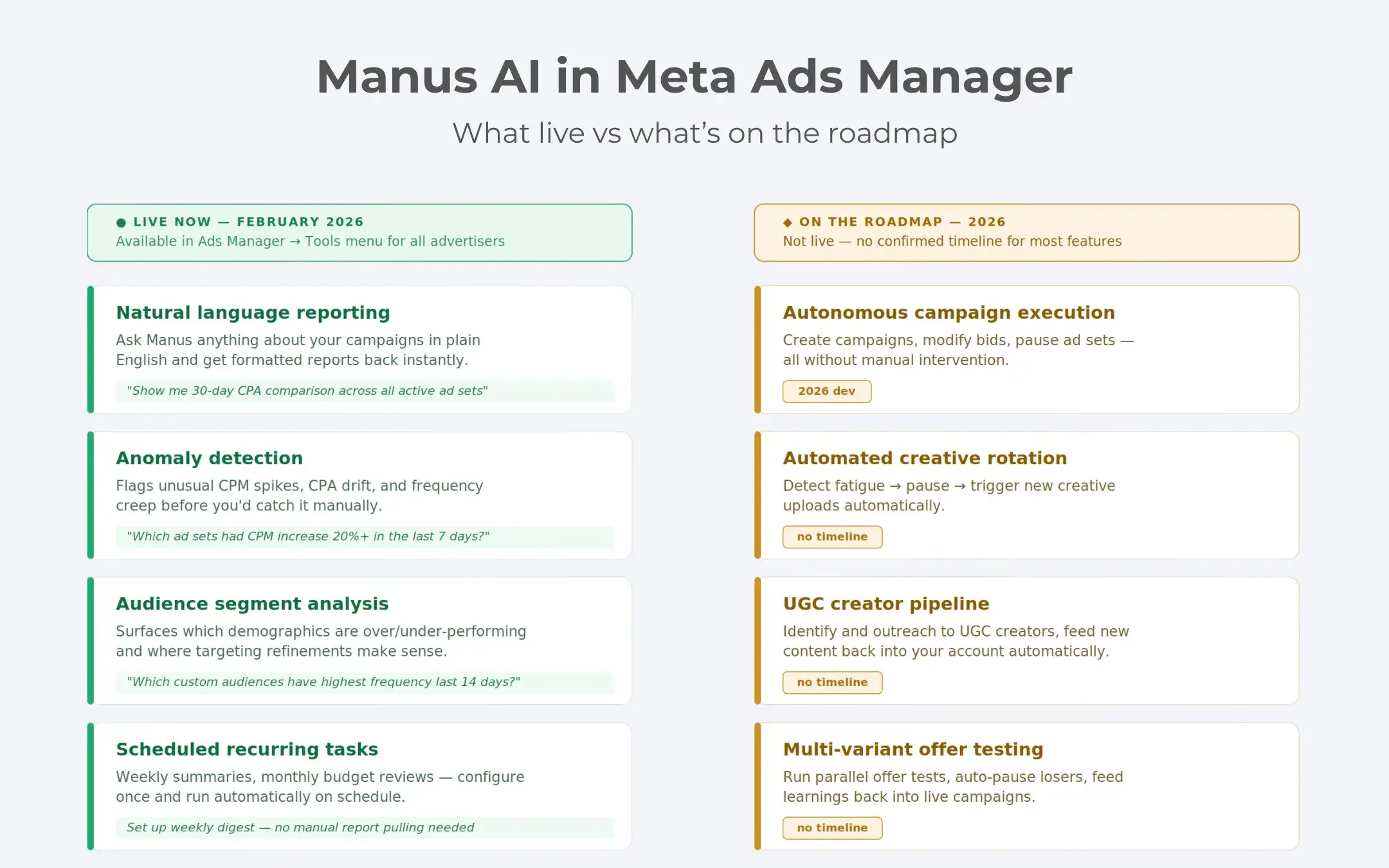
You can also schedule recurring reports. Weekly summary, monthly budget review. Set it up once and it runs on its own. Saves 20-30 minutes every week, without you having to think about it.
What it cannot do: no bid changes, no pausing ads, no moving budget, no creating anything. Jon Loomer clicked the Manus button in February, got redirected to Manus.im which is a completely separate paid product. The Ads Manager version is read-only. It tells you things. It doesn’t do things.
The creator outreach thing that keeps showing up in people’s posts, AI that finds UGC creators, pitches them, tracks responses, then feeds new creatives back in at the right moment, that’s where the product is pointed eventually. It isn’t a feature you can use. Meta hasn’t said when it will be. If you’ve already told clients about it, worth flagging that distinction.
Creative Fatigue: Where Manus Earns Its Place
Here’s where Manus actually earns its place even in this stripped-down form: every account eventually has a creative that dies slowly and you notice it too late. Usually day five or six of it already being fatigued. Budget already gone. The detection lag exists because of how Meta responds to declining engagement. If you’re not sure when to act on that signal, our guide on when to kill a Meta ad covers the full decision framework.
When engagement drops on an ad, Meta doesn’t just serve it less. It compensates by routing delivery toward cheaper audience segments outside your target to keep spend levels up. That’s what makes CPM go up at the same time CTR goes down. The algorithm is actively working against you at that point. And by the time your CPA is 25% over target, you’ve typically been in that pattern for almost a week.
The signals show up in a predictable order. First, CTR drops against the creative’s own first-week performance, not against any benchmark, against itself. A 20%+ decline from launch week is your warning. You have to track this per creative though. At the campaign level, CTR gets averaged across everything and individual problems get buried.
Second signal is frequency crossing 3 on prospecting. By itself that’s not always fatal. A strong hook can sustain higher exposure. But frequency above 3 combined with a CTR that’s been sliding is basically a confirmed fatigue pattern. Then you’ll see CPM climbing while CTR keeps dropping, which means Meta is actively routing your ads toward cheaper, worse audience segments. Last comes CPA drift. By that point you’re already cleaning up a mess. Rising CPMs are a broader trend worth understanding – here’s why Meta ads are getting more expensive in 2026.
Before Manus AI Ads Manager existed, catching that first signal meant either checking manually every single day or paying for Motion or a similar tool. Now you just ask: “Which creatives have frequency above 3.5 in the last 7 days, show me their CTR trend.” One prompt.
Worth knowing: Meta had a native creative fatigue feature inside Account Insights before Manus existed. It flags overexposed creatives, shows similarity scores. Different system, predates the acquisition. Worth using both.
Tested this on an e-commerce account spending around $1,200 a day. Had a UGC video that was performing well for almost three weeks, CPA sitting comfortably below target. Checked Manus on a Monday morning, asked it to pull frequency and CTR trend for all active creatives over the past 14 days. The video was at frequency 3.8 and CTR had dropped 26% from its launch week numbers. Nothing in the dashboard was screaming about it. CPA hadn’t moved yet. Two days later it had climbed 22% and we were already scrambling for a replacement. The early read from Manus didn’t save us completely but it gave us a 48-hour window we wouldn’t have had otherwise.
Five Prompts to Run in Manus AI Ads Manager This Week
Vague questions get vague answers. Always give it a time window and ask for comparisons, not summaries.
- “Which ad sets had the biggest week-over-week CPA increase in the last 14 days?”
- “Show me all creatives with frequency above 3.5 and their CTR trend for the last 7 days”
- “Which Advantage+ audiences are outperforming my manual targeting setups right now?”
- “Flag campaigns where CPM increased more than 15% in the last 5 days while conversions dropped”
- “What’s my average frequency per prospecting ad set, flag anything above 3.0”
Before you close the tab: set up a recurring Monday morning summary. Top performing ad sets. Top spenders with CPA above target. Creatives with declining CTR. Two minutes to configure. 20-30 minutes saved every week.
Where This Is All Actually Going
On where this is going: Meta has committed $115-135 billion in capital expenditure for 2026. One year. 97% of their revenue is advertising. So the investment has a pretty obvious destination.
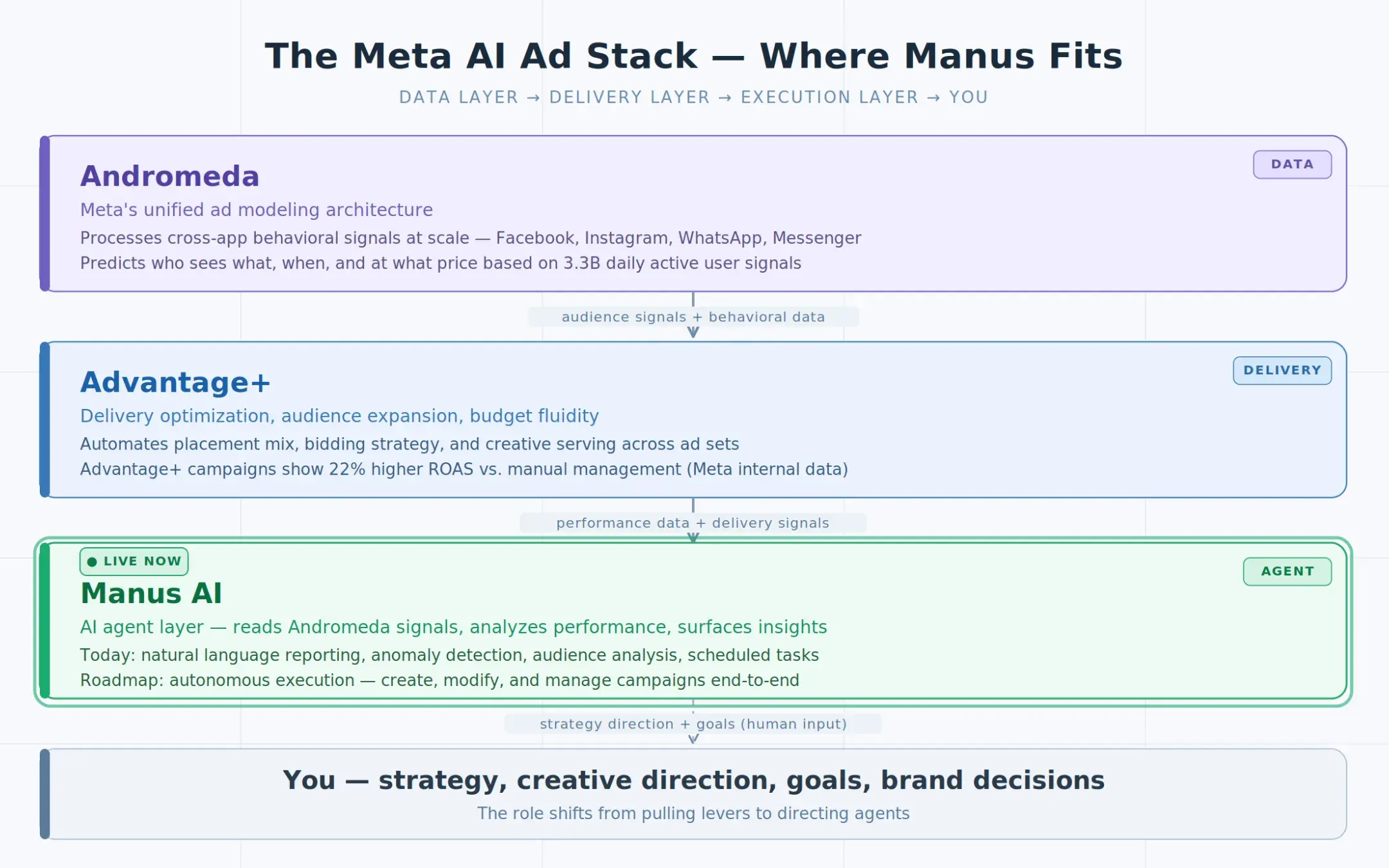
The data layer: Andromeda
Andromeda is Meta’s unified ad modeling system. It pulls behavioral signals from 3.3 billion daily users across Facebook, Instagram, WhatsApp, and Messenger and uses that to predict who should see which ad, when, and at what auction price.
The delivery layer: Advantage+
Advantage+ sits above that handling delivery optimization: placement mix, audience expansion, bidding. It’s the system that already automates a large chunk of how your ads actually get served.
The execution layer: Manus AI Ads Manager
Manus is being built as the execution agent on top of both — reads what the lower layers surface, and eventually acts on it. Right now it can only report what it sees. Closing that loop is what the roadmap is clearly building toward. If you want to understand how the algorithm thinks about creative right now, this breakdown of how creative wins in 2026 Meta ads is worth reading alongside this one.
Once execution features land, the day-to-day operational work of running Meta ads gets automated. Reporting, bid management, creative rotation, anomaly response — that becomes the agent’s job. What stays human is everything that requires actual context. Your real margin. The sale starting next week. The brand constraint that makes a creative angle off-limits even when every metric says run it. That piece doesn’t automate. Everything else probably does.
If you haven’t opened it yet, go check the Tools menu in Ads Manager. It’s worth two minutes of your time.
Running Meta ads and want to make sure your tracking, account structure, and creative setup are built for where things are heading? Explore Coinis AdForce. Built by practitioners, for practitioners running real budgets.


Isidora Matovic
Author
Social media enthusiast and a full time researcher. She takes digital presence very seriously and that is why you are always in touch in what is going on with us! Follow us for more posts like this.