

Open any ad set and scroll down to Placements. Count what you are allowed to uncheck there. A placement, a platform, a device, an operating system. Four levers, all four on their way out, and nobody has been given a date.
The panic reading is that Meta is switching off control. Not quite. Control moved, it did not disappear, and a good share of what people are about to lose they were using wrong anyway. That second part is the uncomfortable one, and it is the part worth an afternoon.
What the notice actually says
Jon Loomer caught it on August 20, a message showing up inside the Placements section of ad sets for some advertisers: "Excluding placements, platforms, devices and operating systems will no longer be available for your ad sets." One sentence, four separate controls. No rollout date, no staged timeline, no note on which accounts see it first. So this is a notice, not a change you can go verify in your account this morning.
Read it slowly, because most of the reaction only picked up the first word. Individual placements go, which is the one everybody uses. Whole platforms go with them, so no more building an Instagram-only ad set by switching Facebook off. Device targeting goes, meaning mobile-only and desktop-only stop being a setting. Operating system goes too, so no more iOS-only or Android-only delivery from the ad set level.
One dated thing is worth separating from the rest, because it is real and it is this week. Messenger Stories is being retired as a placement on August 27 through v26.0 of the Marketing API. That one is API-only, Ads Manager is unaffected, and if Messenger Stories was in your eligible pool the delivery simply redistributes. Different change, different mechanism, easy to confuse with the big one.
Value rules are the replacement, and they are narrower
What you get instead is bid pressure. Value rules let you bid more or less by placement, by device, and by mobile operating system. There is no value rule for platform, though you can lean on Facebook-specific or Instagram-specific placements to get roughly there. Useful, and clearly the direction of travel.
The catch is the size of the list. Only seven placements are eligible for bid adjustment right now, Audience Network among them, which is at least the one most people were trying to escape. Everything outside those seven has no lever at all once the checkboxes go. The gap between "never serve here" and "bid less here" is not a philosophical one either. Bid less and the impressions still happen, just fewer of them, and the budget still leaks in that direction.
The account-level switch people forget
There is a second door, and it stays open. Advertising Settings, then Account Controls, then Placement Controls. Turn on the option that says your business advertises only on specific placements, then uncheck what you want gone. That removes placements across the whole account.
Blunt, though. It is a policy, not a tactic. Fine for a brand safety rule that should never have been living in an ad set in the first place, wrong for a single test where you wanted one campaign to behave differently for three weeks. Most people will discover they have been using an ad set setting to express an account-level decision, and the fix is to move it up a level rather than mourn it.
When excluding a placement was ever the right call
Loomer's harder point is the one worth sitting with: the vast majority of advertisers removing placements are doing it when it is not necessary. Ritual, not diagnosis. Somebody unchecked Audience Network in 2021, the template got copied, and it has been in every ad set since without anyone rechecking if it still earns its place.
The cases where it genuinely earns its place are narrow and specific. Optimize for link clicks or landing page views and Audience Network will find you an enormous pile of cheap, low-quality clicks. Optimize for ThruPlay and the problem is Audience Network Rewarded Video, where third-party apps pay users in virtual currency to sit through your video. Both are real. Both are also, as Loomer notes, a decent argument that the performance goal is the actual problem.
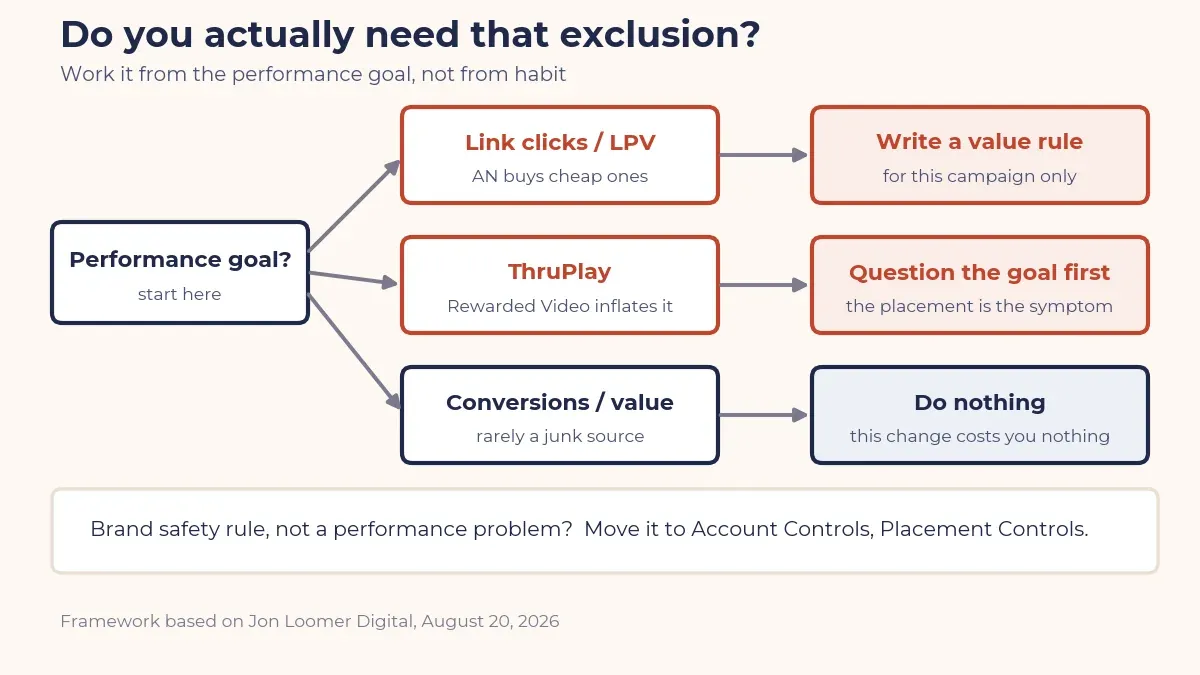
Take a traffic campaign at $80 a day optimizing for link clicks. Strip out the placement that was buying the cheapest clicks and your blended CPC goes up, your click count drops, and the campaign looks worse on every number your dashboard shows. Nothing about the business changed. You just stopped paying for clicks that were never going anywhere. If that trade makes the campaign look broken, the campaign was already measuring the wrong thing, and no checkbox was ever going to fix that.
Optimizing for conversions or conversion value is a different situation entirely. Placements are rarely a source of cheap junk conversions there, so the honest answer for most conversion campaigns is that this change costs you nothing, and the value rule you were about to write is one you do not need. It is the same lesson as the slow death of manual targeting, arriving one settings panel later.
The trail Meta left, in plain sight
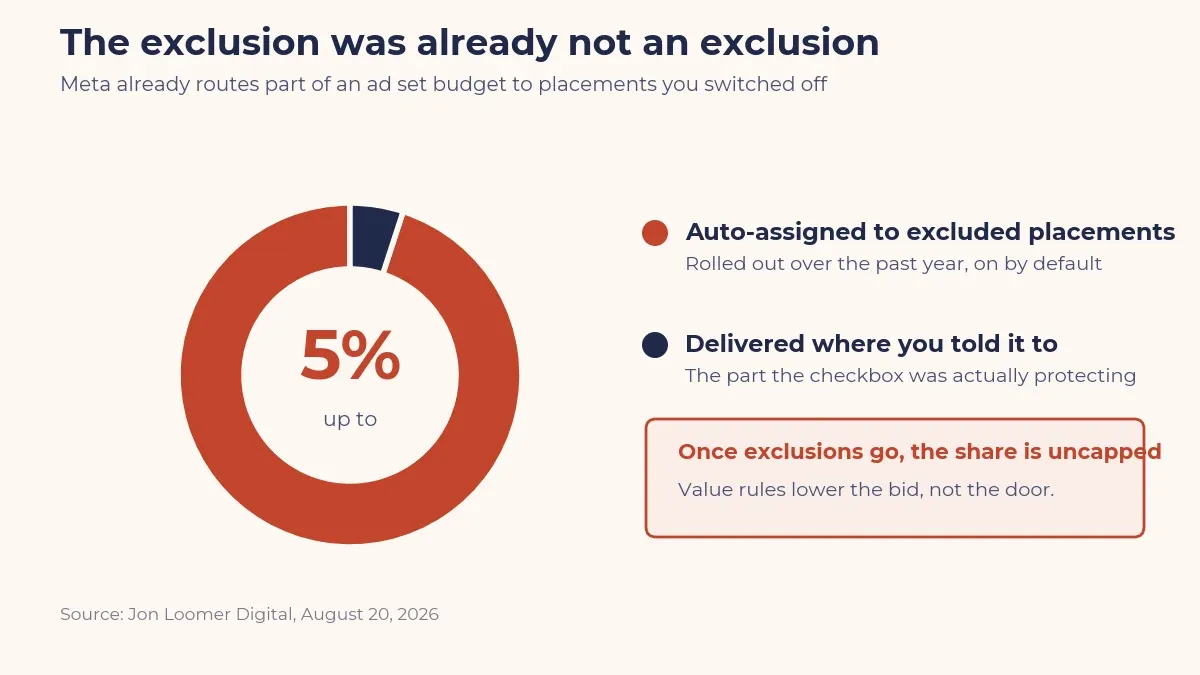
Anyone surprised by this has not been reading the room for three years. First the branding, with all-placements repackaged as Advantage+ Placements and quietly made the default everyone had to argue with. Then warnings appeared when you removed one. Then the controls kept getting buried a little deeper with each interface refresh. Then, over the past year, up to 5% of your budget started being assigned to placements you had explicitly excluded. Read that one again. The exclusion was already not really an exclusion.
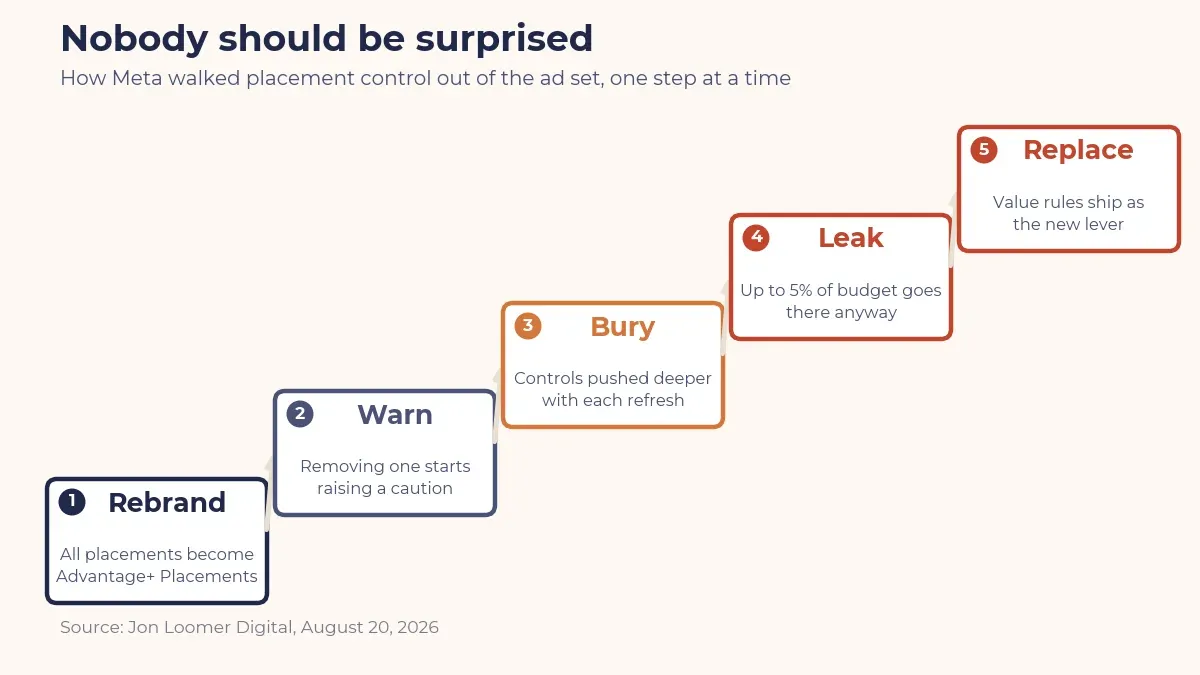
And then value rules launched, which was the actual tell. Meta has been building the replacement in public the whole time, the same way it quietly widened audiences before anyone announced it. Mark Zuckerberg described the destination to Ben Thompson last year without much decoration: you come with an objective, "you connect to your bank account, you don't need any creative," and the system handles the rest. Placement checkboxes are not compatible with that sentence. Neither, eventually, is most of the ad set.
What to do this week
Pull the placement breakdown for every campaign that currently excludes something, and check the results against the reason the exclusion exists. Most of the time no reason will be findable, which is your answer. Where the exclusion is doing real work, write the value rule now while you can still compare the two side by side, and write it for that campaign only rather than rolling it across the account out of habit. Where it was always a brand safety line, move it to Account Controls where it belonged. Where the campaign optimizes for conversions, close the tab.
Across Coinis accounts the exclusion that turns up most is Audience Network, sitting in campaigns whose goal was never suited to it. That is not a placement problem. Once the checkbox is gone, the campaigns that were hiding behind it will start telling the truth about themselves, which is inconvenient this quarter and useful after that.
Go look at your placement breakdown before the option disappears, ten minutes, and you will know which exclusions were decisions. If keeping up with each platform quietly rewriting its own rules is eating your week, Try Coinis AI. Built by practitioners, for practitioners.