

A campaign's media buyer sets up a new ad in Meta Ads Manager, drops in the creative, and hits publish. Nothing happens. The account needs authorization first: identity verification, a location check, a "Paid for by" disclaimer tied to a real committee, and until all three clear, the ad sits in limbo while the news cycle it was built for moves on. Multiply that delay across every new creative test a campaign wants to run between now and election day, and the authorization step alone can eat the window a fast-moving race needs.
Then there's the creative itself. Coinis's own political-industry page names the second problem directly: "stock campaign photos look identical district to district." A generic photo of a smiling candidate shaking hands, or a stock image of a voter at a polling place, reads the same whether the race is in a coastal suburb or a rural county three states over. Voters scroll past it because nothing in the frame signals this campaign, this district, this issue.
Both problems have the same root cause: campaigns treat creative production and platform compliance as two separate headaches, so they either slow down to do both carefully or speed up by skipping the parts that are easy to skip. There's a faster path that doesn't skip the compliance step, built around generating creative that's both compliant by default and specific enough to a district or issue that it doesn't blur into every other race's ad.
What Meta actually requires before an ad about politics runs
Meta's own Transparency Center spells out the authorization process for any advertiser running ads about social issues, elections, or politics in a designated country: get authorized, then attach a verified "Paid for by" disclaimer identifying the entity or person responsible for the ad (Meta, "Ads about Social Issues, Elections or Politics," Transparency Center, accessed 2026-10-30). The rule applies regardless of whether the advertiser is a candidate committee, a PAC, or an issue-advocacy group, and Meta is explicit that these ads are not allowed to run in the European Union at all, except for voting-logistics ads placed by official election authorities.
Ahead of the 2026 US midterms, Meta set a hard deadline: campaigns needed to complete authorization and set up an approved disclaimer by October 13, 2026, because any ad that hadn't already delivered an impression before a restriction period starting October 27 would not be allowed to launch fresh during the final week before voting (Meta for Government and Nonprofits, "Restriction period for ads about social issues, elections or politics before the US 2026 Midterm Election," facebook.com, 2026). Miss that window, and a campaign loses its last chance to test anything new before voters decide.
The federal baseline sits underneath all of this independent of Meta's own rules. The Federal Election Campaign Act requires a disclaimer on any public communication by a political committee stating who paid for it, whether or not the ad was created with AI (FEC, "Advertising and disclaimers," fec.gov, accessed 2026-10-30). Meta's authorization process doesn't replace that legal requirement, it adds a platform-specific layer on top of it.
Then there's the newest layer, specific to AI-generated creative. As of June 1, 2026, Meta requires advertisers to disclose when a social-issue, election, or political ad contains a photorealistic image or video, or realistic-sounding audio, that was created or edited with third-party generative AI tools, using the platform's built-in disclosure control when the file itself doesn't already carry that signal (Meta, "Ads about Social Issues, Elections or Politics," Transparency Center, accessed 2026-10-30). An ad that fails to disclose gets rejected in review, and Meta states repeated failures can bring penalties against the advertiser.
That disclosure gap is already showing up at scale. The Wesleyan Media Project, a nonpartisan academic research group that has tracked political television advertising for sixteen years, reported in September 2026 that at least $80 million had been spent on AI-assisted political ads this cycle, and that 69 percent of those ads, representing 78 percent of the spending, ran without a disclaimer disclosing AI use (Wesleyan Media Project, "At Least $80 Million Spent on AI Ads This Cycle," mediaproject.wesleyan.edu, September 4, 2026). By mid-October, independent reporting put total AI-ad spending for the cycle above $137 million (The New York Times, "$137 Million in A.I.-Generated Ads Flood the Midterms," October 16, 2026). None of that changes what the rule requires. It does mean a campaign that disclosed properly from the start is running less compliance risk than most of the field.
Why the creative problem and the compliance problem are the same bottleneck
A campaign that treats authorization as a one-time setup step and creative production as a separate, ongoing scramble ends up testing less. Every new concept means another round of photography or stock-image sourcing, another review pass to make sure the new creative still carries the right disclaimer and disclosure, and another wait for Meta's ad review. The campaigns that test the most win the most, because ad testing is how a campaign finds out which message actually moves a specific audience before spending real money scaling it.
The fix isn't skipping compliance to move faster. It's generating creative that's built compliant and built specific to a district or issue from the first draft, so the production side stops being the bottleneck. generate_ugc_video's candidate-direct and volunteer-testimonial presets, already demonstrated on this blog for product and service testimonials, apply the same way to a campaign's own messaging: a candidate-style talking-head clip or a volunteer-style street interview, built from a script and a reference photo instead of a camera crew and a shoot day, with the disclosure baked into the output from the start rather than added as an afterthought before publishing.
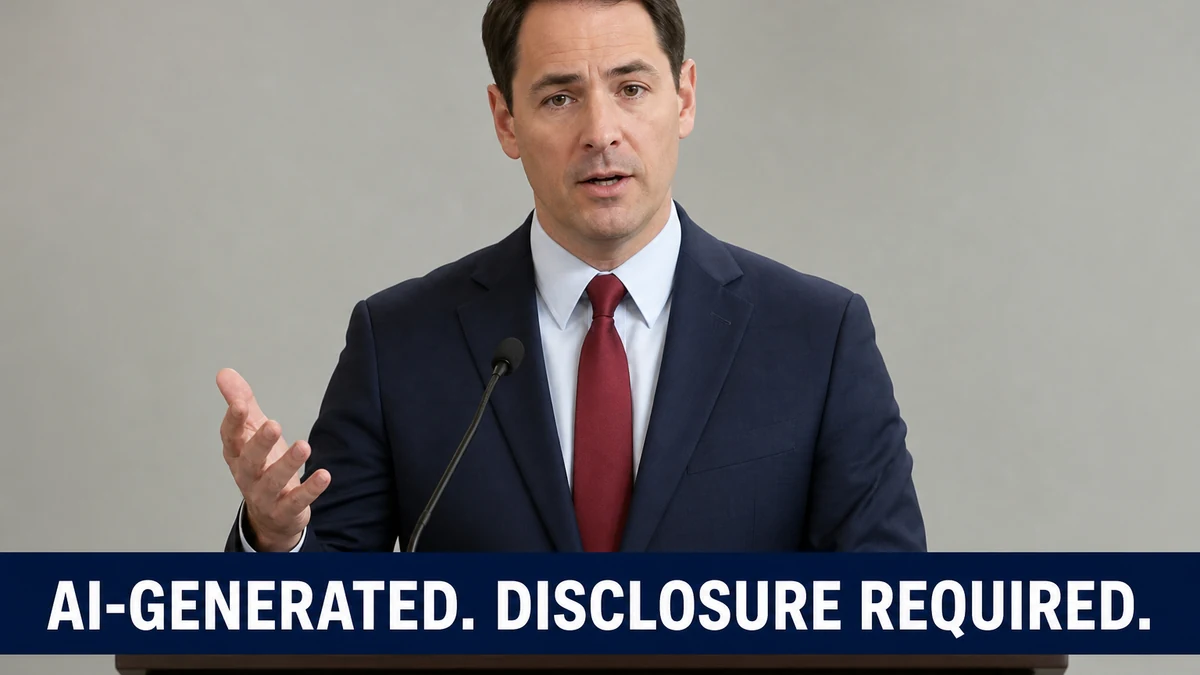
mcp.coinis.dev is in a confirmed security-hold outage as of this writing (a recurring tampered-issuer credential incident), so the real generate_ugc_video candidate-direct render could not be fired for this image. The still above is an illustrative generic, fictional, unbranded speaker at a podium with a persistent disclosure caption, standing in until the real render ships. See generate_ugc_video's actual output on the street-interview ads article for the tool working today.
Building district-specific creative instead of one generic ad
The second half of the fix is variety without a reshoot. generate_image_templates's multi-format fan-out, already demonstrated for turning one product photo into every ad size a campaign needs, works the same way for an issue-carousel format: one base concept (a local issue, a specific policy point, a volunteer story) generated once, then fanned out into the square, Story, and feed-video sizes a Meta or Google campaign actually runs, each carrying district-relevant framing instead of the same generic handshake photo reused across every race on the ballot.
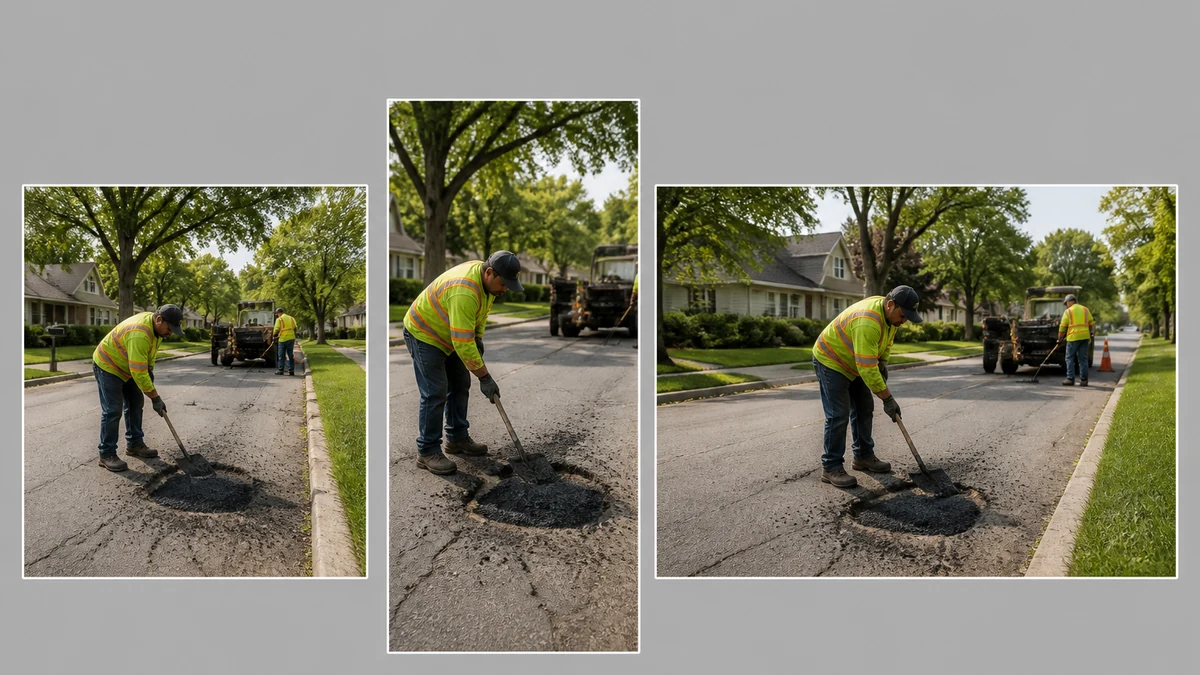
The same outage applies here: this fan-out mockup is an illustrative generic street scene standing in for a real generate_image_templates render. See generate_image_templates' actual multi-format output on the one-photo-every-ad-size article for the tool working today.
This doesn't replace the authorization process or the disclaimer requirement. A campaign still has to complete Meta's authorization, still has to attach a verified "Paid for by" disclaimer naming the real committee, and still has to disclose AI-generated media where the platform's own rules require it. What generating creative this way changes is how much of a campaign's limited pre-election window gets spent waiting on production instead of testing messages.
What this format can't honestly claim
Generating compliant-by-default creative does not mean a campaign can skip Meta's authorization process, skip the disclaimer, or skip legal review. Coinis does not verify a campaign's identity, does not file or guarantee a "Paid for by" disclaimer on a campaign's behalf, and does not confirm an ad's legal compliance in any jurisdiction. Those steps stay the advertiser's responsibility, same as they would be with creative built any other way. Authorization and disclosure rules also vary by country, and Meta does not allow social-issue, election, or political ads in the European Union at all outside the narrow voting-information exception for official election authorities. A campaign running internationally needs to check the specific rules for each country it targets before assuming the same workflow applies everywhere.
The disclosure label matters for a second reason beyond the platform rule. An ad that presents a synthetic spokesperson as a real, specific individual, or that fabricates a quote and attributes it to a real candidate or opponent, crosses from disclosed AI creative into deceptive content regardless of what label is attached. Every example built this way should stay fictional and neutral: a generic "Candidate A," an unbranded local issue, no real party or race referenced, with the disclosure visible for the full runtime of the ad, not hidden in fine print.
This isn't the first regulated, compliance-heavy category Coinis has built this pattern for. Compliant testimonial creative for medical clinics and before/after ad formats both show the same shape: a generation workflow that bakes in the disclosure or disclaimer language the regulator or platform requires, instead of treating compliance as a separate step bolted on after the creative is already done. A campaign that wants to try this on its own messaging can start with a Coinis Ad Studio template rather than building the prompt sequence from scratch.
FAQ
Does generating creative this way replace Meta's political ad authorization process? No. Authorization, identity verification, and the verified "Paid for by" disclaimer are still required before any ad about social issues, elections, or politics can run, regardless of how the creative itself was produced.
Do I still need to disclose that an ad was AI-generated? Yes, whenever the ad contains a photorealistic image or video, or realistic-sounding audio, created or edited with generative AI, per Meta's policy effective June 1, 2026. Build the disclosure into the creative itself as a persistent, legible label rather than relying only on Meta's platform-level disclosure control.
Can this run on Google or TikTok the same way? Each platform sets its own political-advertiser rules and its own AI-disclosure requirements, and they differ in scope and enforcement. Confirm the specific requirements for each platform before assuming a Meta-compliant disclosure automatically satisfies a different platform's policy.
What happens if a campaign misses the pre-election authorization deadline? During a restriction period like the one Meta set for October 27 through November 3, 2026, no new ad about social issues, elections, or politics can start running in the US, including freshly authorized ones, unless it already delivered an impression before the window opened. Authorization has to happen well ahead of the final stretch, not during it.
Is there any situation where this format shouldn't be used at all? Any ad that would present a synthetic person as a real, named individual, fabricate a quote or endorsement, or encourage voter suppression or election-legitimacy doubt is out of bounds regardless of disclosure, and several platforms and jurisdictions restrict or ban that kind of content outright. Keep every generated example fictional, neutral, and clearly labeled.
Sources
- Meta, "Ads about Social Issues, Elections or Politics." Transparency Center, accessed October 2026. https://transparency.meta.com/policies/ad-standards/SIEP-advertising/SIEP/
- Meta for Government and Nonprofits, "Restriction period for ads about social issues, elections or politics before the US 2026 Midterm Election." facebook.com, 2026. https://www.facebook.com/government-nonprofits/blog/2026-restriction-period-for-ads
- Federal Election Commission, "Advertising and disclaimers." fec.gov, accessed October 2026. https://www.fec.gov/help-candidates-and-committees/advertising-and-disclaimers/
- Wesleyan Media Project, "At Least $80 Million Spent on AI Ads This Cycle." mediaproject.wesleyan.edu, September 4, 2026. https://mediaproject.wesleyan.edu/releases-090426/
- The New York Times, "$137 Million in A.I.-Generated Ads Flood the Midterms." October 16, 2026. https://www.nytimes.com/2026/10/16/us/politics/midterm-elections-ai-generated-ads.html

Isidora Matovic
Author
Social media enthusiast and a full time researcher. She takes digital presence very seriously and that is why you are always in touch in what is going on with us! Follow us for more posts like this.