

Most product ads sell a feature list. This preset sells a feeling: the specific, almost-physical satisfaction of watching a zipper glide, a lid click shut, or fabric catch the light at close range. It's the same sensory trigger behind the ASMR video trend, applied to a single still image instead of a whispering unboxing video.
Ad Studio's generate_image_preset_agent ships an asmr-macro preset built for exactly this: an extreme close-up of a product's own texture, rendered so close the viewer can almost feel it.
Why texture close-ups actually move people
ASMR, short for Autonomous Sensory Meridian Response, started as a YouTube phenomenon: whispering, tapping, slow deliberate movements that trigger a pleasurable tingling sensation in some viewers. Brands noticed. A 2022 study in the Journal of Advertising Research ran four experiments testing ASMR against normal audio in real advertisements and found ASMR consistently improved recall, mediated by how intensely viewers experienced the "tingle" response, how immersed they felt, and how transported they were into the ad's narrative.
That study was about sound. The asmr-macro preset works on the visual half of the same phenomenon, and the visual research tells a more specific story than "close-ups always work better." A 2026 study presented at the DRS biennial design research conference tested how ASMR sound interacts with visual richness across three experiments with 630 participants, and found an inverted U-shaped relationship: at low visual richness, sensory cues from sound add engagement. At high visual richness, close-up, the already-rich visual information combined with added sensory stimulus can overload rather than help. The practical read for a still image with no audio at all: a macro shot works because it concentrates visual richness into one satisfying texture, not because "closer is always better."
What the asmr-macro preset actually does
generate_image_preset_agent's asmr-macro preset takes a product photo and renders an extreme close-up of the product's own surface texture, tight enough that the material itself becomes the subject: the weave of a fabric, the condensation beading on a bottle, the precise click-fit of a hinge, the way a glaze catches light on ceramic. No needs field restricts it and no extra reference asset is required, the same minimal-input shape as the comparison-vs and teaser presets elsewhere in this enum.
This only works on products with something worth looking at up close. A flat matte plastic surface photographed at macro distance is just a close-up of nothing. The preset depends on the advertiser picking, or at least photographing, a product whose material actually has visual interest: grain, sheen, texture, a satisfying mechanical detail. That selection step happens before the prompt is written, not inside the tool.

It sits next to its siblings in this family without repeating any of them. The knolling preset shows an entire set arranged at a wide, orderly distance. The hand-holding preset adds a human grip for scale and context. The packshot preset isolates the whole product on compliant white. The teaser preset conceals most of the product in shadow to build curiosity. The asmr-macro preset does the opposite of all four: it gets so close that scale and context disappear entirely, and texture alone carries the ad.
Worked example: building a texture-first ad
Start with a product photo of something with genuinely satisfying surface detail, something a macro lens would actually reward: textile weave, a metal hinge, a glaze, a liquid. The brief for the preset:
Preset: asmr-macro
Product: [product photo URL or productId]
Texture focus: [the exact physical detail to render in close-up, written literally, e.g. "the ribbed knit texture of the wool and the way light catches individual fibers"]
Style direction: extreme macro distance, shallow depth of field, the material itself as the subject, product still identifiable enough to connect to the brand, no invented surface detail not present on the real product
Avoid: garbled on-image text, an abstract crop so tight the product becomes unrecognizable, any fabricated texture or material the product doesn't actually have
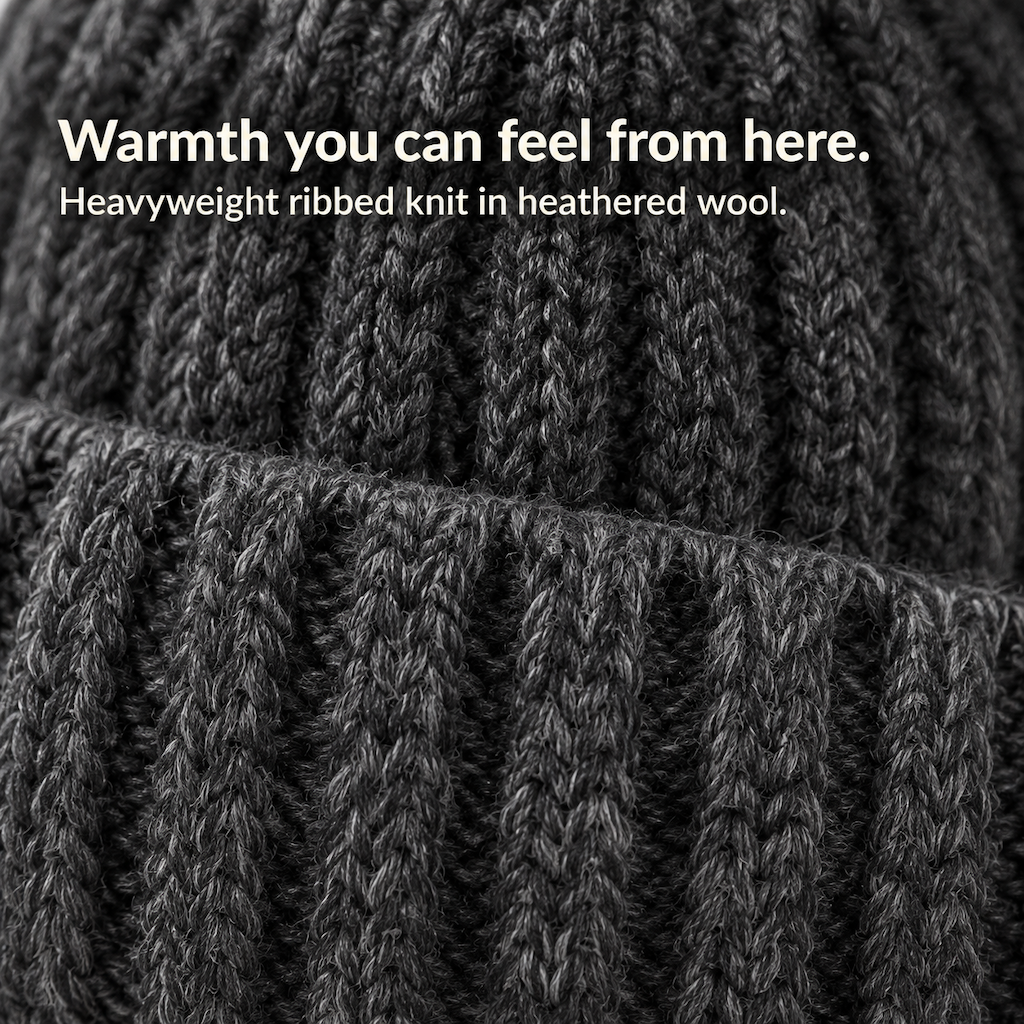
This is a real generate_image_preset_agent render, preset asmr-macro, fired against a demo product photo with the exact prompt above. The output composed a true macro-distance texture shot of the named surface detail, confirmed on inspection before publishing.
The one rule that makes or breaks this format
The product has to stay identifiable. It's easy to crop so tight that the image becomes abstract texture with no visible connection to the brand or the product category at all, which defeats the point: a beautiful macro shot that nobody can place is just stock wallpaper, not an ad. Brief the preset for texture that still reads as belonging to a recognizable object, a zipper pull still looks like a zipper pull, a fabric weave still looks like it's on a garment, even at extreme close range.
The second rule follows the same substantiation discipline every preset in this family runs into: don't invent a texture the product doesn't have. If the material is matte and flat, the preset can't manufacture a satisfying sheen that isn't real, and asking it to try risks a render that looks wrong to anyone who's actually handled the product.
FAQ
Does this preset need sound to work, since ASMR is usually about audio? No. This is a still image, not a video with audio. The visual research behind this preset, the DRS 2026 study on visual richness and sensory engagement, is specifically about what a close-up image alone contributes, separate from any whispering or tapping sound. The name borrows the ASMR concept for the visual trigger it shares: tight, satisfying sensory detail.
What products does this preset work best for? Anything with real surface interest at close range: textiles, ceramics, liquids, metal with a satisfying finish, mechanisms with a clean click or glide. Flat, matte, texture-free products are a poor fit, there's nothing for the macro lens to reward.
How is this different from the packshot preset? Packshot isolates the whole product on a plain white background at normal viewing distance, built for marketplace compliance. Asmr-macro abandons the whole-product view entirely and gets close enough that only a fragment of surface texture fills the frame. They serve opposite goals: one proves the product looks clean and complete, the other makes a tiny physical detail feel worth lingering on.
Can I use this for every product in my catalog? No, and that's the point. This preset is a specialty tool for products where texture genuinely sells, not a default. Running it on a product with nothing visually interesting up close will produce a technically fine but pointless image.
Should I pair this with a wider shot in the same ad set? Often, yes. A macro texture shot rarely carries the whole story of what the product does. Pair it with a packshot or lifestyle preset in the same creative set so the texture close-up builds desire while a wider shot confirms what the product actually is.
Try it on Coinis
Pick the one physical detail your product earns a close look, a weave, a glaze, a satisfying mechanical click, and let the asmr-macro preset build an ad around the texture instead of another feature bullet.
Start building ad creative on Coinis
Sources
- Sands, Sean, Colin Campbell, Alexis Mavrommatis, and Veronika Kadomskaia, "Can a Whisper Boost Recall Of Video Advertisements? Exploring the Effects of Autonomous Sensory Meridian Response (ASMR) in Advertising," Journal of Advertising Research 62, no. 4 (2022), DOI 10.2501/JAR-2022-016: https://www.researchgate.net/publication/362406659_Can_a_Whisper_Boost_Recall_Of_Video_Advertisements_Exploring_the_Effects_of_Autonomous_Sensory_Meridian_Response_ASMR_in_Advertising
- Chen, Huan, and Peiyao Cheng, "When can ASMR sound improve consumer product evaluation? Exploring the joint influences of ASMR sound and visual richness," DRS2026: Edinburgh, Design Research Society Biennial Conference, DOI 10.21606/drs.2026.6261: https://dl.designresearchsociety.org/cgi/viewcontent.cgi?article=3868&context=drs-conference-papers

Isidora Matovic
Author
Social media enthusiast and a full time researcher. She takes digital presence very seriously and that is why you are always in touch in what is going on with us! Follow us for more posts like this.