

A church books a room for a fundraiser, a concert night, or a wedding, and someone takes a photo to promote it. The photo comes back with a patch of blue light lying across one side of a face, a strip of red on the carpet that was never there in person, and a pew that reads gold on one end and violet on the other. Nothing is broken about the camera. The room did that.
Why a sanctuary does this and a conference room doesn't
Most colored-light problems in advertising photography come from an artificial source: a stage light, a neon sign, a phone screen. Stained glass causes a different kind of contamination, because it isn't emitting color, it's filtering it.
A pane of stained glass works as a spectral bandpass filter. Sunlight passing through the colored sections is not tinted the way a colored gel tints a stage light. Specific wavelengths are absorbed and others pass through, so the light that lands on the floor, the pews, or a person standing nearby carries only the narrow color the glass let through. Because the sun moves and the glass sections are different colors at different heights and widths, the resulting light patches are uneven, directional, and impossible to predict from one hour to the next. A photo shot at 10 a.m. can look completely different from the same spot shot at 2 p.m., without anyone touching a light switch.
This is a documented property of stained glass, not a camera fault. Corning's own glass-science education materials describe stained glass color as the product of selective light absorption and transmission through metal-oxide compounds fused into the glass, meaning the glass is built specifically to pass some wavelengths and block others (Corning Museum of Glass, "How Is Color Produced in Glass?," cmog.org). A camera sensor faithfully records whatever wavelength mix actually reaches it, so it records the patch exactly as filtered, blue face and all.
Why this matters for a category that runs on visual trust
Religious organizations and community institutions are not a small advertising category. Nonprofit organizations, including religious institutions, reported an estimated 557.16 billion dollars in total giving in the United States in 2023, with religious giving remaining one of the largest single categories of charitable contribution tracked nationally (Giving USA Foundation, "Giving USA 2024: The Annual Report on Philanthropy," givingusa.org). A meaningful share of that giving is influenced by how an event, a building fund, or a community program is presented to the people being asked to attend or contribute.
A promotional photo with a stray blue patch across someone's face does not read as a lighting quirk to a viewer scrolling past it. It reads as an unpolished, low-effort image, at exactly the moment a congregation or organization is asking people to show up or give. The fix is not about how anyone looks. It is about making the photo represent the room the way it actually looks to someone standing in it.
What generic advice gets wrong here
Standard small-business photo advice says to avoid backlighting and to shoot during golden hour for warm, even light. Neither rule accounts for stained glass, because the light isn't coming from a window a photographer can angle away from, it is coming through dozens of small colored panels spread across an entire wall, each transmitting its own wavelength independent of camera position or time of day chosen. Moving the shot ten feet does not remove the effect. It just relocates which patch of color lands where.
The correction that actually works targets only the contaminated patch, not the whole frame. This is a masked repair, not a full-frame color-cast reset like a landscaping photo needs. The colored light is a localized, spatially uneven artifact sitting on top of an otherwise normal photo, not a cast spread evenly across every pixel.
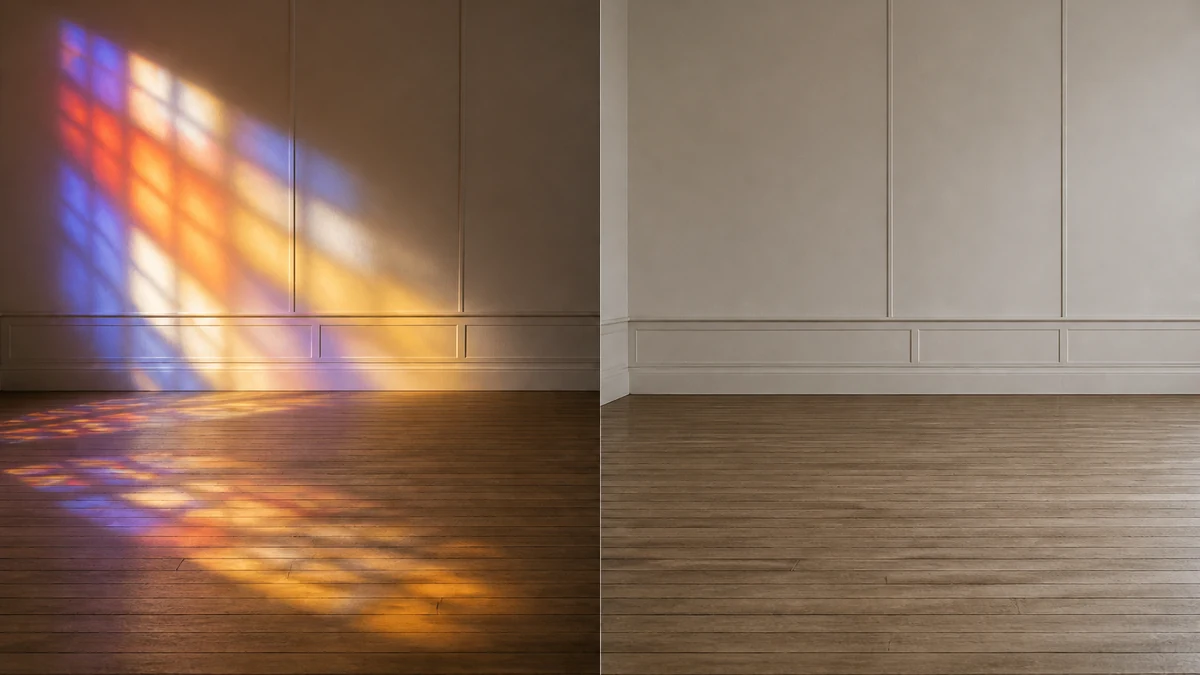
mcp.coinis.dev (the connection that runs enhance_asset_proxy) was offline when this article was produced. The image above is an illustrative still generated directly, not a live enhance_asset_proxy render. See a real enhance_asset_proxy correction in action on a bakery display-case photo.
On Coinis, this runs through Ad Studio's enhance_asset_proxy, the same masked-correction tool that fixes a nightclub's colored stage-light contamination on a product photo. The mask stays tight to the affected patch. Everything outside it, the room, the people, the setup, stays exactly as photographed.
From one corrected photo to a full campaign
Once the color patch is corrected, the same photo needs to become several ad sizes: a square crop for a Facebook or Instagram feed post, a vertical crop for Stories, and a wide crop for a church's own website banner or a local Google Display placement announcing a service time, a fundraiser date, or a community event.
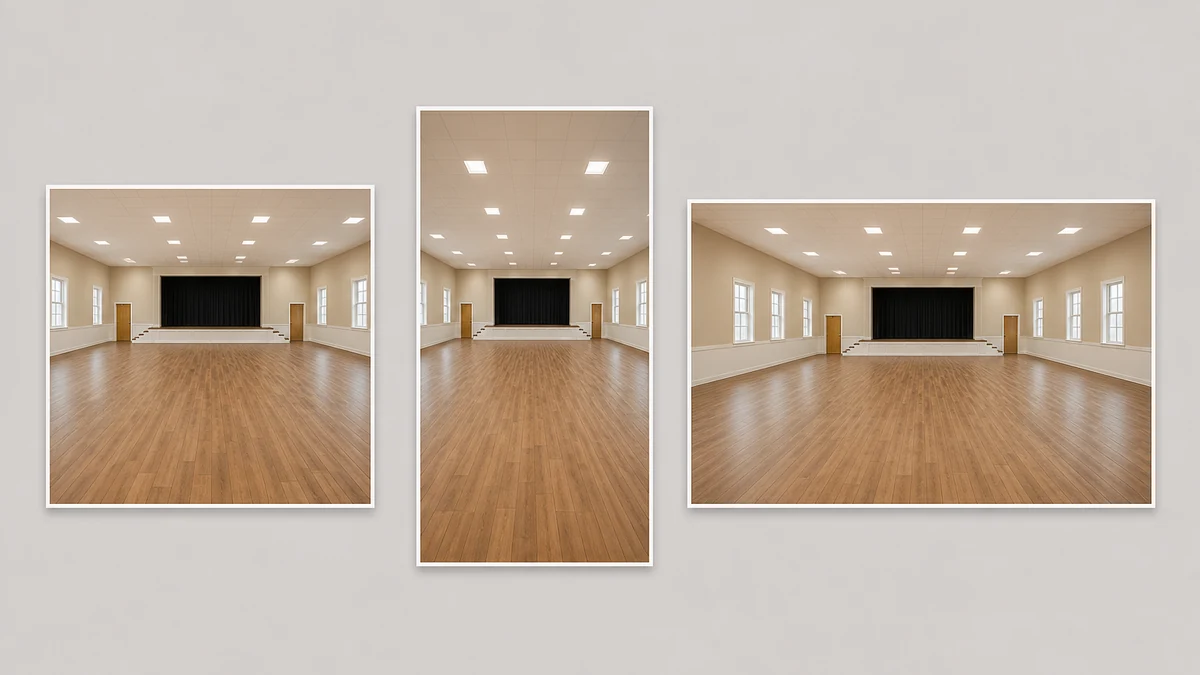
Same outage note applies here: this fan-out mockup is an illustrative still, not a live generate_image_templates render. See a real generate_image_templates fan-out for the actual tool in action.
Coinis's generate_image_templates produces that matched set from the one corrected photo in a single Ad Studio pass, instead of a volunteer or part-time staffer manually cropping and re-color-correcting three separate files by hand, a real bottleneck for organizations that rarely have a dedicated design budget.
What to do with a sanctuary or event-hall photo before it becomes an ad
- Treat any photo with visible stained glass in frame as a color risk, even in a room with otherwise even lighting.
- Mask the correction to the contaminated patch only. A full-frame fix will alter parts of the photo that were never affected.
- Frame every correction as restoring the true color of the space, not adjusting how a person looks. The subject of the fix is the room's lighting, not anyone's appearance.
- Generate every ad size from the corrected photo, and have a person review the full set before it goes into an actual campaign or fundraising appeal.
- Keep the promotional message factual: event details, dates, and what the gift or attendance supports, rather than pressure-based appeals.
FAQ
Why does light through stained glass cause colored patches instead of a normal shadow? Stained glass absorbs some wavelengths of light and transmits others, so the light that passes through carries only the narrow color the glass let through, landing as an uneven colored patch rather than a neutral shadow (Corning Museum of Glass).
Is this the same as a colored-stage-light problem at a concert venue? The visible result looks similar, an unwanted color patch, but the cause is different. A stage light emits colored light directly. Stained glass filters existing sunlight, which is why the effect shifts constantly with the sun's position and can't be dialed out with a lighting setup change.
Does the correction change how a person in the photo looks? No. A masked correction targets the colored light patch itself, restoring the true ambient color of that area. It is not a retouching or appearance-altering step, and any photo involving real people from an organization should still get a human review before it's used.
Can this be fixed without reshooting the event? Yes. Because the defect is a localized patch rather than a whole-frame problem, a masked correction on the affected area resolves it without needing to restage or reshoot.
What ad formats does a church or nonprofit typically need from one photo? At minimum a square crop for social feeds, a vertical crop for Stories, and a landscape crop for a website banner or Display placement, all generated from the same corrected source photo.
Turn today's event photo into this week's outreach
A community program, a building fund appeal, or a concert night doesn't need better weather or a professional reshoot to get a photo that represents the room honestly. It needs the stray color patch corrected once, reviewed by a real person, then generated into every format the outreach needs. On Coinis, that's enhance_asset_proxy for the masked correction and generate_image_templates for the fan-out, run through Ad Studio as one workflow. Start from the last event photo on a phone and turn it into a ready-to-run set with Coinis Ad Studio.
Sources
- Corning Museum of Glass, "How Is Color Produced in Glass?" https://www.cmog.org/article/how-color-produced-glass
- Giving USA Foundation, "Giving USA 2024: The Annual Report on Philanthropy." https://givingusa.org/

Isidora Matovic
Author
Social media enthusiast and a full time researcher. She takes digital presence very seriously and that is why you are always in touch in what is going on with us! Follow us for more posts like this.