
Pour a beer, set up the shot, check the frame, click the shutter. By the time all of that happens, the foam head sitting on top of the glass in frame one is not the foam head you are photographing in frame four. It has already started collapsing. No amount of relighting, white balance correction, or camera setting fixes a problem that happened to the beer itself, not to the camera.
What's actually happening to the pour
Beer foam is not a static prop. It is a structure built from malt proteins, isomerized hop alpha acids, and metal ions, and that structure starts breaking down the moment it forms. Brewing-science writer John Palmer describes the process in Brew Your Own: a freshly poured foam is "wet," carrying a high proportion of beer inside the bubble film, and as that liquid drains out, the bubbles dry, coalesce, and collapse. Fats and oils, lipids in brewing terms, are the primary foam destabilizers, and they work fast. The same forces that make a well-brewed beer hold a stable head for minutes instead of seconds are also the reason that head is visibly thinner by the time a photographer has adjusted a reflector or waited on a second take.
Food and beverage photographers have run into this for years without needing the chemistry to know the practical consequence. The Slanted Lens's own food-styling guide puts it plainly: "within minutes after being poured, a beer can lose its head of foam." Their on-set fix is a pinch of salt stirred in to rebuild a working head for a few more shots, a trick that works on an actual physical pour but does nothing for a photo that has already been taken.
That is the gap this defect class sits in. Every other optical problem in this series, total internal reflection inside a wine bottle, glare off a soda can, a mirror-polished ring, happens to light bouncing around a fixed physical object. A beer's foam head is not fixed. It is decaying in real time between the pour and the shutter click, and a retail or taproom photo taken even a minute or two late captures a pour that already looks tired, flat, and half-finished, regardless of how good the lighting and composition are.
Why relighting and reshoots don't solve it
A photographer can control light, angle, and background. None of that reaches into the glass and rebuilds bubble structure that has already coalesced. The only real-world fixes are time-sensitive: shoot within the first minute or so of the pour, keep a backup glass ready to swap in in case the first one goes flat mid-shoot, or use a foam-reviving trick like a pinch of salt between takes. All of that assumes a controlled studio pour. It falls apart for a brewery or bar that needs a usable pour photo from an already-shot event, a taproom opening, a seasonal release night, where nobody was thinking about foam decay at the moment the camera came out.
This is also a volume problem, not just a timing problem. A brewery running weekly specials, a bar promoting a rotating tap list, or a bottle shop photographing a new seasonal release does not have the luxury of a dedicated beverage photographer standing by with a backup pour for every shot. Most of those photos get taken once, on a phone, under whatever light the bar already has, and the foam head is whatever it happened to be at that moment.
Fixing it after the fact
Coinis's photo-repair tool (enhance_asset_proxy, the recraft-inpaint operation) treats a collapsed foam head the same way it treats any other localized defect already demonstrated in this series, jewelry's blown-out specular hotspot or the wine bottle's internal dark band, with the mask shaped to hug the foam region specifically rather than the whole glass.
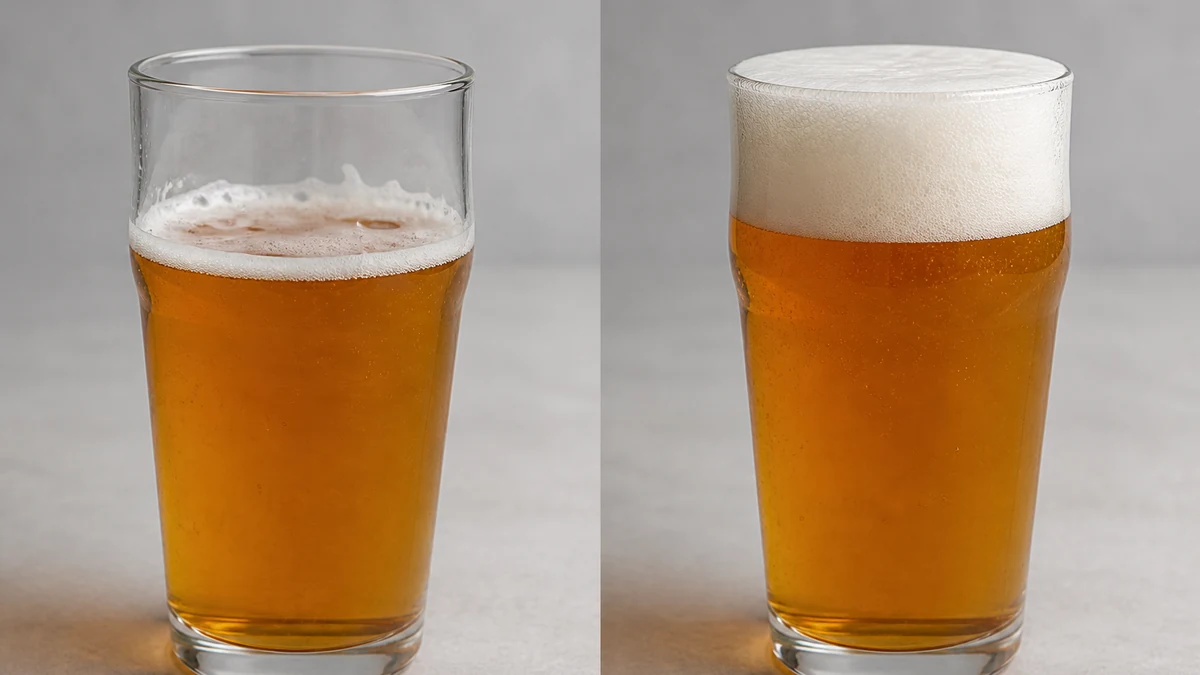
mcp.coinis.dev is in an extended OAuth outage as this article went to press, so the before/after above is a vision-QA'd illustrative still generated directly through OpenAI's image model rather than a live enhance_asset_proxy render. For a real enhance_asset_proxy recraft-inpaint repair on a comparable localized defect, see the wine bottle internal-reflection fix.
The masking discipline here is narrower than it looks. The mask covers only the foam-head region itself, measured off the real source photo, and the correction prompt describes only the fix, "a fuller, fresher-looking foam head consistent with this pour, no change to the liquid, glass, or background." The goal is a plausible fresh-pour state anchored to what the same beer actually looks like seconds after pouring, not an invented or exaggerated head the product never produces. The liquid color, fill level, glass shape, and any can, bottle, or tap-handle branding in frame stay untouched. This is a cosmetic retouch of a photo, not a claim about the beer's actual carbonation, freshness, or quality, and the article treats it that way rather than implying the fix makes the product better than it is.
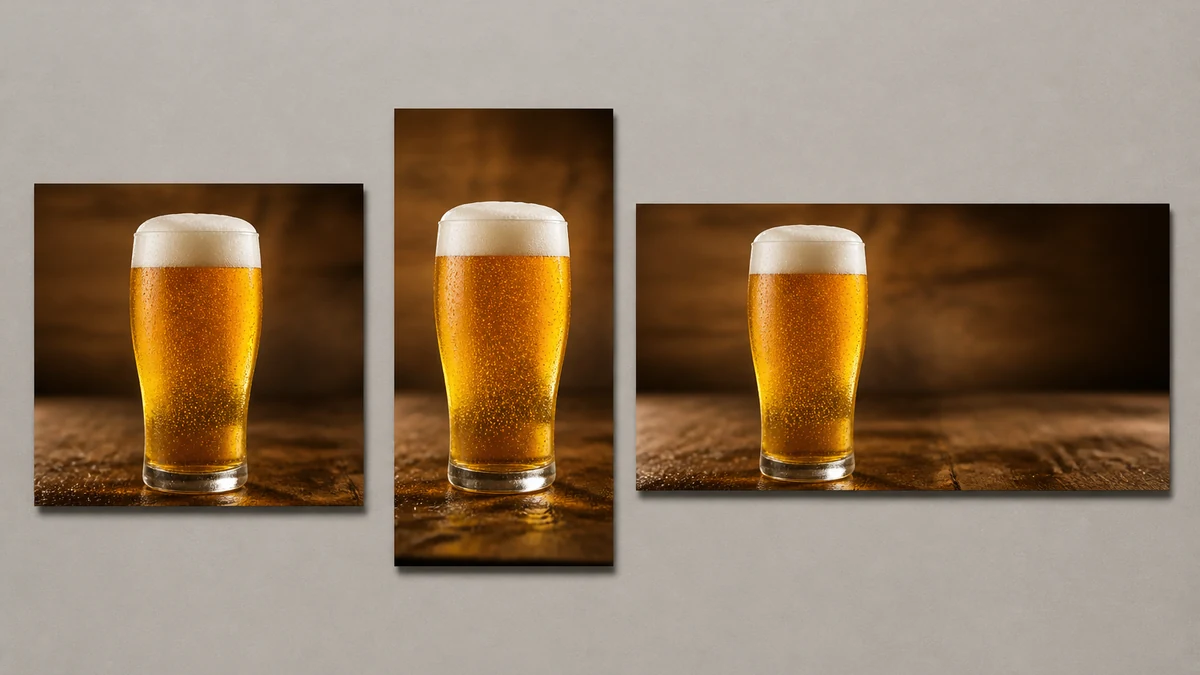
Once the base photo is clean, Coinis's generate_image_templates tool rebuilds it into the formats a brewery or bar actually needs: a square feed post, a vertical story crop, a wide landscape banner, all pulled from the one corrected photo instead of a second photo shoot or a second pour.
What to do with the fixed photo
A corrected pour photo is still just a corrected photo. The step that turns it into something that actually runs as an ad is Coinis's Ad Studio, which takes the repaired image and the same multi-format fan-out shown above and assembles it into launch-ready ad creative with copy, the template-to- launch-ready step that sets Ad Studio apart from plain marketplace model access. A brewery announcing a new seasonal release or a bar promoting a weekend tap takeover does not need to re-pour and reshoot to get a usable ad live. It needs the one good photo it already has, corrected, and the ad built from it the same day.
Any ad built from a corrected pour photo still needs to go through the platform's own alcohol-ad review and whatever jurisdiction-specific rules apply to that business's market before it runs. A retouched photo fixes a cosmetic defect. It does not substitute for that review, and it is not a claim about the beer itself, only about how one photo of it looks.
FAQ
Does every beer photo with a thin foam head need this fix? No. A deliberately flat-pour style, a beer style that naturally produces a thinner head, or a photo taken seconds after pouring with no decay at all are all legitimate as-is. This fix is for photos where the head collapsed between the pour and the shot in a way the photographer did not intend.
Will the repair change the beer's color or the can or bottle branding? No. The mask is drawn tight around the foam-head region itself, measured off the real source photo, and the correction prompt names only the foam fix, never a color, a logo, or a background element. Liquid color, fill level, glass shape, and any packaging or tap-handle branding outside the masked region stay exactly as photographed.
Does restoring the foam head mean the beer is fresher or better quality? No. This is a cosmetic photo retouch, not a claim about the product. The fix restores a plausible fresh-pour appearance anchored to what the same beer actually looks like right after pouring. It says nothing about the beer's actual freshness, carbonation, or quality, and the article does not claim otherwise.
Does a corrected photo guarantee the ad gets approved? No. Platforms run their own alcohol-advertising review on top of image quality, and jurisdiction rules vary by market. A corrected photo removes a cosmetic defect from the creative. It does not replace that review process.
Sources
- John Palmer, "Understanding the Science Behind Beer Foam," Brew Your Own -- foam formation, coalescence, and the role of lipids as primary destabilizers: https://byo.com/articles/beer-foam-advanced-brewing/
- Jay P. Morgan / The Slanted Lens, "How to Style Food for Photography" -- independent food-styling source documenting that "within minutes after being poured, a beer can lose its head of foam" and the on-set salt-based revival trick: https://theslantedlens.com/food-styling-tips-and-tricks/

Isidora Matovic
Author
Social media enthusiast and a full time researcher. She takes digital presence very seriously and that is why you are always in touch in what is going on with us! Follow us for more posts like this.