
Photograph a wine bottle or a filled glass at the wrong angle and a hard dark band appears across the glass, sometimes across the liquid itself, like a shadow with no obvious light source causing it. Relighting the shot does not fix it. Neither does bouncing in more fill light. The band is not missing light. It is light that entered the glass and never got back out.
What's actually happening to the photo
Glass and liquid both bend light differently than air does, and that difference has a limit. Light traveling inside glass or wine toward the glass-to-air boundary refracts (bends) and exits normally, up to a certain angle of incidence. Past that angle, called the critical angle, no light can exit at all. Every bit of it reflects back inward instead, a phenomenon physicists call total internal reflection. It is the same optical limit that explains why a full glass of water looks like a mirror when you view the side at a steep angle, or why the inside of an aquarium can show a bright silvery band along the water's surface instead of a clear view through.
On a curved bottle or a stemmed glass, the geometry that triggers this changes constantly as the surface curves, so the effect does not show up as a uniform problem across the whole shot. It shows up as a band or wedge, often running right through the label, the shoulder of the bottle, or the bowl of the glass, exactly where the surface curvature pushes the internal light past the critical angle. It is worth being precise here: not every dark band on a glass bottle is total internal reflection specifically. A shadow from a nearby object, underexposure, or a reflector positioned wrong can all produce a similar-looking dark region. The angle-dependent test is simple: shift the camera or the bottle by a few degrees and watch the band. A shadow from an object moves gradually with the light. A band caused by total internal reflection can snap in or out abruptly as the surface angle crosses the critical threshold, because the physics underneath it is a hard cutoff, not a gradient.
This is a different mechanism from the glare and condensation problem beverage brands run into with glass and aluminum packaging, which is light bouncing straight off the outside of a container as a bright highlight. Total internal reflection happens inside the glass, and it reads dark, not bright, because the light that should have passed through to the camera never arrives. A bottle shoot can have both problems in the same frame: an external glare streak on the shoulder and an internal dark band through the body, caused by two unrelated optical mechanisms that happen to live on the same piece of glass.
Photographers working this out by hand use a few standard moves: angle the bottle or the camera slightly off the straight-on view that triggers the worst bands, use a large diffused light source behind or beside the bottle rather than a small hard one, and sometimes cross-polarize with filters on both the light and the lens to cut the internally reflected light selectively. All of these work in a controlled studio setup. None of them help with a library of bottle photos a wine shop, liquor store, or winery already has sitting in a product feed, shot under whatever lighting was available at the time.
Fixing it after the fact
Coinis's photo-repair tool (enhance_asset_proxy, the recraft-inpaint operation) treats this the same way it treats any other localized optical artifact already demonstrated in this series, jewelry's polished-metal hotspot or electronics' flat-screen mirror glare, with the mask shaped to hug the actual band rather than the whole bottle.
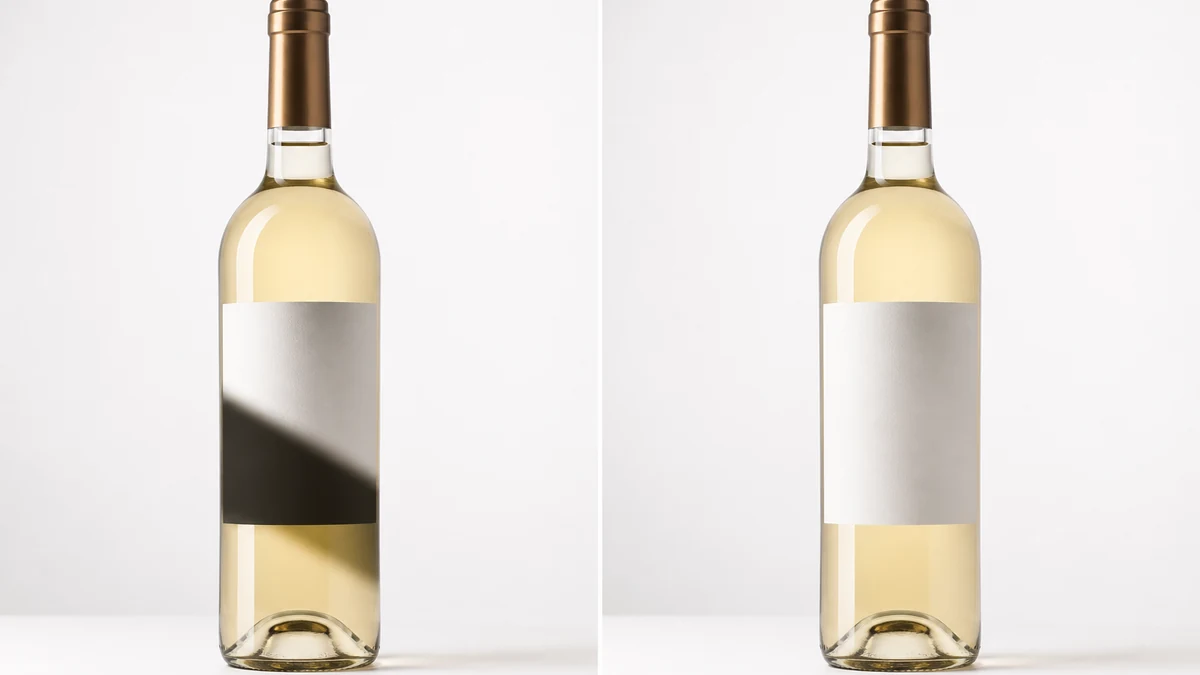
mcp.coinis.dev is in an extended OAuth outage as this article went to press, so the before/after above is a vision-QA'd illustrative still generated directly through OpenAI's image model rather than a live enhance_asset_proxy render. For a real enhance_asset_proxy recraft-inpaint repair on this exact defect family (a localized optical artifact on glass or metal), see the fishing-tackle purple-fringe fix.
The masking discipline matters more here than on most spot defects, because a wine or liquor bottle carries information a repair absolutely cannot touch: the label art, the vintage year, the ABV percentage, government warning text, and the fill level and liquid color that signal the product is genuine and correctly represented. A tight mask drawn to cover only the band itself, measured off the actual source photo rather than guessed, keeps the repair from drifting onto any of that. The prompt describes only the correction, with zero mention of a color or a background detail: something like "restore the natural glass clarity and label visibility in this region, no dark band, no added text, no logos." That keeps the fix scoped to removing the optical artifact, not repainting the bottle.
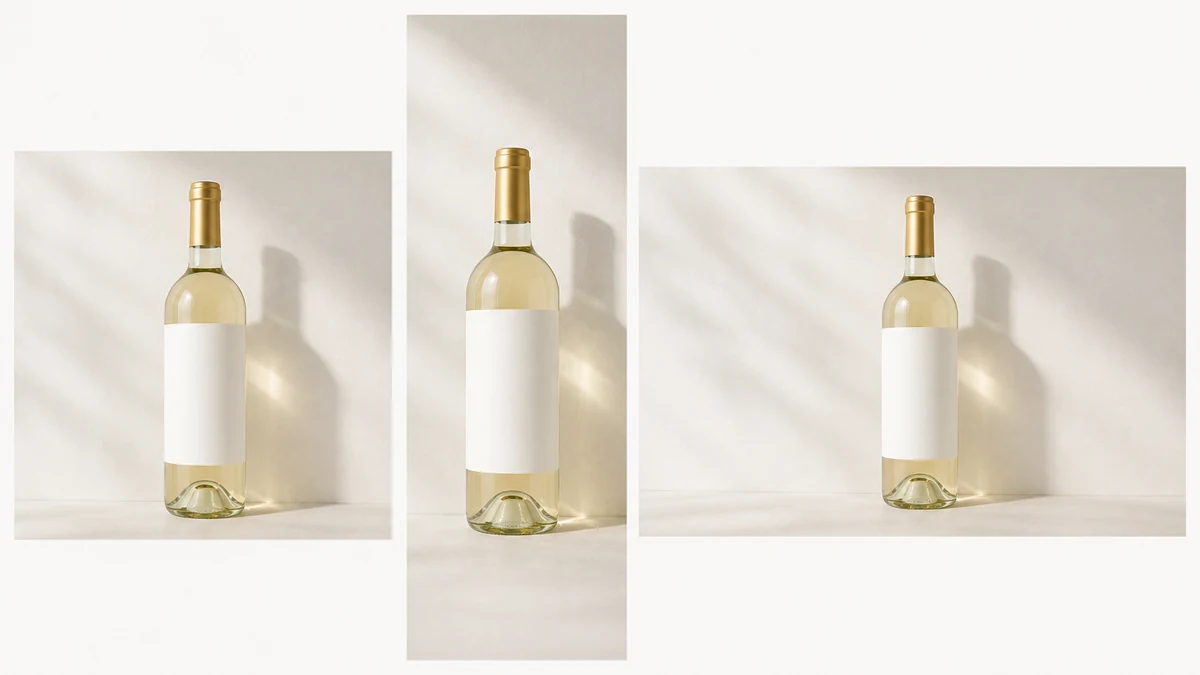
Once the base photo is clean, Coinis's generate_image_templates tool rebuilds it into the formats a wine shop or liquor store actually needs to run ads: a square feed image, a vertical story crop, a wide landscape banner, all pulled from the one corrected photo instead of a second photo shoot.
Why this is a harder problem for bottled products specifically
Most product categories that fight glare or reflection are dealing with an external light source hitting an opaque or semi-glossy surface. A wine bottle or a filled glass is different because the product itself is the optical medium causing the problem. The glass is not just reflecting light, it is bending and sometimes trapping it on the way through, and the liquid inside adds a second refractive medium stacked behind the first. A retailer cannot simply swap the bottle for a less reflective one the way a jewelry seller might choose a different display backdrop. The bottle's shape and the glass itself are the product being sold, and both are fixed well before the photo gets taken.
It also compounds with how bottle shops typically shoot their own catalogs. A winery or liquor store photographing dozens of SKUs a week for an online store or a weekly promotion rarely has a dedicated studio set up with cross-polarized lighting and careful angle control for every bottle. The dark band is not a one-off mistake from a rushed shoot. It is close to a structural feature of photographing curved glass under ordinary retail lighting conditions, which is exactly why a repair step that works on an existing photo matters more here than for a product where reshooting under better conditions is a realistic option.
What to do with the fixed photo
A corrected bottle photo is still just a corrected photo sitting in a product feed. The step that turns it into something that actually runs as an ad is Coinis's Ad Studio, which takes the repaired image and the same multi-format fan-out shown above and assembles it into launch-ready ad creative with copy, not just a resized picture, the template-to-launch-ready step that sets Ad Studio apart from plain marketplace model access. A wine shop running a new-arrivals promotion or a liquor store running a weekend sale does not need to wait on a reshoot to get a clean ad live. It needs the clean photo and the ad built from it, the same day, with every piece of required label and legal text intact and unchanged.
Any ad built from a corrected bottle photo still needs to go through the platform's own alcohol-ad review and whatever jurisdiction-specific rules apply to that retailer's market before it runs, same as any other alcohol-category campaign on Coinis. A clean photo removes an optical defect. It does not substitute for that review.
FAQ
Is every dark band on a bottle photo caused by total internal reflection? No. A shadow from a nearby object, underexposure, or a misplaced reflector can all produce a similar-looking dark region. The angle test is the fastest way to tell the difference: shift the camera or the bottle a few degrees. A shadow moves gradually. A total-internal-reflection band can appear or vanish abruptly as the glass surface crosses the critical angle, because the underlying physics is a hard threshold rather than a gradual falloff.
How is this different from the glare problem beverage brands already deal with? Glare is external light bouncing off the outside surface of glass or aluminum, and it shows up as a bright highlight. Total internal reflection happens inside the glass itself and shows up dark, because the light that should pass through to the camera gets redirected back inward instead. The two can appear on the same bottle at the same time from two unrelated causes.
Will the repair change the label, the vintage, or the ABV text? No. The mask is drawn tight around the dark band itself, measured off the real source photo, and the repair prompt names only the correction, never a color, a logo, or a background element. Every piece of label art, legal text, fill level, and closure detail outside the masked region stays exactly as photographed.
Does a corrected photo guarantee the ad gets approved? No. Platforms run their own alcohol-advertising review on top of image quality, and jurisdiction rules vary by market. A corrected photo removes an optical defect from the creative. It does not replace that review process.
Sources
- OpenStax College Physics (via Michigan State University's open-access mirror), "Total Internal Reflection" -- defines the critical angle via Snell's law and the condition under which total internal reflection occurs: https://openbooks.lib.msu.edu/collegephysics2/chapter/total-internal-reflection-2/
- Wikipedia, "Total internal reflection" -- general mechanism description and real-world critical angle values for common glass and water: https://en.wikipedia.org/wiki/Total_internal_reflection
- Digital Photo Mentor, "Tips for Photographing Glassware on both Black and White Backgrounds" -- independent photography-technique source on the practical lighting/angle workarounds photographers use for reflective glass and bottles: https://www.digitalphotomentor.com/tips-for-photographing-glassware-on-both-black-and-white-backgrounds/
- Two Loves Studio, "Must Know: How to Avoid Reflections in Beverage Photography" -- independent photography-technique source on light angle and modifier choice for glassware and bottle shoots: https://twolovesstudio.com/blog/avoid-reflections-in-your-beverage-photography/

Isidora Matovic
Author
Social media enthusiast and a full time researcher. She takes digital presence very seriously and that is why you are always in touch in what is going on with us! Follow us for more posts like this.