

An insurance agency's Google Business page, its "meet the team" section, and its lead-gen ad creative all run on the same asset: a headshot of the actual agent a prospective client will talk to on the phone. More than six in ten American adults wear prescription eyewear, so a meaningful share of every agency's roster is going to show up in front of a camera in glasses (The Vision Council, "Consumer inSights Q2 2024," accessed 2026). When the light that photographed them bounces straight back off the lenses, the fix is not better editing. It is physics that was already decided before the shutter opened.
The angle was set the moment the flash fired
A lens reflects light at a predictable angle: whatever angle the light hits it at, it leaves at the same angle on the other side, an old optics rule usually stated as the angle of incidence equals the angle of reflection. A photographer answering this exact question on Photography Stack Exchange put it in plain terms: avoid facing directly into a light source with the incoming and outgoing angle equal, because that is precisely the geometry that sends a bright reflection straight back into the camera (Photography Stack Exchange, "Is it possible to photograph me without reflections on my glasses?," accessed 2026). A flash or a softbox mounted near the camera, aimed straight at a seated subject's face, creates exactly that geometry. The reflection lands directly over the pupil, and the eye behind it disappears into a flat white patch.
This is not a lighting mistake in the sense of underexposure or a bad white balance. The rest of the photo can be perfectly exposed, perfectly framed, and perfectly on-brand, and the eyeglass reflection still wins, because it is a property of how a flat glass surface bounces light, not a setting a camera can auto-correct. Uncoated glass reflects a real, measurable share of the light that hits it at each surface, which is exactly why lens manufacturers apply anti-reflective coatings in the first place to cut that reflected share down (Edmund Optics, "Anti-Reflection (AR) Coatings," accessed 2026). Plenty of everyday eyewear still doesn't have that coating, or has an older coating that has worn thin, and a headshot session is rarely the moment anyone checks.
Why an agent's face carries more weight here than in most industries
An insurance or financial-advisory relationship is built on trust before a single policy or account number changes hands. A prospective client scanning an agency's website or a lead-gen ad is not evaluating a product shot. They are evaluating a person's face, deciding in a couple of seconds whether this is someone they'd want handling a claim or a retirement account. A headshot where the eyes are obscured by a bright reflective patch does the opposite of that job. It reads as a stock photo gone wrong, or worse, as a photo nobody bothered to check before it went live on the page meant to build confidence.
The industry running these headshots at scale is large. IBISWorld's tracking puts US insurance agency and brokerage revenue at 283.6 billion dollars in 2026, growing at a 2.42% rate (IBISWorld, "Insurance Agencies and Brokerages," NAICS 524210, accessed 2026). That is a wide field of individual agents, each with their own bio photo, agent-directory listing, and local lead-gen ad running at the same time, and each one is a candidate for this exact defect landing on the page doing the most trust-building work.
A photo-quality fix, not an editing workaround
The correction that matters here restores the visible eye behind the reflection while leaving the rest of the headshot untouched: same person, same expression, same background, same wardrobe. Nothing about the agent's face should change except the removal of a reflection that was never supposed to be part of the photo. This is strictly an optical repair on an existing photo, the same kind Coinis's photo-repair tool already demonstrates on other localized defects, not a retouch that alters how someone looks, and it carries no claim about the agent's qualifications, the insurance products they sell, or anything to do with pricing or coverage.
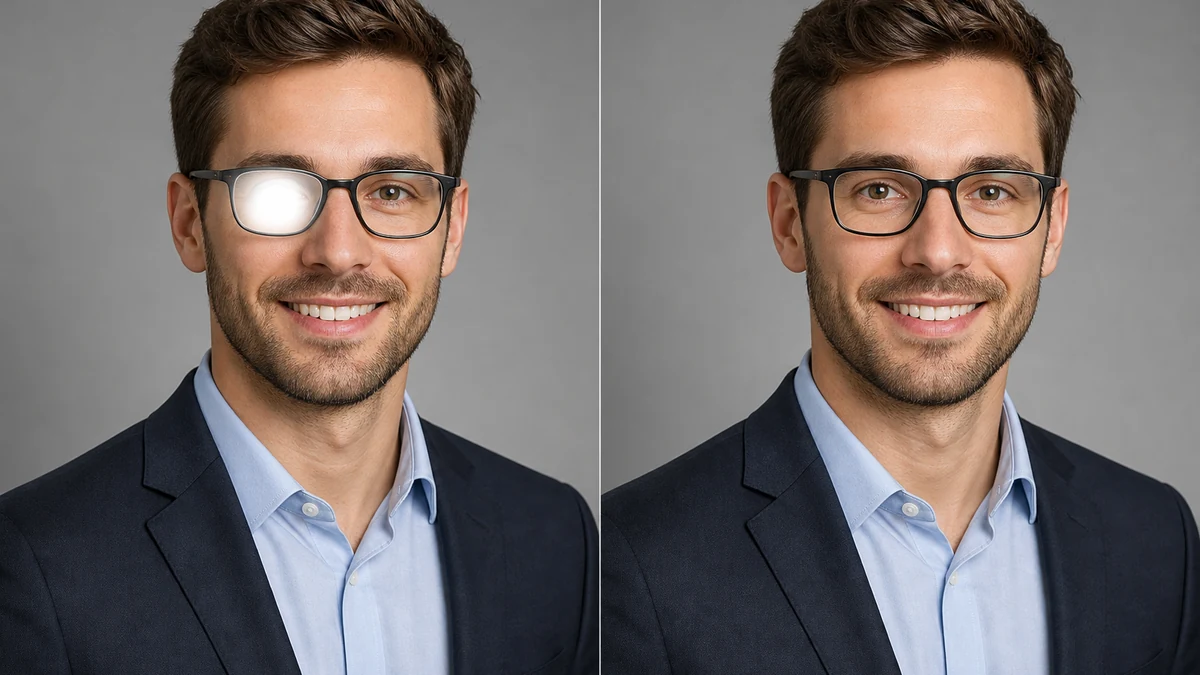
mcp.coinis.dev is in an extended OAuth outage as this article went to press, so the before/after above is a vision-QA'd illustrative still generated directly through OpenAI's image model rather than a live enhance_asset_proxy render. For a real enhance_asset_proxy correction on a comparable localized-highlight defect, see a wedding-dress fabric-highlight fix and a jewelry ad photo fix.
Once the correction exists on one clean source photo, the same agent's face needs to appear consistently across every channel an agency runs: the website team page, a Google Business listing, a Facebook lead-gen ad, an Instagram story ad, and a local directory listing, each with its own crop and aspect ratio.

Same generation-pipeline note as above: this fan-out is a vision-QA'd illustrative still, not a live generate_image_templates render. A real multi-format fan-out from this tool is demonstrated in the formats sibling article.
For an insurance or financial-advisory agency, an agent doesn't need to schedule a reshoot every time someone notices a reflection problem on a headshot. One corrected photo, run through Coinis's photo-repair pipeline and fanned out to the sizes every channel needs, means the same trustworthy face shows up everywhere a prospective client might see it first, without a repeat photo session.
FAQ
Why does this happen even with good lighting and a skilled photographer? Because the reflection is a function of the angle between the light source, the glasses, and the camera, not the overall quality of the lighting setup. A photographer can nail exposure, color, and composition and still have a bright reflective patch land over an eye if that specific angle isn't addressed, usually by moving the light off-axis or angling the subject's head or glasses slightly.
Can this be prevented by asking the agent to remove their glasses? That avoids the reflection, but it also changes how the person looks to clients who will meet them wearing their glasses. Many agencies prefer to keep the headshot accurate to how the agent actually appears in person rather than photographing a different look just to sidestep a lighting problem.
Does anti-reflective coating on the glasses fix this automatically? It reduces how much light the lens reflects, since coated lenses pass through more light and reflect less than uncoated ones, but it does not eliminate reflections outright, especially from a strong, direct flash. A photo already taken with an uncoated or reflective lens still needs the correction applied after the fact.
Is this the same problem as a specular highlight on a shiny product? The underlying physics (light bouncing off a smooth surface at a predictable angle) is related, but the fix has to be far more careful here because the surface in question sits directly over a person's eye. The correction has to restore a natural-looking eye without altering the person's actual appearance, which is a different bar than smoothing a highlight off a bottle or a piece of jewelry.
Sources
- The Vision Council, "The Vision Council Releases New Research Spotlighting Q2 Consumer Trends and Generational Differences," Consumer inSights Q2 2024 (83% of respondents use a form of vision correction, 68% use prescription eyewear): https://thevisioncouncil.org/blog/vision-council-releases-new-research-spotlighting-q2-consumer-trends-and-generational
- Photography Stack Exchange, "Is it possible to photograph me without reflections on my glasses?" (angle of incidence/angle of reflection mechanism, CC BY-SA community answers): https://photo.stackexchange.com/questions/39874/is-it-possible-to-photograph-me-without-reflections-on-my-glasses
- Edmund Optics, "Anti-Reflection (AR) Coatings" (uncoated glass reflection mechanism): https://www.edmundoptics.com/knowledge-center/application-notes/lasers/anti-reflection-coatings/
- IBISWorld, "Insurance Agencies and Brokerages," NAICS 524210 (revenue $283.6bn 2026, growth 2.42%): https://www.ibisworld.com/classifications/naics/524210/insurance-agencies-and-brokerages/

Isidora Matovic
Author
Social media enthusiast and a full time researcher. She takes digital presence very seriously and that is why you are always in touch in what is going on with us! Follow us for more posts like this.