

Midday sun is supposed to be the easy light. It is bright, it is free, and it fills a room without a single flash. Point a camera at a living room with closed venetian blinds on a sunny afternoon and that same light turns into a problem: hard, parallel bars of light and shadow striping across the wall, the floor, and whatever furniture happens to be in the way. The room is genuinely bright and genuinely well-lit. The photo reads like the inside of a jail cell.
This is one of the most common, most avoidable defects in real estate advertising, and it shows up constantly in listing photos and agent ads precisely because the room looks fine to the naked eye standing in it. The camera is what turns a familiar window-blind pattern into a distracting, graphic stripe that competes with the room itself for attention.
Why blinds do this to a camera and not to your eye
A venetian blind's slats are a precise, repeating obstruction. When direct sunlight comes through them at an angle, it does not diffuse the way it would through an open window or a sheer curtain, it gets chopped into a series of hard-edged bright and dark bands that land wherever the geometry of the sun angle and the slat spacing puts them: across a wall, down onto a sofa, over a hardwood floor. Cinematographers have a name for this exact effect and use it deliberately, it is one of the most recognizable signatures of film noir lighting, where a venetian-blind gobo throws a stark barred pattern across a character or a room to build mood (Spectrum by Rosco, "The Basics of Film Lighting," 2026). That same pattern reads as atmospheric tension in a detective movie. It reads as a flaw in a listing photo meant to make a buyer feel at home.
Real estate photographers run into this constantly, and their own community treats it as a known, recurring problem rather than a rare accident. A photographer asking for advice on a recent shoot described exactly this situation, hard lines from the blinds cutting across a room, and the most common answer from other working photographers was blunt: close the blinds completely before shooting, because once that direct, slatted sunlight is in the frame there is no graceful way to shoot around it (r/RealEstatePhotography community discussion, "How would you handle the lines from the blinds?," accessed 2026). A separate, longer-running photography-education resource for the same industry gives the identical advice from the other direction, recommending photographers close the blinds whenever the view outside isn't worth preserving, specifically because doing so "dramatically reduces the dynamic range" and eliminates the slat-shadow problem at the source (Improve Photography, "6 Ways to Photograph Interior Windows in Real Estate Photography," accessed 2026).
The trouble is that advice only helps on the next shoot. It does nothing for the photo that already exists, the one an agent already paid for, already uploaded to the MLS, or already has sitting in a folder as the best available shot of a listing's brightest room.
Why this costs more than it looks like it should
Listing photos carry an outsized share of the weight in a home sale, more than almost any other category of product photography. The National Association of Realtors reports that more than 90% of home buyers search for homes online, and 85% say the photos themselves are the single most important factor in deciding which homes they bother to go view (National Association of Realtors, "8 Tips To Make Your Listing Picture Perfect," accessed 2026). A buyer scrolling through a feed of ten similar listings is deciding, almost entirely from photos, which three or four are even worth a showing. A striped, graphic shadow pattern slashed across the one room a listing is supposed to sell, usually the living room or primary bedroom, is a direct distraction from the thing the photo is there to communicate: space, light, and whether this room looks like somewhere a buyer could picture living.
The category also runs a real, measurable volume of paid advertising on top of the free MLS listing itself. Real estate agents spend heavily on Facebook, Instagram, and Google ads to drive traffic to open houses and individual listings, and the real estate photography services market that supplies these photos in the first place is valued at roughly $2.5 billion as of 2025, projected to keep growing through the next decade as demand for high-quality visual content in property marketing increases (WiseGuyReports, "Real Estate Photography Service Market," 2026). Every dollar spent driving clicks to a photo with a distracting shadow pattern across the hero shot is working against itself.
Fix the shadow bars before the ad goes live
Coinis's AI photo-repair tool, enhance_asset_proxy, handles this the same way it handles any shooting-condition defect that lives in one part of a photo rather than the whole frame: a correction scoped to the actual shape of the problem, not a blanket filter run across the entire image.
Step 1: Mask the striped region, not the whole room. The hard light-and-shadow bars from a venetian blind usually land on a specific wall, floor section, or piece of furniture, while the rest of the room, the window itself, the ceiling, the far side of the space, reads normally. A mask drawn around just the striped area keeps the correction from touching parts of the photo that are already fine.
Step 2: Run the correction through enhance_asset_proxy (recraft-inpaint). The prompt describes only the end state, the same wall, floor, or furniture surface with even, natural interior lighting and no striped shadow pattern, nothing about blinds, sun angle, or the specific mechanism that caused it. Naming the technical cause in the prompt is a confirmed way to get a model to invent a different lighting setup or a different surface entirely instead of repairing the one in the photo.
Step 3: Fan the corrected photo into every ad format with generate_image_templates. Once the room reads clean, the same shot becomes a full set of launch-ready ad sizes from one source image, a square crop for Meta and Instagram feed, a vertical crop for Stories and Reels, and a landscape crop for Google Display, instead of a single flawed photo doing double duty across every channel.
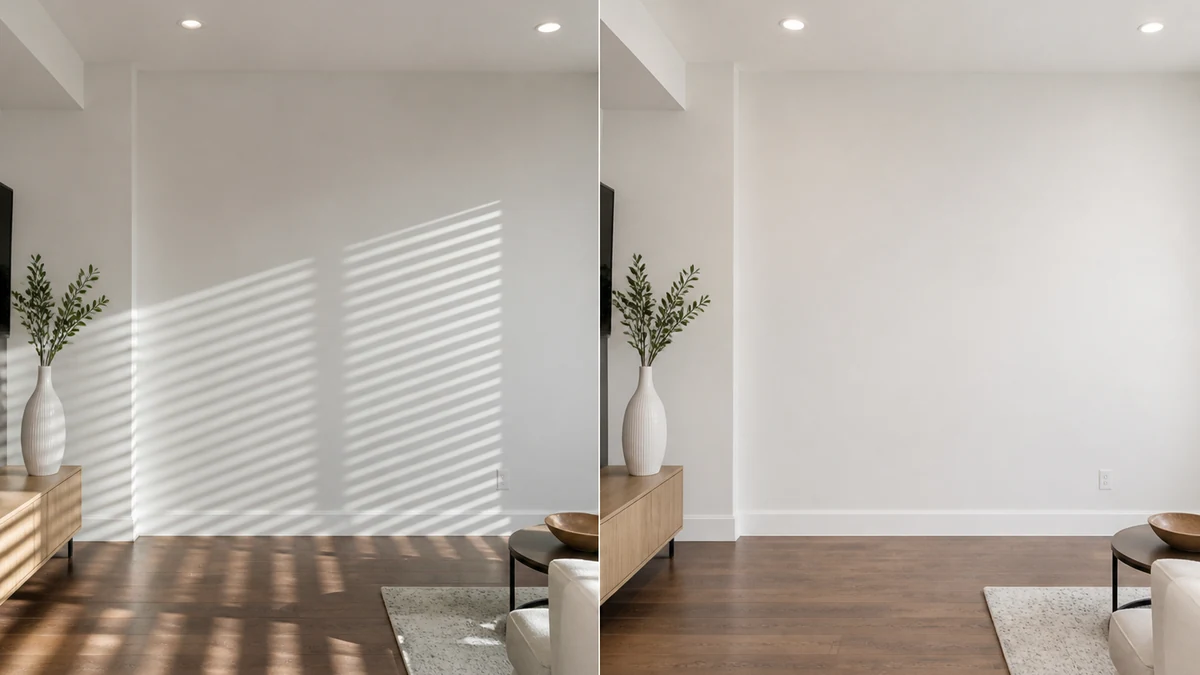
mcp.coinis.dev (the connection that runs enhance_asset_proxy) was offline when this article was produced. The image above is an illustrative still generated directly, not a live enhance_asset_proxy render. See a real enhance_asset_proxy correction in action on a bakery display-case photo.
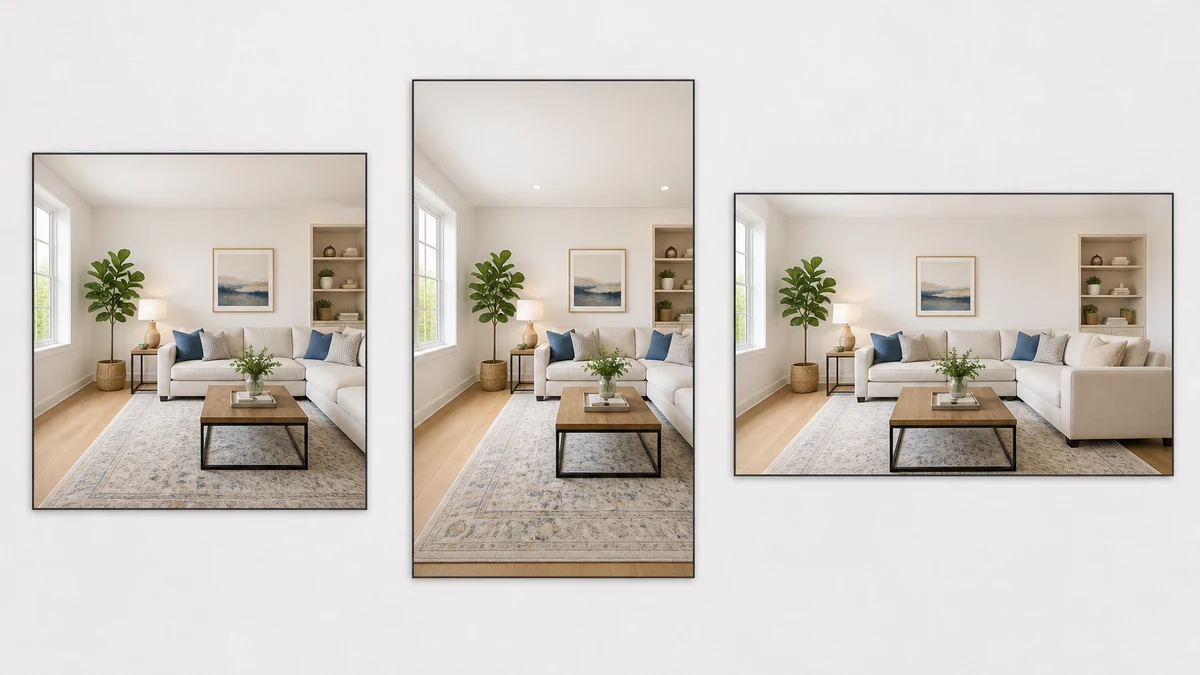
Same outage note applies here: this fan-out mockup is an illustrative still, not a live generate_image_templates render. See a real generate_image_templates fan-out for the actual tool in action.
Why this matters beyond one bad listing photo
The same mechanism shows up anywhere a real estate photo is shot under direct sun through closed horizontal blinds: a primary bedroom, a home office, a sunroom, even an exterior shot through a window from inside. A clean, corrected photo also becomes better raw material for turning a listing into a video ad, since a striped wall or floor would carry the same distraction into motion. It is not limited to one room type or one style of home, any interior with horizontal blinds and strong directional sun is a candidate for the same striped pattern, and most agents shoot multiple listings a month without full control over the time of day or the window treatments already installed in someone else's house.
It is also a defect that is easy to miss at a glance. A thumbnail-sized preview in an MLS grid or an ad manager can look fine from across the screen the same way the room looked fine standing in it. The stripes only register as a problem once a buyer is actually looking at the full-size image, by which point the ad has already been running, or the listing has already gone live, with a hero shot working against the room instead of for it.
What to do now
Pull your current listing and agent-ad photos and look specifically for hard, parallel light-and-shadow bands anywhere in frame, not just whether the room looks bright overall. Lighting defects like this one show up well beyond real estate too, the same localized-correction approach fixes an uneven vignette in a photography portfolio shot. A striped wall or floor is an easy thing to scroll past in a photo-management tool and an easy thing for a buyer to notice the moment the image is full-size on their phone. Any photo with that problem is one targeted correction away from being usable, and once the room reads clean, that same photo turns into a complete set of launch-ready ad formats through Coinis Ad Studio instead of a single compromised shot stretched across every channel. One corrected photo in, a full ad kit out.
FAQ
Is this the same thing as a photo being underexposed or overexposed? No. The room's overall exposure can be correct, properly bright, properly balanced, while still carrying a localized striped shadow pattern from the blinds. It is a shape-and-placement problem in one part of the frame, not a brightness problem across the whole photo.
Will this happen in every room with blinds? Not every room, and not every time of day. The effect depends on the sun being direct and strong enough to cast a hard-edged shadow, the blind slats being closed or angled enough to chop the light into bands, and the sun's angle lining up to throw that pattern somewhere visible in the shot. An overcast day, an open blind, or a sun angle that keeps the light diffuse won't produce the same stripes.
Does correcting this change anything about how the room actually looks? No. The correction restores even, natural-looking light to the striped surface, it doesn't add or remove furniture, change the room's layout, or alter anything that isn't already there. The wall is still the same wall, the floor is still the same floor, just without the shadow pattern a specific lighting condition happened to leave on top of it.
Why not just reshoot at a different time of day? Reshooting at the right time, often described as the "equalization point" when interior and exterior light levels match, is the ideal fix for a brand-new shoot. It is not practical for a listing that's already live, a shoot that already happened, or an agent who doesn't control when they can access the property again. The photo correction works on what already exists, without waiting for a second shoot window.
What ad formats should I generate from the corrected photo? At minimum, a square crop for Meta and Instagram feed, a vertical 9:16 crop for Stories and Reels, and a landscape crop for Google Display. Building all three from the same corrected source photo keeps a listing's creative consistent across every platform an agent runs ads on.
Sources
- Spectrum by Rosco, "The Basics of Film Lighting," venetian-blind gobo shadow-pattern mechanism. https://spectrum.rosco.com/the-basics-of-film-lighting
- r/RealEstatePhotography, "How would you handle the lines from the blinds?," working-photographer consensus on closing blinds before shooting. https://www.reddit.com/r/RealEstatePhotography/comments/1q27oxu/how_would_you_handle_the_lines_from_the_blinds/
- Improve Photography, "6 Ways to Photograph Interior Windows in Real Estate Photography," close-the-blinds dynamic-range guidance. https://improvephotography.com/36784/6-ways-to-photograph-interior-windows-in-real-estate-photography/
- National Association of Realtors, "8 Tips To Make Your Listing Picture Perfect," 90% online search / 85% photos-most-important-factor statistics. https://www.nar.realtor/blogs/styled-staged-sold/8-tips-to-make-your-listing-picture-perfect
- WiseGuyReports, "Real Estate Photography Service Market," $2,538.9 million 2025 market size. https://www.wiseguyreports.com/reports/real-estate-photography-service-market

Isidora Matovic
Author
Social media enthusiast and a full time researcher. She takes digital presence very seriously and that is why you are always in touch in what is going on with us! Follow us for more posts like this.