
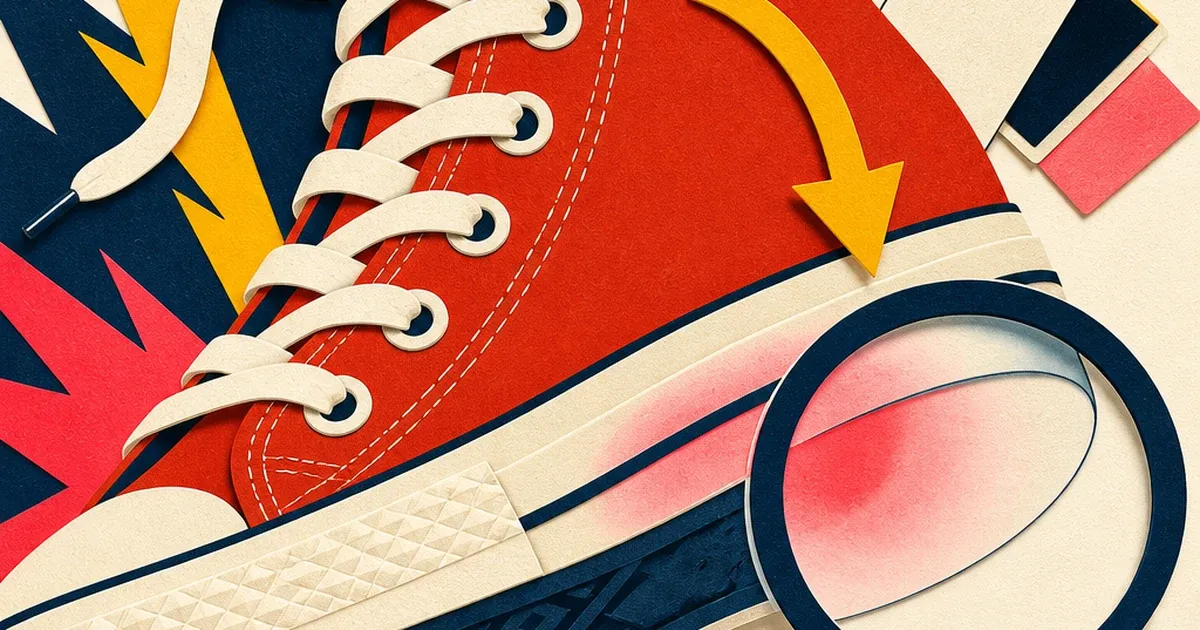
A sneaker brand photographs a bright red high-top against a clean white backdrop, color-matches the upper carefully, and ships the image to the product page and the ad campaign. Zoom into the midsole in that same photo and the white rubber isn't white. It carries a faint pink or salmon cast, strongest right where the red upper curves closest to it. Nobody touched a color slider. The red leather itself put that tint there, and no white-balance adjustment aimed at the whole photo will remove it without also shifting every other color in the frame.
Why one part of the shoe tints another part of the same shoe
Light doesn't stop at the surface it first hits. A photon that bounces off a brightly colored, reflective material picks up a wash of that material's color and keeps traveling, landing on whatever sits nearby. In computer graphics this is called color bleeding, defined as the phenomenon where objects or surfaces are colored by reflection of light from nearby surfaces, the same physics that makes a red tablecloth cast a faint pink glow onto a white plate sitting on it (Wikipedia, "Color bleeding (computer graphics)," accessed 2026). A sneaker is a small, curved object with a saturated-color upper sitting centimeters from a bright white sole, which is close to the ideal geometry for this effect to show up strongly.
Professional product photographers run into the same mechanism constantly, just framed as "color contamination." One photographer's documented case: silver jewelry shot against a vibrant blue backdrop came back with a distinct blue tint on the metal in every frame, confirmed through a controlled side-by-side test and traced to the backdrop reflecting its own color onto the reflective product, not a white-balance error (Replica Surfaces, "Beyond the Surface: The Technical Art of Product Photo Backgrounds," accessed 2026). A sneaker doesn't need a colored backdrop to trigger this. The upper is its own colored light source for the sole sitting right next to it, concentrated most heavily in whichever concave curve of the sole sits closest to the colored material and catches the most bounced light.
Why a global white-balance fix makes this worse, not better
The instinct when a white sole reads warm or tinted is to nudge the white balance until it looks neutral again. That instinct works for a cast that affects the entire frame evenly, the kind that comes from one ambient light source lighting everything the same way. Color bleed isn't that. It's localized to wherever the bounce actually lands, strongest near the colored material and fading out across the rest of the white surface. Push a global white-balance correction far enough to neutralize the tinted patch and the rest of the sole, the laces, and the backdrop all shift the opposite direction, introducing a new cast somewhere else in the frame to chase one that was only ever sitting in one spot.
The fix that actually matches the problem is a masked, localized correction rather than a frame-wide one.
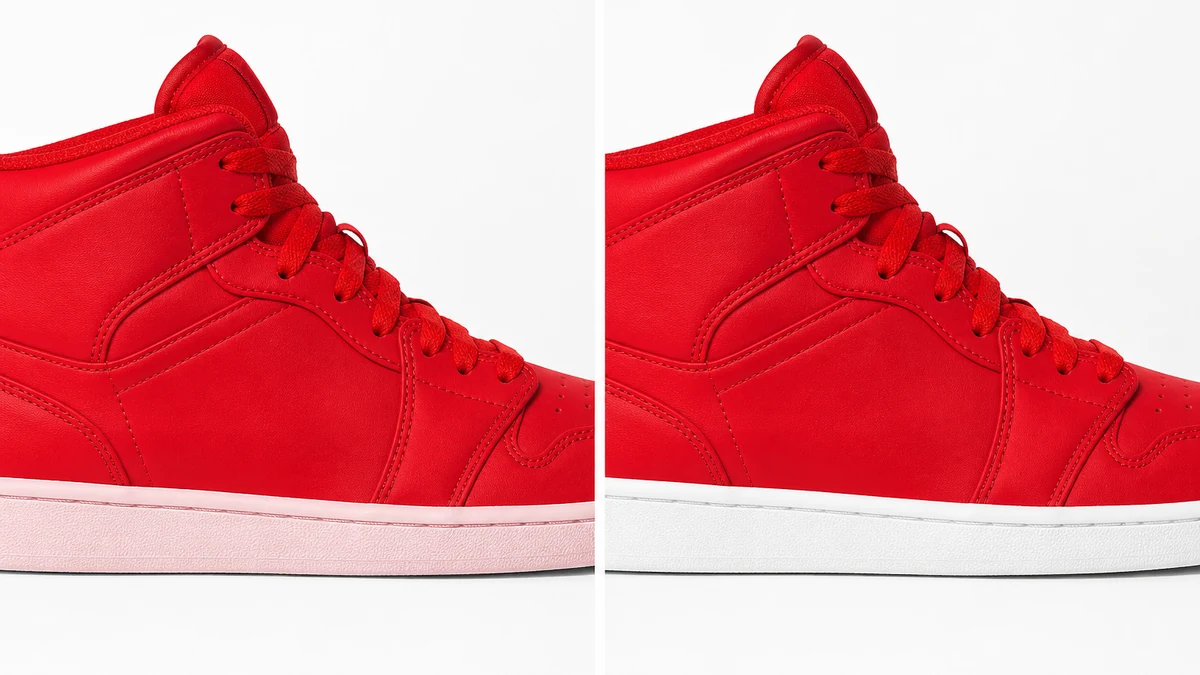
Illustrative example. mcp.coinis.dev, the live connection to Ad Studio's marketplace generation tools, is in an extended outage as of this writing, so the before/after shown above is a studio-style illustration of the fix rather than a live enhance_asset_proxy render. See the fishing tackle color-correction article for a real enhance_asset_proxy render of this same repair tool on a different optical defect.
Ad Studio's repair layer, enhance_asset_proxy, handles exactly this kind of spot correction without a reshoot. One tool covers upscaling, sharpening, denoising, lighting and white-balance fixes, background swaps, and masked inpainting, selected through a single model field matched to the flaw on the photo. For a bleed patch confined to one curve of the sole, the right call is recraft-inpaint with a tight mask hugging only the tinted region, paired with a prompt describing the masked area corrected to neutral true white, matching the surrounding unaffected sole material. The prompt never names the specific hue the camera got wrong. It describes only the target state, neutral white, rather than instructing the model to remove the pink or fix the salmon tint, because naming a color in a defect-repair prompt risks the model reading it as a design instruction instead of a correction target.
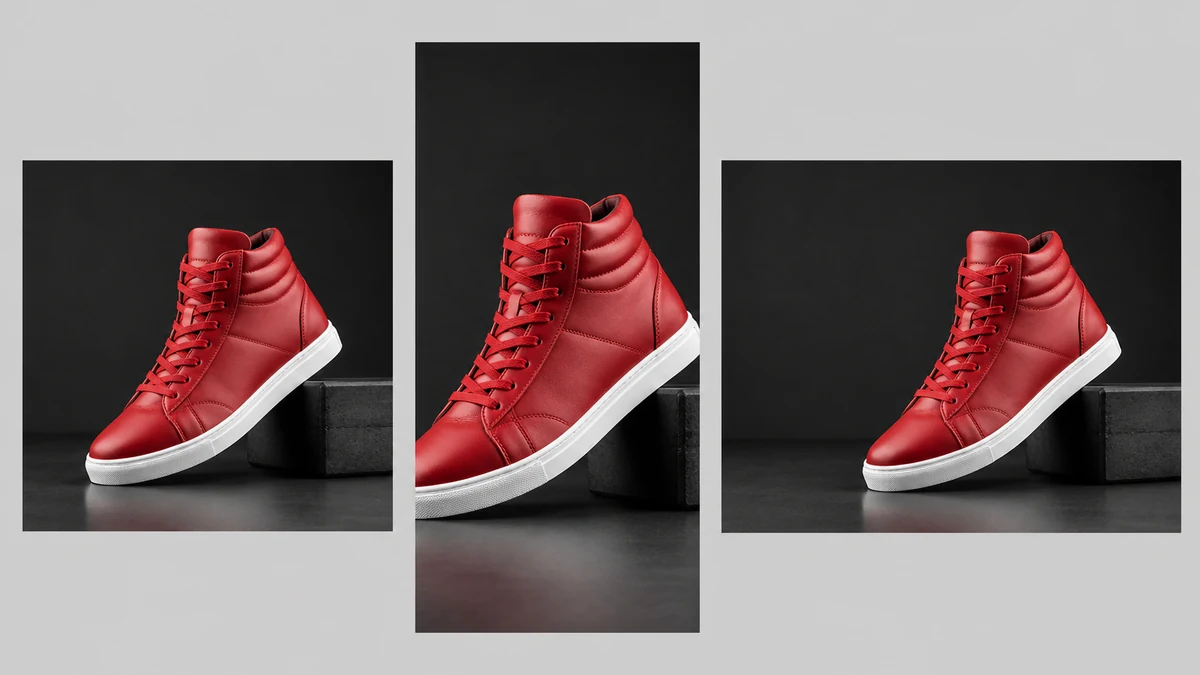
Once the sole reads true white with the upper's own color untouched, the fan-out step is generate_image_templates, Ad Studio's primary image-ad generator. One corrected catalog photo becomes a square feed post, a 9:16 Story, and a horizontal Display banner in a single pass, without rebooking a studio session for every platform's own size spec.
Why this keeps resurfacing across a sneaker catalog
A sneaker brand doesn't shoot one colorway once and move on. New colorways drop on a seasonal cycle, and every single one pairs a different saturated upper color against the same white sole, regenerating the same bleed risk from scratch each time, often more severely on the most saturated releases precisely because those are the colorways marketing wants to push hardest in ads. The order that holds up: correct the bleed patch on each new colorway's photo first with a tight recraft-inpaint mask, confirm the upper's own color and the shoe's logos and stitching are untouched, then hand the corrected file to generate_image_templates for the size fan-out. Resizing a bleed-tinted photo before correcting it just multiplies the same tinted patch across every ad placement instead of resolving it once.
This is the same underlying pattern already proven across other optically sensitive product categories on this blog: a jewelry piece's polished-metal specular hotspot and an apparel catalog photo's platform-policy background rejection are both versions of the same lesson applied to the footwear retail space, a color or exposure failure has a specific, citable physical cause, and the fix has to target that exact mechanism rather than a generic color-grade pass. It is distinct from both of those cases because sneaker color bleed isn't a lighting-source problem, a lens artifact, or a platform rule. It's one part of the product itself acting as an unintentional light source for another part of the same product, with zero external cause required.
Ready to clean up a catalog's worth of color-bleed photos and turn each one into every ad size your campaigns need? Build the fix and the size fan-out inside Coinis Ad Studio, no reshoot required.
FAQ
Is this the same thing as a color cast from bad lighting? No. A color cast from lighting affects the whole frame roughly evenly because one light source is lighting everything. Color bleed is localized, strongest right where a bright colored surface sits close to a lighter one, and fades out the further away you look. The two need different fixes, a global white-balance pass for the first, a masked local correction for the second.
Does this only happen with red uppers? No, though highly saturated, reflective colors (bright red, hot pink, cobalt blue) bleed more noticeably than muted or matte ones, because more light is reflecting off the colored surface with less of it being absorbed. Any strongly colored material sitting close to a white or light-colored surface in the same shot carries some risk.
Will a white backdrop fix this? No. The backdrop isn't the source of the bleed in this case, the sneaker's own colored upper is. Swapping the backdrop color doesn't change how much light the upper itself bounces onto the sole sitting right next to it.
Do I need a separate photo for every ad platform's size spec? No. generate_image_templates crops and composes each platform's spec from one corrected source photo, which is the entire point of fixing the bleed once instead of re-shooting for every export.
Sources
- Wikipedia, "Color bleeding (computer graphics)" (accessed 2026): https://en.wikipedia.org/wiki/Color_bleeding_(computer_graphics)
- Replica Surfaces, "Beyond the Surface: The Technical Art of Product Photo Backgrounds" (accessed 2026): https://www.replicasurfaces.com/blogs/updates/beyond-the-surface-the-technical-art-of-product-photo-backgrounds
- Pixelz, "Learn How Accurate Colors Can Reduce Your eCommerce Return Rates" citing European Journal of Marketing research (accessed 2026): https://www.pixelz.com/blog/color-correct-product-photography-reduce-e-commerce-return-rates/
- Grand View Research, "Sneakers Market Size, Share And Trends Report, 2026-2033" (accessed 2026): https://www.grandviewresearch.com/industry-analysis/sneakers-market-report
- IBISWorld, "Shoe Stores in the US" (2025): https://www.ibisworld.com/united-states/market-size/shoe-stores/1073/

Isidora Matovic
Author
Social media enthusiast and a full time researcher. She takes digital presence very seriously and that is why you are always in touch in what is going on with us! Follow us for more posts like this.