

A spa sells calm, and calm has a look: low warm light, a few candles, maybe one dim overhead fixture turned down so the room doesn't feel clinical. That same lighting choice is the whole reason a treatment room or product display photographs badly. A camera or phone shooting in that kind of dim, warm room either pushes its ISO up to compensate, which drags visible grain and speckled color noise across every shadow and mid-tone in the frame, or it stays at a low ISO and comes out underexposed, a dark, muddy image where the towel texture, the stone dish, the product label all blur into indistinct shapes. Either way, the room that is supposed to look serene and inviting ends up looking like a blurry, grainy phone photo taken by accident.
A spa's photos carry more of the sale than most service businesses
A spa client is buying an experience they haven't had yet, which means the photo is doing almost all of the persuading before anyone books. Academic eye-tracking research on wellness marketing backs this up directly: a controlled study of 85 older consumers found that wellness-service marketing pictures with clearer, more legible visual cues captured significantly more sustained visual attention and produced higher willingness-to-pay responses than pictures where those cues were harder to read, with the effect showing up in actual eye-movement data, not just self-reported preference (Wang, T.-C., Tang, T.-W., & Tsai, C.-L., "The Visual Attention and Psychological Responses from Older Customers to Wellness Service Pictures of Hotels," International Journal of Environmental Research and Public Health, 19(3), 1084, 2022). A treatment-room photo where the detail is buried in grain or lost in underexposure is working directly against the mechanism that gets a viewer to actually study the image and form a willingness to pay.
Why the exact lighting that sells the mood breaks the photo
The mechanism here is well documented in photography technique literature and it isn't really about ISO itself. Raising ISO in a dim room lets the camera brighten the image, but past a certain point that brightening reveals grain and blotchy discolored pixels that were always latent in the low light the sensor actually captured (Photography Life, "What is ISO? Understanding ISO for Beginners," accessed 2026). The instinct many phone cameras and casual shooters have instead, keeping ISO low to avoid that grain, backfires in the opposite direction: a properly exposed image at a higher ISO in low light produces cleaner results than an underexposed image at a low ISO that then gets brightened afterward, because underexposing throws away real sensor information that no amount of after-the-fact adjustment can recover (Photography Life, "Low-Light Photography Explained: A Beginner's Guide," accessed 2026). A spa shooting on a phone in ambiance lighting usually ends up with one of these two failure modes rather than a deliberate exposure choice, and either one leaves the same result: a treatment room, a product bottle, or a therapist's hands mid-massage rendered as noisy grain or crushed, illegible shadow instead of a calm, detailed scene.
Clean up the noise and the exposure before you multiply the photo
Ad Studio's repair layer, enhance_asset_proxy, handles this as a lighting and denoise correction rather than a blanket filter. The tool exposes exposure/lighting correction, denoising, sharpening, background replacement, and inpainting through a single model field, so the operation gets matched to the actual flaw instead of running one generic enhancement over the whole image. A grainy, underexposed spa photo needs a full-frame correction, since both the noise and the underexposure span the entire frame rather than sitting in one isolated spot: the mask covers the whole image, and the prompt describes the target state directly, a clean, properly exposed version of the same room at the same candlelit ambiance, with the towel weave, the stone dish texture, and the product label all legible, never naming the specific defect itself or inventing a different scene, since a prompt that names a flaw or a color risks the model reinventing the background instead of correcting it.
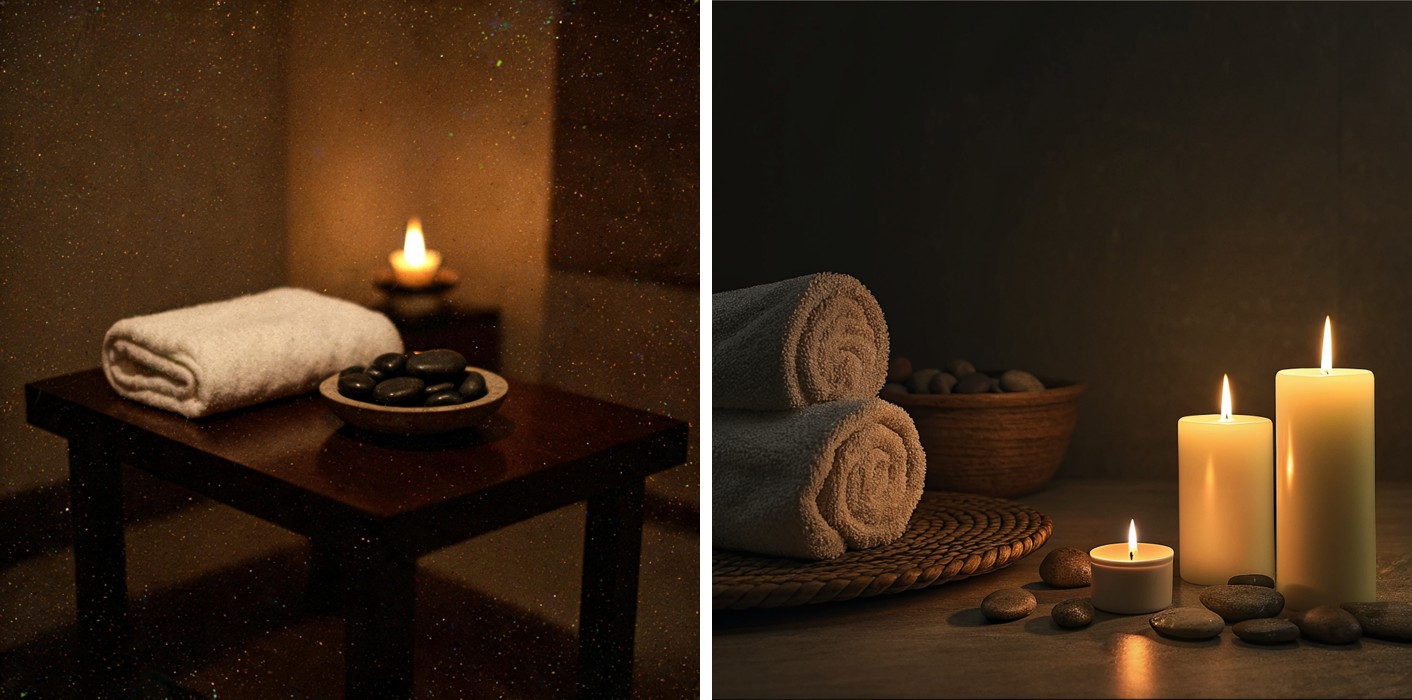
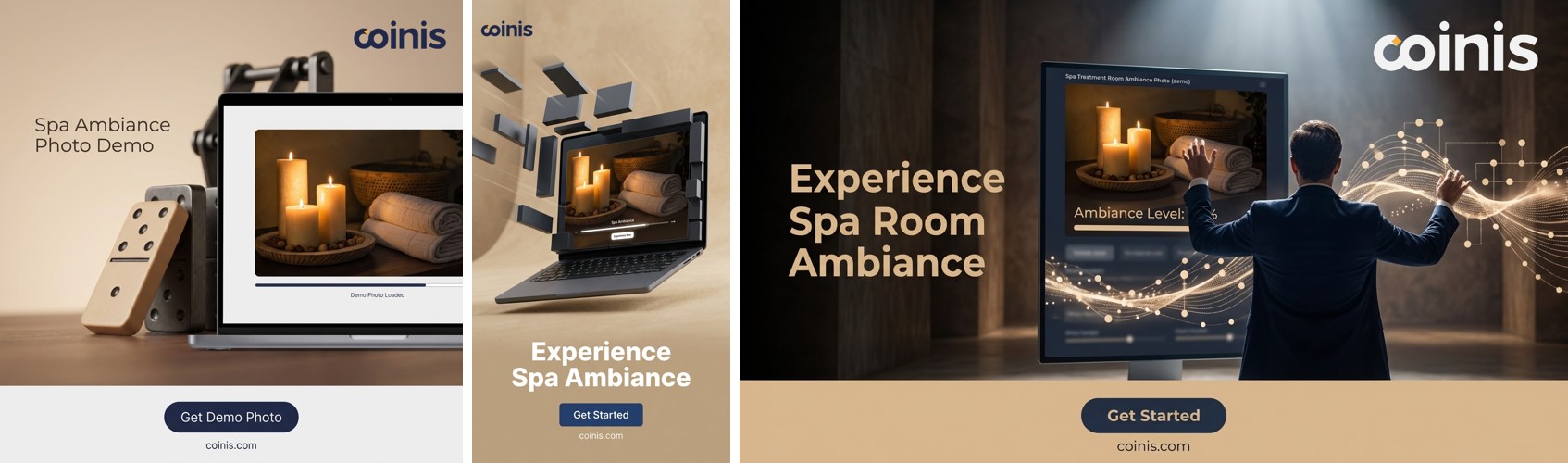
With a corrected room photo in hand, generate_image_templates, Ad Studio's primary image-ad generator, turns that single shot into a square feed post, a vertical Story crop, and a horizontal Display banner in one pass, matched to what each placement expects.
Building this into a recurring shoot habit
A spa's marketing needs change constantly: a new seasonal treatment, a redesigned relaxation lounge, a fresh product line on the shelf. Bringing in studio lighting equipment every time a new offering needs a photo isn't realistic for most single-location spas, which means the ambiance lighting that makes the room feel right is a permanent fact of the shot, not a mistake to fix once and move past. The order matters every time: correct the noise and exposure first with enhance_asset_proxy, then hand the corrected file to generate_image_templates for the ad-size fan-out. Doing it in the other order just resizes a photo that still has the grain and the underexposure baked into it, producing three flawed variants of the same problem instead of one clean set.
This is a distinct shooting-environment defect from a hotel room's mixed color-temperature lighting split, which is two light sources of different color fighting in one frame rather than a single dim source pushed too far, and from a beauty brand's whole-photo color-cast misrepresentation, which is a shade-accuracy problem rather than a noise-and-exposure one. It sits closest to a skincare brand's backlighting failure in spirit, both are low-light studio setups that need correcting rather than reshooting, but the actual defect mechanism, grain and crushed exposure across an entire ambiance-lit room, is its own class. A corrected room photo that survives both fixes and a full ad-size fan-out gives a spa a rotation it can keep pace with a redesigned lounge or a new treatment menu.
FAQ
Does enhance_asset_proxy change the actual room, or just the photo quality? Just the photo. The correction targets the sensor noise and the underexposure the camera introduced in low ambiance light, not the room's real layout, its actual candles, or its real furniture and decor. What changes is visible grain and legibility, not the design of the space.
Will the corrected photo still look calm and dim, or does it end up looking like a bright, clinical room? It still reads as a warm, candlelit space. The correction restores detail and reduces noise at the same exposure level and color temperature the room was actually shot at, it does not relight the scene into a bright, evenly lit room. A well-corrected spa photo keeps its mood while showing texture a noisy, underexposed shot was hiding.
Does this apply to every kind of spa photo, or just treatment rooms? The same grain-and-exposure problem shows up anywhere a spa shoots in its own ambiance lighting rather than under bright studio lights: a product display on a shelf, a therapist demonstrating a technique, a relaxation lounge or waiting area. Any of these shot in dim, warm light is a candidate for the same correction.
Do I need a different photo for every ad platform, or does one corrected shot cover all of them? One corrected shot covers every size. generate_image_templates handles the resizing and cropping into each placement's spec from that single clean source, which is the entire point of correcting the photo once instead of every time a new format is needed.
The Coinis angle
A spa doesn't need to relight its treatment rooms or bring in a studio crew to get a clean, detailed photo that still feels calm. Correct the grain and exposure on the ambiance-lit photo already sitting on a phone with Ad Studio's enhance_asset_proxy, then turn it into a full ad-ready set with generate_image_templates, and land the whole thing as a launch-ready ad through Ad Studio's templates instead of exporting raw images and building the ad by hand.
Sources
- Wang, T.-C., Tang, T.-W., & Tsai, C.-L., "The Visual Attention and Psychological Responses from Older Customers to Wellness Service Pictures of Hotels," International Journal of Environmental Research and Public Health, 19(3), 1084, 2022. https://pmc.ncbi.nlm.nih.gov/articles/PMC8834234/
- Photography Life, "What is ISO? Understanding ISO for Beginners," accessed 2026. https://photographylife.com/what-is-iso-in-photography
- Photography Life, "Low-Light Photography Explained: A Beginner's Guide," accessed 2026. https://photographylife.com/low-light-digital-photography-tips

Isidora Matovic
Author
Social media enthusiast and a full time researcher. She takes digital presence very seriously and that is why you are always in touch in what is going on with us! Follow us for more posts like this.