
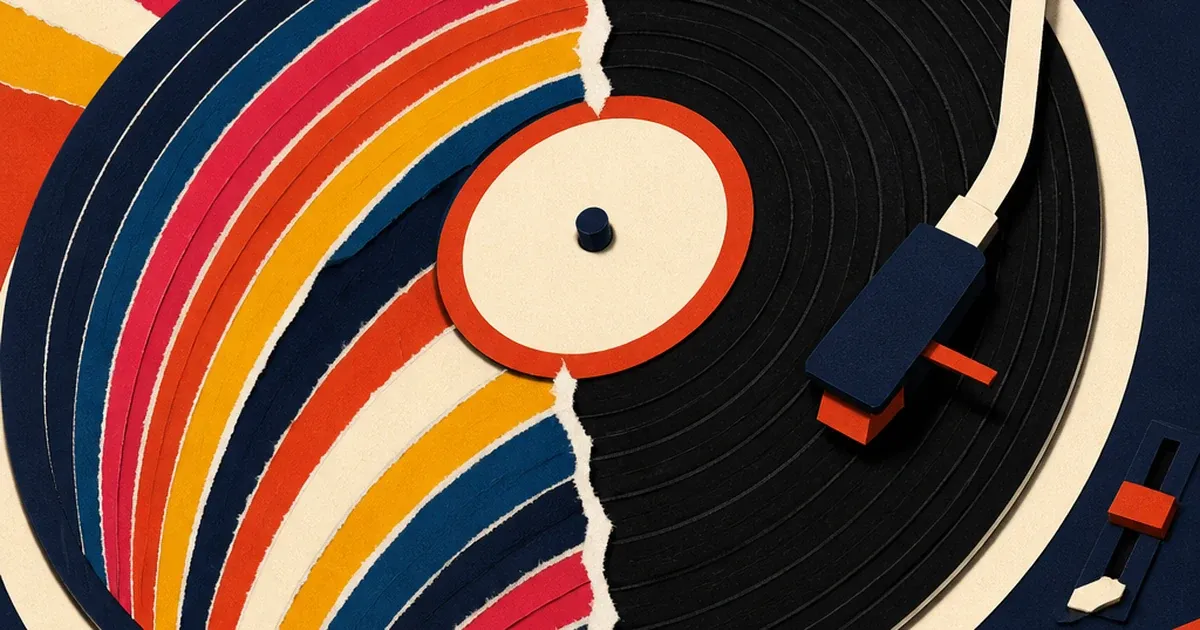
A record store photographs a fresh pressing under a strong overhead light to catch the sleeve art and the groove detail together, and the vinyl itself comes back streaked with a band of rainbow color running across the black surface. Nobody spilled anything on the record. Nobody scratched it. The pressing is flawless, the exact copy the customer would receive. The rainbow only shows up in the photo, right where the light hits the grooves at a certain angle, and it reads on screen as a defect on a product that has no defect at all.
This is not dust, oil, or a bad pressing. It is light itself splitting apart on a surface built out of thousands of microscopic parallel grooves, and it happens whether the record is brand new or decades old.
Why grooves do this to a lens and not to a shopper's eye
A vinyl record's surface is, physically, a spiral of continuous, extremely fine grooves cut to carry sound. Under the right lighting, that groove structure behaves like a diffraction grating, a surface with regularly spaced ridges that splits white light into its component wavelengths and sends each color off at a slightly different angle (Wikipedia, "Diffraction grating," 2026). A CD or DVD shows the same rainbow effect far more strongly because its data tracks are packed roughly 100 times closer together than a record's grooves, which is why the CD version of this effect is common knowledge and the vinyl version catches people off guard (physicist observation on the differing groove densities, Physics Forums thread "Interference colors on a vinyl record," 2021). Physicists studying this exact question in an open forum thread found that a vinyl groove's own geometry, not just its spacing, drives the effect: the groove's angled walls act as tiny reflectors, and light bouncing between both walls interferes with itself before it reaches the camera, producing color bands that shift with the angle of view (Physics Forums, "Interference colors on a vinyl record," contributor analysis, 2021).
A shopper picking up the same record in a store rarely sees this. The angle between a person's eye, the record, and the ambient light in a shop is almost never the narrow band of angles where the interference lines up cleanly, and human vision does not fix on one static viewpoint the way a locked-off product camera does. Point an overhead studio light at the same record and hold a camera at the matching angle, and the interference pattern that a browsing shopper would likely miss becomes the single dominant feature of the shot.
What a rainbow-streaked cover shot costs a record store
Record stores are riding one of retail's more unusual growth stories right now. US vinyl revenue crossed $1.4 billion in 2024, the RIAA's own year-end revenue report shows, marking an eighteenth consecutive year of growth for the format even as most other physical media formats kept shrinking (RIAA, "2024 Year-End Revenue Report," March 2025). Winning a share of that growth online means the product photo is doing the entire selling job, since a shopper cannot drop the needle before buying.
Ecommerce research on image quality backs up how much weight that one photo carries. Baymard Institute's research on shopper behavior found that 56% of online shoppers' first action on a product page is to explore the images, ahead of reading any title or description (cited in letsenhance.io's review of academic ecommerce research, 2026), and the same review cites Salsify's 2025 Consumer Research Report finding that 77% of shoppers say high-quality images and video are important to their purchase decision. For a collectible object bought largely on visual and tactile appeal, a rainbow artifact running across the surface reads as damage to exactly the buyer evaluating condition hardest.
Arts and Entertainment is also the single cheapest and most efficient category in this year's published ad benchmarks: the lowest average cost per click of any tracked industry at $1.63, alongside the highest average click-through rate of any category at 12.75% (WordStream/LocaliQ, "Google Ads Benchmarks 2026," 2026). Record stores sit inside that category, which means the clicks are unusually affordable and unusually likely to land, making it worse, not better, to spend that traffic on a photo carrying an artifact that was never part of the product.
Fix the interaction, not the record
Ad Studio's repair layer, enhance_asset_proxy, treats a diffraction rainbow the same way it treats any other localized optical artifact: as a targeted correction, not a full-frame relight or a reshoot. One tool covers upscaling, sharpening, denoising, lighting and white-balance fixes, background swaps, and masked repairs, all through a single model field matched to the specific flaw. A diffraction rainbow sits only where the light hits the groove surface at the trigger angle, never on the label, the sleeve, or the background, so the correction that fits is a tight masked inpaint: a mask drawn around the affected groove area, paired with a prompt describing the same record surface with a uniform, consistent black finish and no color banding, so the fix rebuilds only the surface's optical appearance and leaves the label text, sleeve artwork, and edge wear entirely untouched.
Per the standing hue-naming lesson learned across this pipeline's own prior color-correction work, the prompt never names the specific colors in the rainbow itself. It describes only the desired end state (even, uniform, matte black surface, no shimmer, no banding) rather than instructing the model to "remove the rainbow," which risks the model reading a color word as a design instruction instead of a defect description.
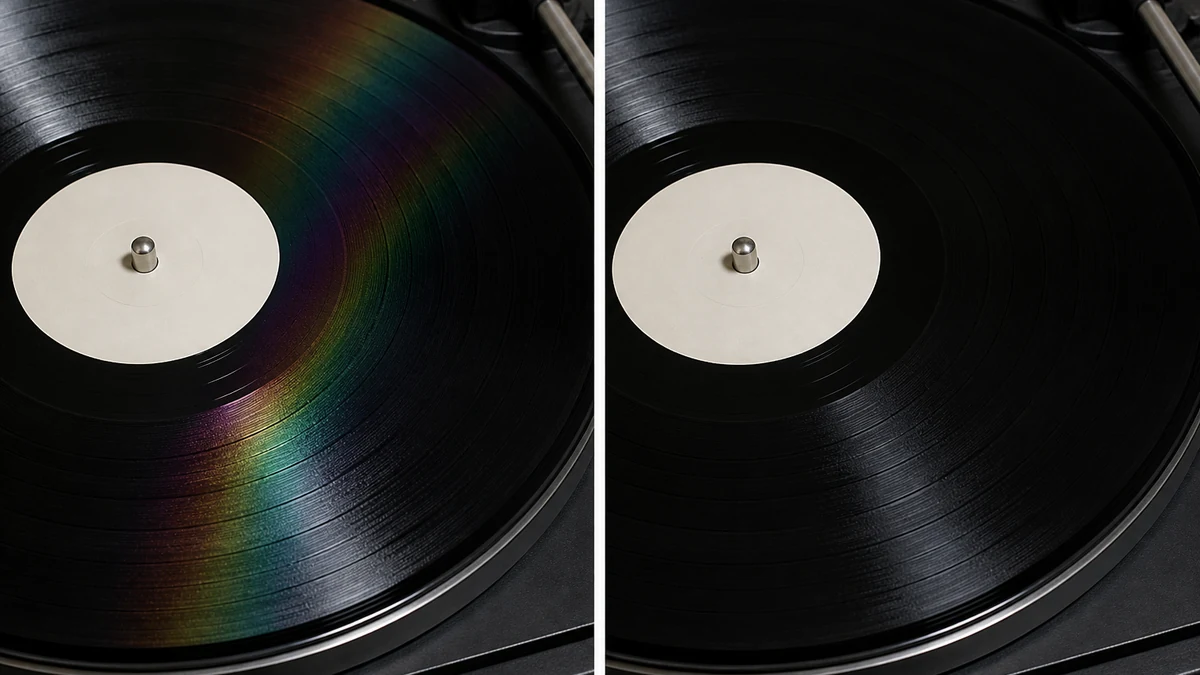
mcp.coinis.dev, the live render pipeline for enhance_asset_proxy, is in an extended OAuth outage at publish time. The image above is an illustrative composite generated separately to show the intended before/after result, not a live enhance_asset_proxy render. See the bakery display case fix for a real enhance_asset_proxy correction on a different optical problem.
Once the surface reads clean, the fan-out step is generate_image_templates, Ad Studio's primary image-ad generator. One corrected product photo becomes a square feed post, a 9:16 Story, and a horizontal Display banner in one pass, cropped and composed for each placement, without rebooking the same overhead shot three more times to catch every ad size.
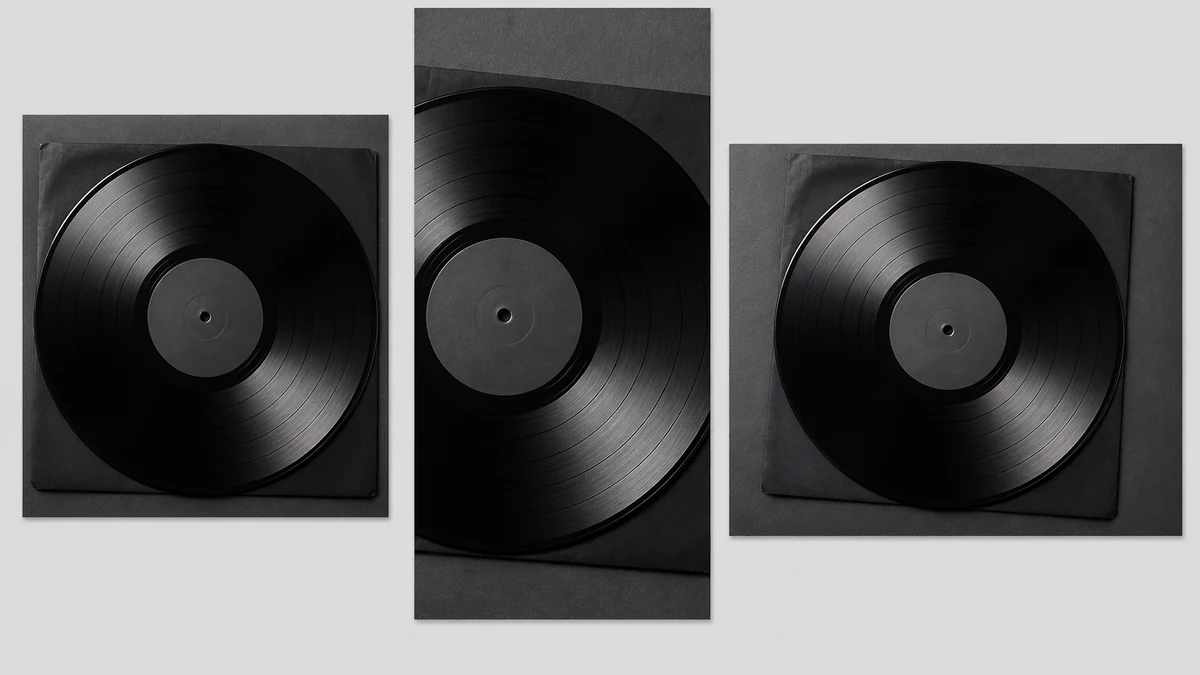
Same outage note applies here: this is an illustrative mockup of the intended generate_image_templates fan-out, not a live render. See one photo, every ad size for a real generate_image_templates fan-out.
Building this into a record store's actual workflow
A record store's catalog turns over constantly, with new arrivals, reissues, and colored-vinyl variants photographed under the same overhead lighting rig week after week, and every glossy black pressing can trigger the exact same groove-diffraction interaction regardless of how careful the studio is with white balance or exposure. The order matters every time: repair the specific surface artifact first with enhance_asset_proxy, confirm the label and sleeve are untouched, and only then hand the clean file to generate_image_templates for the size fan-out. Resizing a rainbow-streaked record photo before fixing it just multiplies the same artifact across every ad placement instead of solving it once.
This is the same underlying pattern already proven across other optically sensitive product categories: a watch's domed-crystal lens distortion, a sunglasses lens's stress-birefringence rainbow, and a solar panel's thin-film-interference iridescence are all versions of the same lesson: a fine, repeating physical structure or a transparent optical layer interacts with light in a way specific to its own physics, and the fix has to target that exact mechanism rather than a generic filter. The vinyl case is distinct from all three: it is neither a curved refractive surface, a two-polarizer interaction, nor a thin coating layer, but a reflective diffraction grating built from the groove pattern itself, the same optical family as a CD's rainbow sheen but far more subtle at a record's coarser groove spacing.
FAQ
Does the fix change the record's actual surface or grooves? No. The masked inpaint rebuilds only the color-banding artifact using the record's own base black finish as reference. Label text, sleeve artwork, and any visible edge wear stay exactly as photographed. What changes is the unintended rainbow band, not the physical product.
Can a different lighting setup avoid this at the shoot? Sometimes, since the interference depends on the exact angle between the light source and the camera relative to the groove pattern. Photographers who shoot records commercially often work at an angle that avoids the strongest banding, but it is unpredictable without testing multiple angles on every pressing, and a repair step covers whatever photo is already on file, including ones shot before anyone knew to angle around it.
Does this happen on every record, or only certain pressings? The effect depends on groove spacing and surface reflectivity more than on any specific title, so any standard black vinyl pressing can show it under the right lighting angle. Colored or picture-disc vinyl can behave differently since the surface reflects light differently, which is a separate case from this one.
Do I need a different photo for every platform's ad size? No. generate_image_templates handles the cropping and composition into each platform's spec from one corrected source photo, which is the entire point of fixing the surface once instead of on five separate exports.
The Coinis angle
A record photo with an unintended rainbow running across the groove surface does not need a rebooked overhead shoot to become usable. Repair the one photo already on file with Ad Studio's enhance_asset_proxy, confirm the label and sleeve are untouched, then turn it into a full ad-ready set with generate_image_templates, and land the result as a launch-ready ad through Ad Studio's templates instead of exporting a rainbow-streaked photo and building the ad by hand.
Sources
- Wikipedia, "Diffraction grating," accessed 2026. https://en.wikipedia.org/wiki/Diffraction_grating
- Physics Forums, "Interference colors on a vinyl record," discussion thread, February 2021. https://www.physicsforums.com/threads/interference-colors-on-a-vinyl-record.1000158/
- RIAA, "2024 Year-End Revenue Report," March 2025. https://www.riaa.com/wp-content/uploads/2025/03/RIAA-2024Year-End-Revenue-Report.pdf
- letsenhance.io, "How product image quality impacts e-commerce conversion and returns," 2026 (citing Baymard Institute and Salsify 2025 Consumer Research Report). https://letsenhance.io/blog/all/product-image-quality/
- WordStream/LocaliQ, "Google Ads Benchmarks 2026: Competitive Data & Insights for Every Industry." https://www.wordstream.com/blog/2026-google-ads-benchmarks

Isidora Matovic
Author
Social media enthusiast and a full time researcher. She takes digital presence very seriously and that is why you are always in touch in what is going on with us! Follow us for more posts like this.