
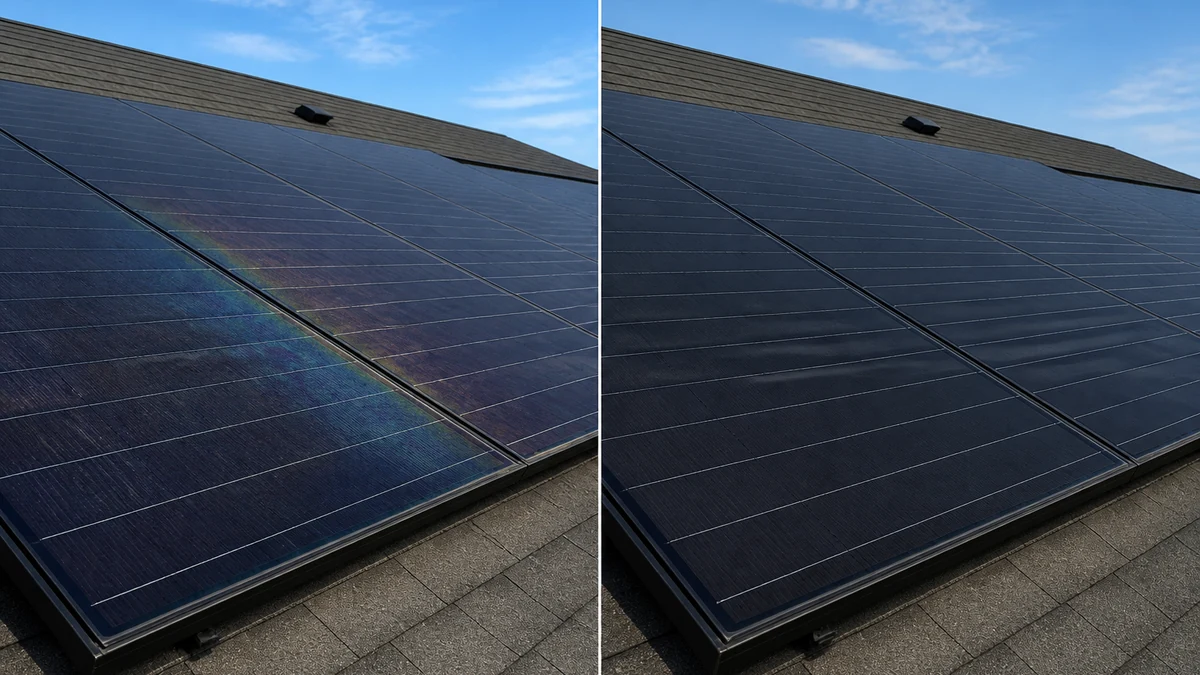
You shot the panel array at golden hour. Clean roofline, blue sky, the install looks sharp. Then you open the file and there it is: a faint oil-slick rainbow smeared across two of the panels, like someone dropped gasoline on the glass. Nothing is wrong with the panel. Nothing is wrong with your camera. The rainbow is coming from the coating that makes the panel work better.
That coating is called an anti-reflective coating, and it is doing exactly what it was engineered to do. It just does it in a way that photographs badly.
What's actually happening on the glass
Every modern solar panel has a nanometre-thin dielectric layer bonded to the glass or the silicon cell underneath. Its job is to cancel reflected light so more sunlight reaches the cell instead of bouncing off. It does this through thin-film interference: light waves reflecting off the top of the coating and light waves reflecting off the layer underneath arrive back out of phase and cancel each other out, at one specific wavelength (PVEducation.org, 2026).
That one specific wavelength is the catch. The coating is tuned to erase reflection at roughly 0.6 micrometres, the peak of the solar spectrum, so the panel captures the most energy. Every other wavelength still reflects a little. Add in tiny thickness variations across the panel surface, plus a camera viewing the glass from an angle instead of dead-on, and you get a shifting rainbow band. It is the same physics as a soap bubble or a thin film of oil on wet pavement: not a defect, not dirt, not a manufacturing flaw. A photograph freezes one viewing angle, and at that angle the coating's cancellation math falls apart into visible color.
For an installer, a panel manufacturer, or a solar financing company running ads, this is a genuine problem. A rainbow streak across a product shot reads as a scratch, a smudge, or cheap glass to anyone who has not read a photovoltaics textbook. It undercuts the exact pitch solar ads are supposed to make: quality, durability, a clean investment on your roof.
The fix: correct the color, keep the panel
The fix here is not "avoid the angle" (you cannot always control it on a real install shoot) or "add a polarizing filter" (most advertisers are working from an existing photo, not reshooting a rooftop). The fix is a targeted photo correction that neutralizes the color banding on the coating without touching the panel's actual geometry, the roofline, or the sky behind it.
Step 1: Isolate the defect with a tight mask. The iridescent band almost never covers the whole panel, and it never covers the roof, sky, or mounting hardware. A tight mask drawn around just the color-banded region keeps the correction from bleeding into parts of the photo that are already fine.
Step 2: Run a targeted repair through enhance_asset_proxy (recraft-inpaint). The prompt describes only the end state: an even, neutral, true-to-life panel surface with consistent dark blue-black color throughout, no color banding, no rainbow, no shimmer. No hue words describing the defect itself go in the prompt. Naming a specific color when asking a model to remove it is a confirmed way to get a model to paint that color back in, sometimes as a hallucinated new design element, so the instruction only ever describes what the corrected surface should look like.
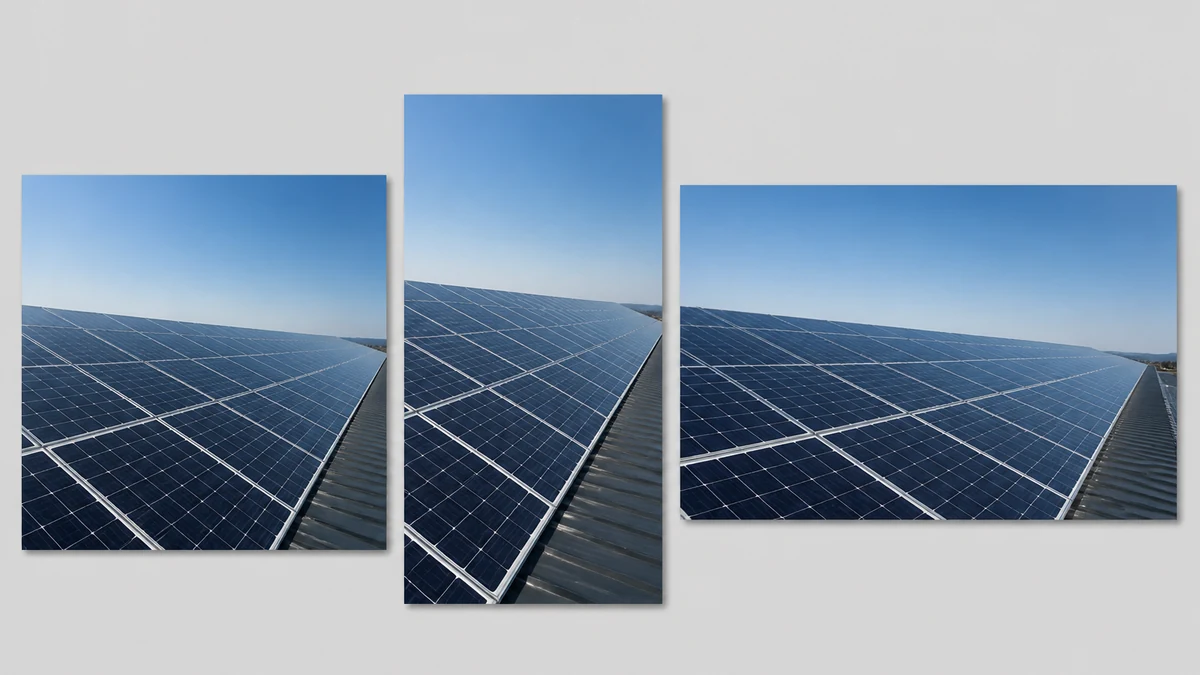
Step 3: Fan it out with generate_image_templates. Once the corrected panel photo exists, the same asset gets re-rendered into every ad format a campaign actually needs from one source photo: square for Instagram feed, vertical for Stories and TikTok, landscape for Google Display and YouTube. One corrected source photo becomes a full multi-channel launch kit instead of one static image. The underlying AI photo-enhancer correction is the same approach Coinis uses on other outdoor-shoot defects, including drone-captured roofing photos with lens flare and construction job-site dust haze.
Why this matters for the solar ad category specifically
Solar is a high-consideration purchase. A homeowner comparing installers is scanning for anything that signals "this company cuts corners," and a rainbow smear on a panel photo is exactly the kind of visual noise that reads as damage even when it is not. The category is also large enough that the fix pays for itself at scale: the US solar panel installation industry alone is a $21.6 billion market with 11,054 businesses as of 2026, growing at a 2.0% CAGR since 2021 (IBISWorld, Solar Panel Installation in the US, 2026). That is a large, fragmented field of installers all competing on trust signals in their creative, most of them without an in-house photo-retouching team.
The same fix applies whether the source photo comes from a drone survey, a customer's own phone shot for a testimonial ad, or a manufacturer's spec-sheet catalog image. Any of them can catch a panel at the wrong angle under the wrong light and pick up the same interference banding, the same way travel photos can pick up a halo artifact around bright light sources or outdoor landscaping shots can pick up a color cast from ambient light nobody planned for.
What to do now
If you run ads for a solar installer, a panel manufacturer, or a solar financing brand, pull your last batch of panel photography and look at it under real scrutiny, not a quick glance. Rainbow banding is easy to miss on a phone screen and obvious on a full-size ad creative. Any photo carrying it is one photo-repair pass away from being usable, and once it is corrected, the same source image can be turned into a full set of ad formats in one pass through Coinis Ad Studio rather than re-shooting or re-editing each size by hand. That is the actual leverage: one clean photo in, a launch-ready ad kit out.
FAQ
Is the rainbow on my solar panel photo actually a coating defect? No. It is a normal side effect of the anti-reflective coating's thin-film interference physics, which is tuned to cancel reflection at one wavelength and lets others reflect faintly. It shows up more at oblique camera angles and does not indicate a faulty or damaged panel.
Will this happen to every solar panel photo? Not every shot. It depends on the camera angle relative to the panel surface, the lighting, and small thickness variations in the coating across the array. Straight-on shots in flat, diffuse light are far less likely to show it than angled shots in direct sun.
Can I just avoid this by changing how I shoot? Shooting straight-on in overcast or diffuse light reduces the odds, but it does not eliminate the risk, and it is not always practical on a live rooftop install. A photo-correction pass is the more reliable fix for photography you already have.
Does correcting this count as misleading advertising? No. You are removing a photographic artifact caused by lighting and coating physics, not altering the actual product, its specs, or its performance. The panel in the corrected photo is the same panel. The color banding was never a feature of the product being sold.
What ad formats should I generate from the corrected photo? At minimum, a square crop for Meta and Instagram feed, a vertical 9:16 for Stories/Reels/TikTok, and a landscape crop for Google Display and YouTube. Generating all three from the same corrected source keeps the creative consistent across every channel a solar campaign runs on.
Sources
- PVEducation.org, "Anti-Reflection Coatings," thin-film interference mechanism and ARC physics. https://www.pveducation.org/pvcdrom/design-of-silicon-cells/anti-reflection-coatings
- IBISWorld, "Solar Panel Installation in the US Industry Analysis, 2026," $21.6bn market size, 11,054 businesses, 2.0% CAGR 2021-2026. https://www.ibisworld.com/united-states/industry/solar-panel-installation/4494/

Isidora Matovic
Author
Social media enthusiast and a full time researcher. She takes digital presence very seriously and that is why you are always in touch in what is going on with us! Follow us for more posts like this.