
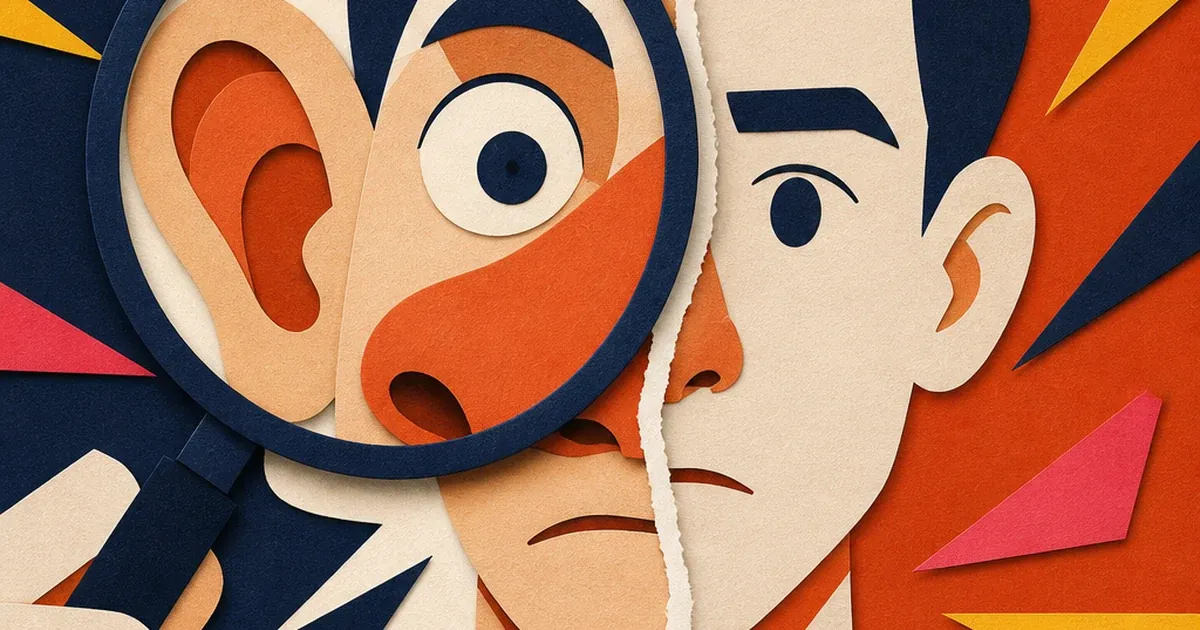
A law firm's website traffic runs through the attorney bio page more than almost anywhere else on the site, and the photo at the top of that page is doing work long before a potential client reads a single credential. Get the shot from too close, on a laptop webcam or a phone held at arm's length, and the face in it does not look like the person walking into the conference room. The nose reads larger. The forehead reads wider. The ears look pushed back toward the edges of the frame. None of it is a lighting mistake or a bad expression. It is what a lens does to a face photographed from too near, and it is one of the most common headshot problems a firm never notices until the photo is already live on every attorney's page, every directory listing, and every ad.
Why the camera distance, not the lens, is doing this
Perspective distortion in a portrait comes from how close the camera sits to the subject, not from the focal length written on the lens. Wikipedia's entry on the phenomenon lays out the mechanism plainly: a camera positioned close to a face exaggerates the relative size difference between features that are near the lens (the nose, the front of the chin) and features that sit farther back (the ears, the sides of the head), because those closer features occupy a disproportionately larger share of the frame the nearer the camera gets. A National Institutes of Health-published study on camera focal length and picture perception makes the same point from the research side: apparent expansions and compressions in a portrait's depth are a function of shooting distance, not a defect in the optics themselves (Wikipedia, "Perspective distortion (photography)," accessed 2026, and NIH/PMC, "Camera Focal Length and the Perception of Pictures," accessed 2026).
That distinction matters for where this shows up. A remote associate photographing their own headshot on a laptop's built-in camera, or a partner snapping one on a phone held at arm's length between calls, is shooting from exactly the close range that produces the strongest version of this effect. No lighting kit or backdrop fixes it, because the flaw was set the moment the camera was positioned, before the shutter ever opened.
Why a law firm's photo carries more weight than most industries' do
Attorney bio pages are not a background element of a firm's marketing. Martindale-Avvo's 2026 State of the Legal Consumer research found that 92.4% of legal consumers research their issue online before ever contacting an attorney, and a large share of that research lands on the attorney's own bio photo before a single credential gets read (Martindale-Avvo, "The State of the Legal Consumer Report 2026," accessed 2026). A photo that reads as slightly off, even when a viewer cannot say exactly why, is doing the opposite of the job it was hired to do on a page built to establish trust before a phone call ever happens.
The industry is also large enough that this is not a niche problem. IBISWorld's market-size tracking puts US law firm revenue at 422.4 billion dollars in 2026, growing at a 0.9% CAGR, a market where an enormous number of small and mid-size firms are running their own marketing and photographing their own attorneys without a studio budget attached (IBISWorld, "Law Firms in the US - Market Size," accessed 2026). Every one of those firms is a candidate for exactly this flaw landing on the page that is supposed to close the sale.
The fix has to happen once, not per photo
A firm cannot simply reshoot its way out of this at scale. Partners are spread across offices, associates work remotely, and a lateral hire's headshot from a previous firm is often the only photo on file. Reshooting an entire roster every time someone notices a distorted feature is not realistic, and correcting the geometry manually, photo by photo, in a general image editor does not scale to a firm with dozens of bios either.
Ad Studio's enhance_asset_proxy handles this as a masked correction rather than a reshoot. The same tool that fixes lighting, background, and exposure flaws elsewhere in this vertical series also supports a targeted recraft-inpaint correction, and a distorted face is a defined region of the frame, not a whole-photo problem. The mask is drawn tight around the face itself, leaving the suit, the background, and the framing untouched, and the prompt describes only the target state, natural, proportionate facial features matching a normal portrait perspective, never naming the flaw itself. Naming a specific defect in an enhance_asset_proxy prompt has repeatedly triggered the model to invent an unrelated scene instead of correcting the one it was given, so the instruction stays scoped to what the corrected photo should look like, not what is wrong with the one on file.
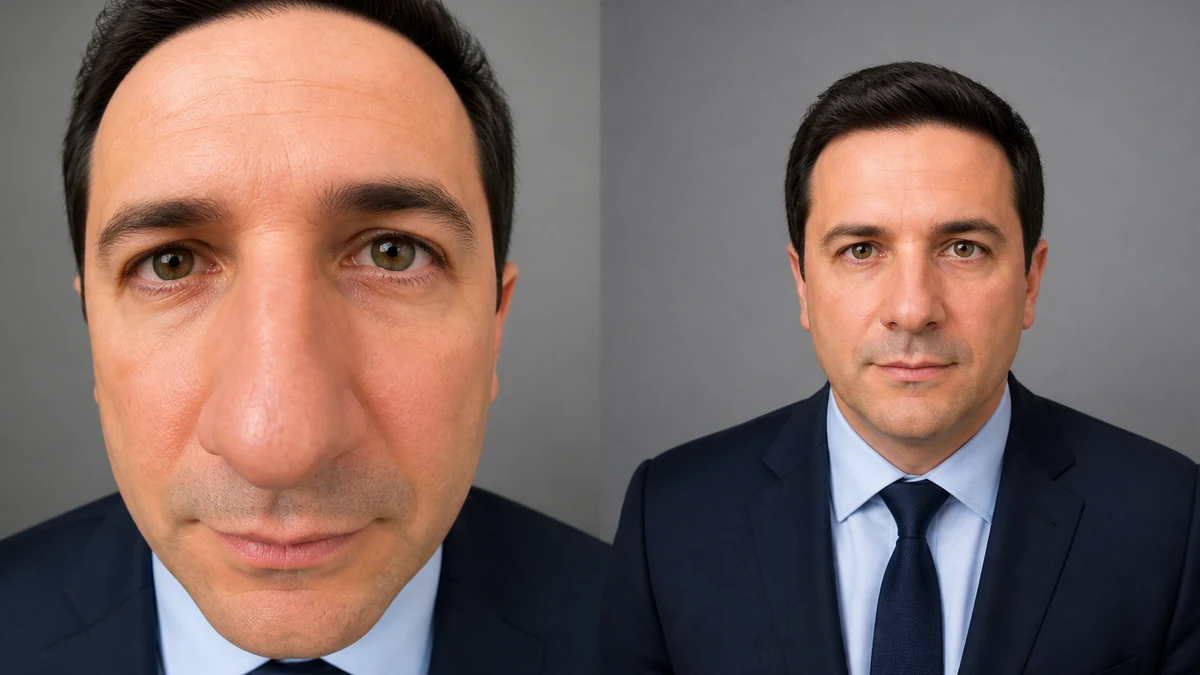
mcp.coinis.dev's Ad Studio connection is in an extended outage as this article publishes, so the image above is an illustrative mockup rather than a live enhance_asset_proxy render. For a real enhance_asset_proxy recraft-inpaint correction, see the fishing tackle photo purple-fringe fix article, which shows the tool's actual output.
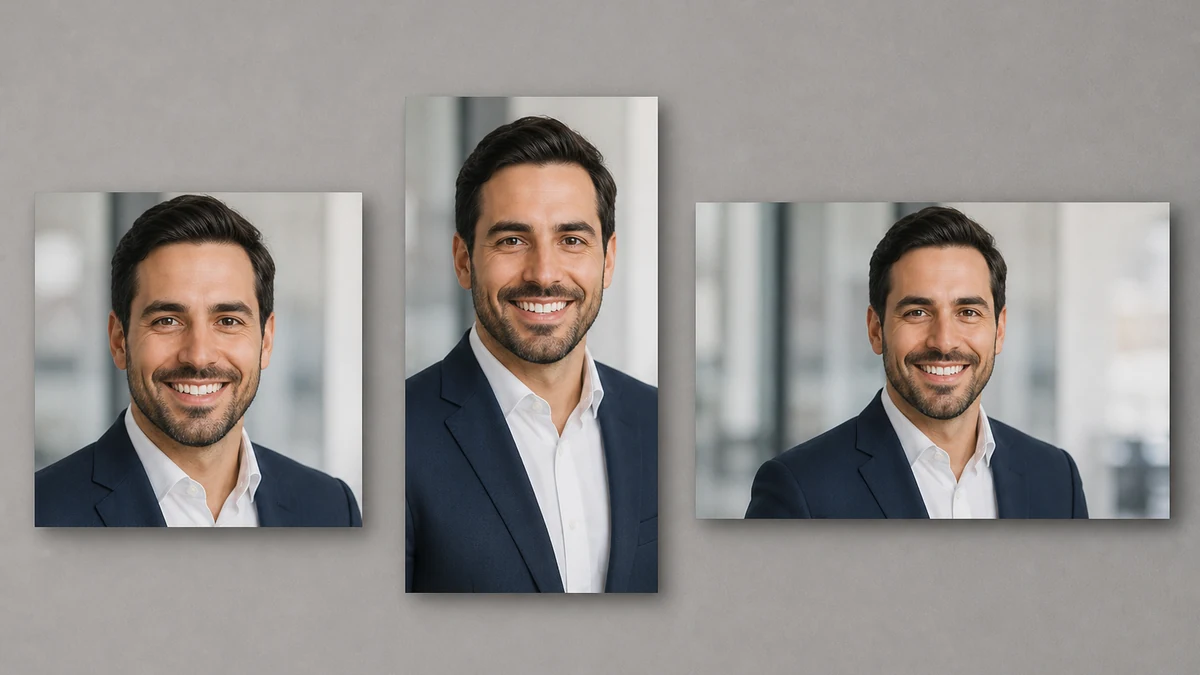
Once the geometry reads naturally, generate_image_templates, Ad Studio's primary image-ad generator, turns that one corrected headshot into a square feed post, a 9:16 Story format, and a horizontal Display banner from a single source, so the distortion that would have shipped across every platform a firm advertises on gets corrected once instead of six separate times.
Building this into a firm's actual photo roster
A firm onboarding a new associate, welcoming a lateral partner, or simply auditing an outdated attorney directory has the same order of operations every time: correct the geometry first with enhance_asset_proxy, confirm the person is still recognizably themselves with nothing else in the frame altered, and only then hand the corrected file to generate_image_templates for the format fan-out. Running the fan-out on a distorted source just multiplies the same flaw across every ad size instead of removing it once.
This is a different mechanism from a portrait studio's lens vignetting, which darkens the corners of a frame rather than exaggerating the proportions of the subject inside it, and from a gadget photo's mirrored studio reflection, which is a flat surface reflecting the room rather than a lens distorting a face. It shares the same underlying lesson as a wedding photo's blown-out fabric highlight: a flaw baked in at the moment of capture needs a correction scoped to the specific mechanism that caused it, not a generic filter applied across the whole image. A firm with a corrected version of every attorney's current headshot on file can turn any of them into a fresh ad set the moment a new practice area launches or a slow quarter calls for new creative, instead of scheduling a reshoot every attorney does not have time for.
FAQ
Does correcting the distortion change how the attorney actually looks? No. The correction restores natural, proportionate facial geometry, the same balance a photo taken from a normal portrait distance would show. It does not change the person's actual features, expression, clothing, or the background behind them.
Is this the same fix as retouching skin or removing blemishes? No. Perspective distortion is a geometric problem caused by camera distance, not a skin-texture or blemish issue. enhance_asset_proxy's masked correction targets facial proportions specifically, which is the mechanism this flaw actually needs.
Can we just tell attorneys to stand farther from the camera next time? That prevents new photos from having the problem, but it does nothing for headshots already taken, already published on bio pages, and already used in directory listings and past ads. This fix is for the photos that already exist and still need to go into new campaigns.
Do we need a different photo for every platform's ad size? No. generate_image_templates produces the crop and composition for each platform's spec from one corrected source photo, so a firm corrects each attorney's headshot once and reuses it across every format instead of managing separate versions per platform.
The Coinis angle
An attorney headshot with a distorted nose or forehead does not need a reshoot to become ad-ready. Correct the one photo already on file with Ad Studio's enhance_asset_proxy, confirm the attorney is still recognizably themselves, then turn it into a full ad-ready set with generate_image_templates, and launch the result through Ad Studio's templates instead of running a bio photo that quietly undermines the trust it was supposed to build.
Sources
- Wikipedia, "Perspective distortion (photography)," accessed 2026. https://en.wikipedia.org/wiki/Perspective_distortion
- NIH/PMC, "Camera Focal Length and the Perception of Pictures," accessed 2026. https://pmc.ncbi.nlm.nih.gov/articles/PMC4114730/
- Martindale-Avvo, "The State of the Legal Consumer Report 2026," accessed 2026. https://www.martindale-avvo.com/academy/research/the-state-of-the-legal-consumer-2026-legal-consumers-in-an-ai-first-world/
- IBISWorld, "Law Firms in the US - Market Size," accessed 2026. https://www.ibisworld.com/united-states/market-size/law-firms/1389/

Isidora Matovic
Author
Social media enthusiast and a full time researcher. She takes digital presence very seriously and that is why you are always in touch in what is going on with us! Follow us for more posts like this.