
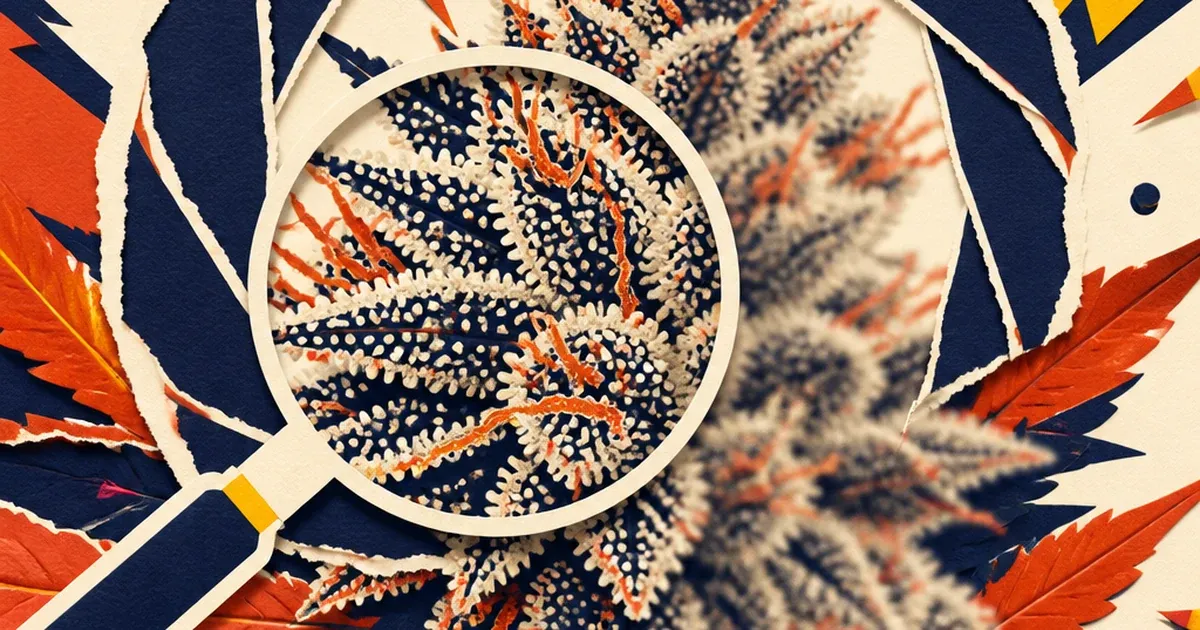
Trichomes are the whole sale in a flower photo. They are also, physically, close to invisible. A capitate-stalked gland head on mature cannabis flower runs roughly 40 to 110 microns across, according to a 2023 morphology study published in the Journal of Cannabis Research [1] -- a human hair is about 70 microns wide. Shoot that at the magnification a product photo needs and you are no longer fighting focus. You are fighting physics.
What's actually happening
Every macro lens has a point where closing the aperture stops helping. Stop down to get more of the flower in focus, and the lens starts spreading light through a smaller opening, which bends it. That bending -- diffraction -- smears a point of light into a slightly larger blur circle (an Airy disk) on the sensor. At normal shooting distances the blur is too small to notice. At macro magnifications, where every micron of the subject maps to many more microns on the sensor, that same blur circle can be larger than the trichome gland it's supposed to resolve. PhotoPills' macro diffraction documentation walks through exactly this: diffraction calculators built for standard photography don't account for magnification at all, because magnification is what turns an invisible softening into a visible one [2].
This is why sharpening a shot like this in post often does nothing. Sharpening amplifies edge contrast in detail that's already there. If the diffraction blur circle swallowed the trichome's actual edges before the shutter even opened, there's no edge left to amplify. You're sharpening noise, not signal.
It's worth saying plainly: softness in a macro shot isn't always diffraction. A missed focus point, a shallow depth of field at a wide aperture, camera shake, or lens flare can all produce a similar blur, and a photographer troubleshooting a soft trichome shot should rule those out first before assuming it's a diffraction ceiling. Experienced cannabis photographers already work around all of this with focus stacking -- shooting a sequence of frames at different focus points and merging only the sharp regions of each, often at f/8-f/11 with a macro rail and strobe lighting to kill vibration, as one working cannabis photographer's own technique breakdown describes in detail [3]. It's the right fix. It's also slow, gear-heavy, and not something a budtender photographing a new drop at 9pm before a menu update is going to do.
The AI angle
This is a case where AI photo-enhancer tools are doing something narrower than "restore detail that wasn't captured." They can't un-diffract a blur circle, and no honest description of this workflow should claim they can. What an upscale/enhance pass CAN do: clean up the compression and resizing artifacts stacked on top of the optical softness, boost local contrast so the trichome field reads as texture instead of a flat haze at thumbnail size, and get a usable base image out of a shot that would otherwise look mushy in a product grid. Call it apparent clarity, not restored resolution, because that's what it actually is.
Coinis's Ad Studio runs this as a two-step pass on an existing product photo. First, enhance_asset_proxy (the same repair tool already demonstrated on electronics screen reflections and jewelry glare elsewhere on this blog) runs an upscale/sharpen operation tuned to the photo's resolution target. Then generate_image_templates takes that corrected image and produces the matching ad-size set from one source photo -- square, story, landscape -- instead of a separate photoshoot per format.
Worked example (illustrative, following the standard photography workflow above -- mcp.coinis.dev's live generation endpoint was unreachable during this drafting session, see disclosure below):
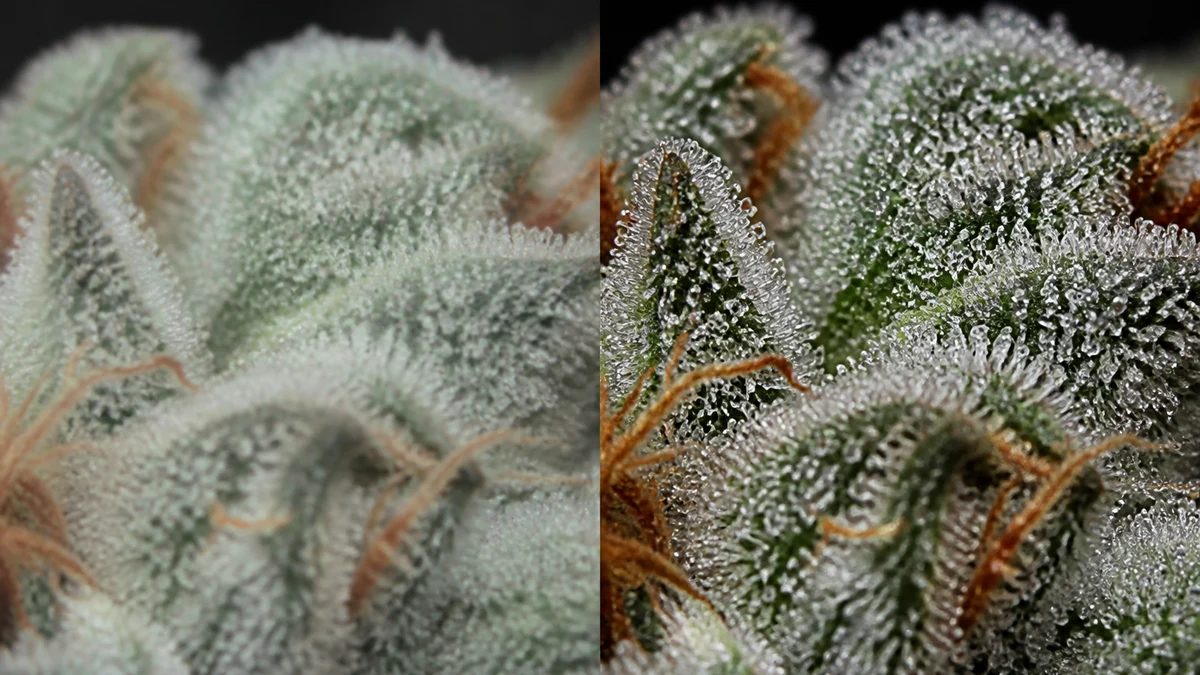
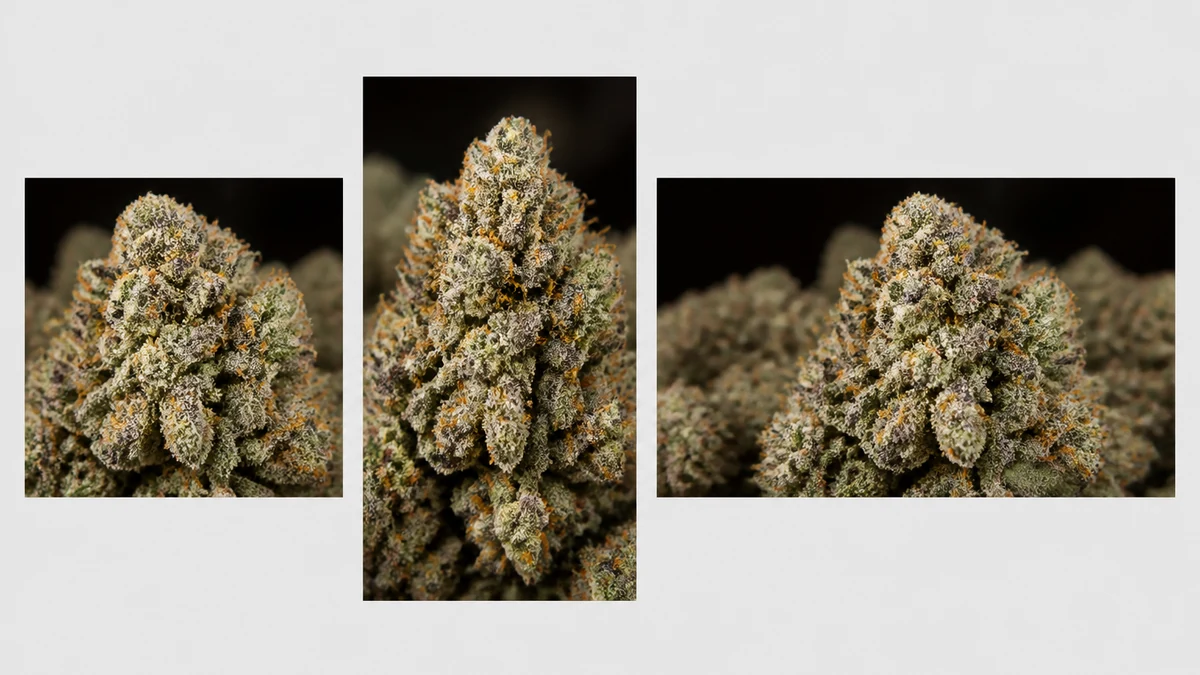
Honest disclosure (standing MCP-outage protocol, per references/mcp-oauth-outage-log.md): mcp.coinis.dev's OAuth connection was down for every prior session this week (confirmed again on 2026-10-07/08), so the images above, once generated, will be illustrative stand-ins built the same way this article describes rather than a live enhance_asset_proxy render. A sibling article on fishing tackle purple fringe correction has a confirmed real enhance_asset_proxy render of the same repair category (lens-optics correction) if you want to see the tool's actual output on a live creative. This article's images will be swapped for a real render once the connection is back.
Why this matters for the menu, not just the photo
A dispensary's product photo usually has one job: make the buyer believe the frost is real before they're standing at the counter. A soft, hazy macro shot reads as a cheap photo, not a weak batch -- but buyers scrolling a menu can't always tell the difference, and a flat, hazy image loses the sale to a sharper-looking competitor regardless of what's actually inside the jar. Getting six ad-ready crops out of one corrected photo means that same fix covers the menu thumbnail, the Instagram story, and the in-store display screen without a second photo session.
What to do now
- Shoot at the sharpest aperture your macro setup allows before assuming the image needs rescuing in post -- diffraction gets worse, not better, as you stop down for depth of field.
- If focus stacking isn't practical for a same-day drop, run the single best frame you have through an upscale/sharpen pass rather than a generic "auto-enhance" filter, which tends to oversharpen the parts of the image that are already in focus while doing nothing for the parts that aren't.
- Fan the corrected photo into your actual ad-size set once, instead of resizing (and softening further) a single master image by hand for each placement.
- Keep the photo's own description to what the image actually shows -- texture, color, structure -- and leave potency, effect, or quality claims off the creative entirely. A sharp photo is not evidence of THC content or grade, and claiming otherwise is exactly the kind of thing that invites platform and regulatory scrutiny neither this article nor Coinis is positioned to advise on. For platform-specific ad policy and compliance questions, Coinis's own cannabis industry page covers how its templates work within Meta's current restrictions.
FAQ
Is this the same problem as a blurry phone photo? No. A blurry phone photo is usually camera shake or missed focus -- both fixable by holding the phone steady or tapping to focus. Diffraction softness happens on a technically well-focused, well-held shot. The aperture setting itself is the limiting factor, and it only becomes visible at macro magnifications.
Does switching to a sharper camera fix this? Only partly. A higher-resolution sensor can resolve finer detail up to the point where diffraction takes over. Past that point, more megapixels just capture the same blur more precisely. The aperture and magnification, not the sensor, set the ceiling.
Can AI sharpening make a soft trichome photo look fake or over-processed? Yes, if pushed too hard -- oversharpening creates a crunchy, haloed look around edges that reads as obviously synthetic. The goal is a clean, natural-looking upscale pass, not a maximum-strength filter.
Will a sharper product photo change how the product is actually priced or graded? No. The photo documents what the flower looks like. It has no bearing on lab testing, grading, or pricing, and nothing in this workflow should be framed as evidence of either.
Sources
[1] "Glandular trichome development, morphology, and maturation are influenced by plant age and genotype in high THC-containing cannabis (Cannabis sativa L.) inflorescences," Journal of Cannabis Research, 2023. https://link.springer.com/article/10.1186/s42238-023-00178-9 [2] PhotoPills, "Macro Diffraction Calculator" (diffraction-and-magnification explainer). https://www.photopills.com/calculators/diffraction-macro [3] Ginja Club, "Focus Stacking: What is it, and is it a must for Cannabis Photography?" (independent photographer's technique guide, not a competing ad-generation or AI-creative product). https://www.ginja.club/blog/focus-stacking-what-is-it-and-why-do-you-need-it-for-cannabis-photography

Isidora Matovic
Author
Social media enthusiast and a full time researcher. She takes digital presence very seriously and that is why you are always in touch in what is going on with us! Follow us for more posts like this.