

In the Meta vs TikTok ads e-commerce debate, the answer isn’t simple. You already know Meta is getting more expensive. CPMs up nearly 20% year-over-year, competition stiffer, and every media buyer in your vertical bidding on the same audiences. TikTok looks tempting: cheaper reach, massive engagement, a platform built around the kind of impulse buying that works well for e-commerce. So the real question isn’t “should I test TikTok.” It’s how much of your budget should actually move, and what you give up when it does.
This Meta vs TikTok ads e-commerce breakdown covers the real 2026 numbers on both platforms: CPMs, ROAS, audience behavior, TikTok Shop growth, and a clear framework for deciding where your money goes.
Key Takeaways
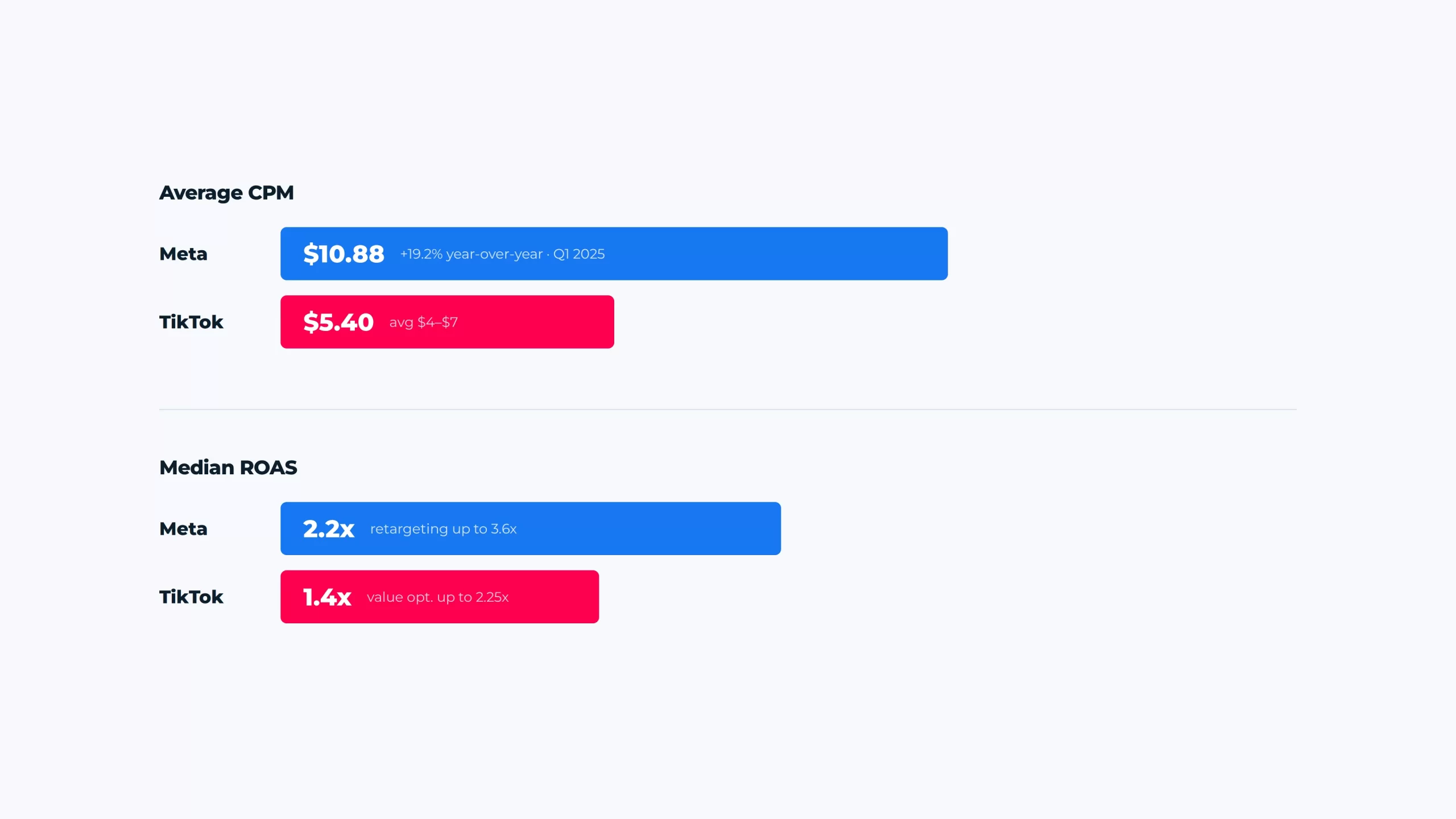
- Meta’s CPM hit $10.88 in Q1 2025, up 19.2% year-over-year, but it still delivers a median ROAS of 2.2x vs TikTok’s 1.4x
- TikTok CPMs run $4–$7, but cheaper reach doesn’t automatically mean cheaper sales
- TikTok Shop hit $15.82 billion in U.S. sales in 2025, up 108% from 2024
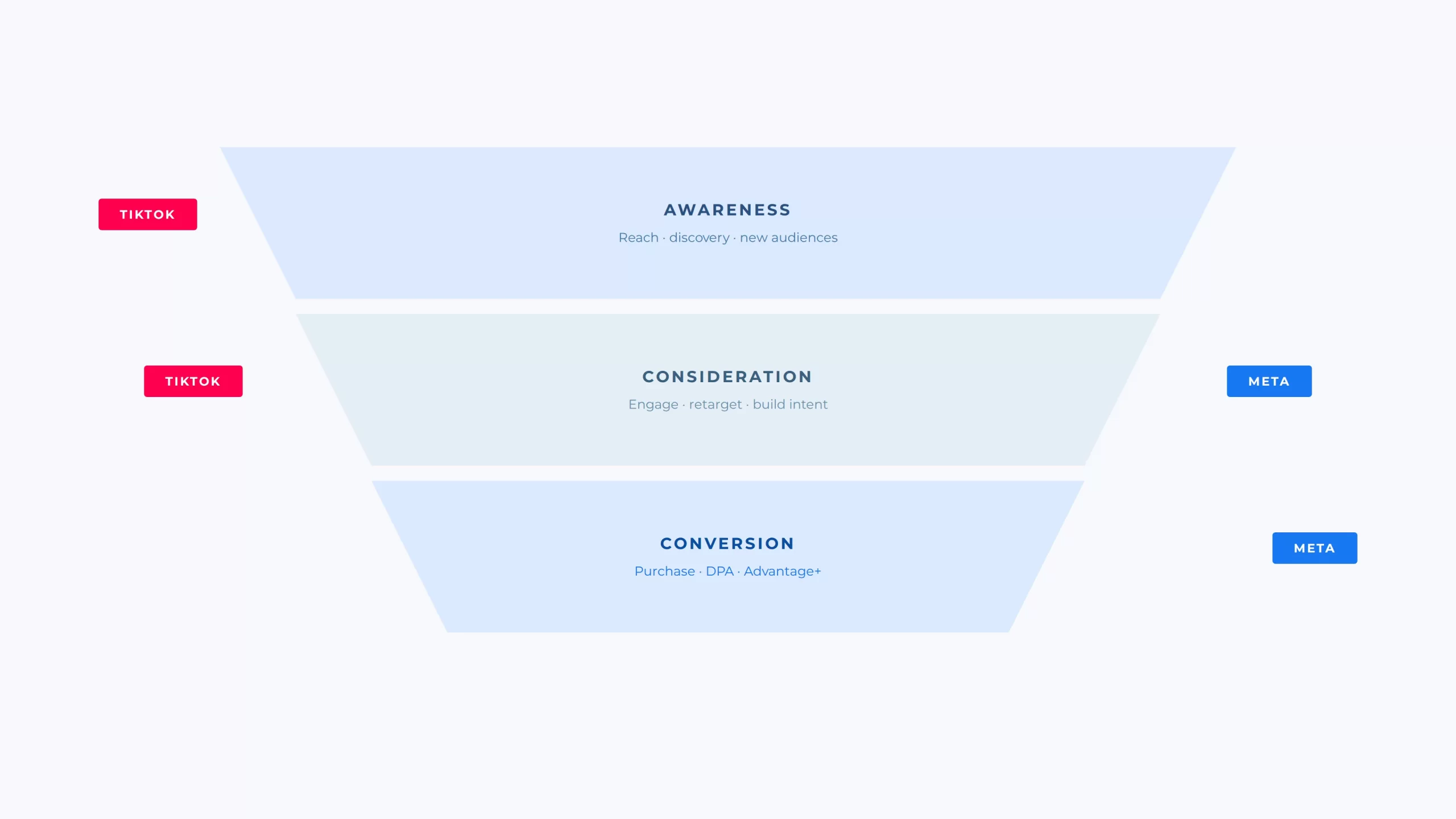
- The two platforms serve different funnel stages: Meta closes, TikTok discovers
- Budget split guidance depends on your AOV, product type, and audience age profile
Meta vs TikTok Ads E-Commerce: The CPM Gap Is Real, But Not the Whole Story
The most common argument for shifting budget to TikTok is cost. On the surface, it holds up. TikTok CPMs ranged from $4 to $7 in 2025, while Meta’s average global CPM climbed to $8.74, up from $7.91 the previous year. Go deeper and Meta’s CPMs hit $10.88 in Q1 2025 specifically, up 19.2% from the prior year.
That’s a meaningful gap. But here’s the trap most e-commerce brands fall into: CPM is what you pay to get in front of someone. It is not what you pay to get a sale.
The conversion gap between the two platforms is where the real story is. Meta platforms show a median ROAS of 2.2x, with retargeting campaigns reaching 3.61x compared to 2.19x for new customer acquisition. TikTok Ads average ROAS sits at 1.4x. TikTok is cheaper to reach people. Meta is more likely to turn those people into paying customers.
That doesn’t make TikTok a bad channel. It makes it a different one, and understanding that difference is what separates brands spending smart from brands just chasing trends.
What TikTok Is Actually Good At in 2026
TikTok’s value for e-commerce isn’t primarily in direct conversion. It’s in discovery at scale, and the numbers on that side are hard to ignore.
About 71.2% of TikTok shoppers say they’re inspired to shop when they stumble across something in their feed. That’s not intent-driven traffic. That’s impulse buying triggered by content, and it’s a completely different purchase psychology than someone clicking a Meta retargeting ad for a product they already viewed.
Where this becomes a real revenue driver is TikTok Shop. TikTok Shop grew its U.S. sales by 108% in 2025, reaching $15.82 billion and commanding 18.2% of total social commerce in the U.S., according to eMarketer. Two years ago it was a rounding error. Now it’s a channel worth taking seriously, but only if your catalog fits it.
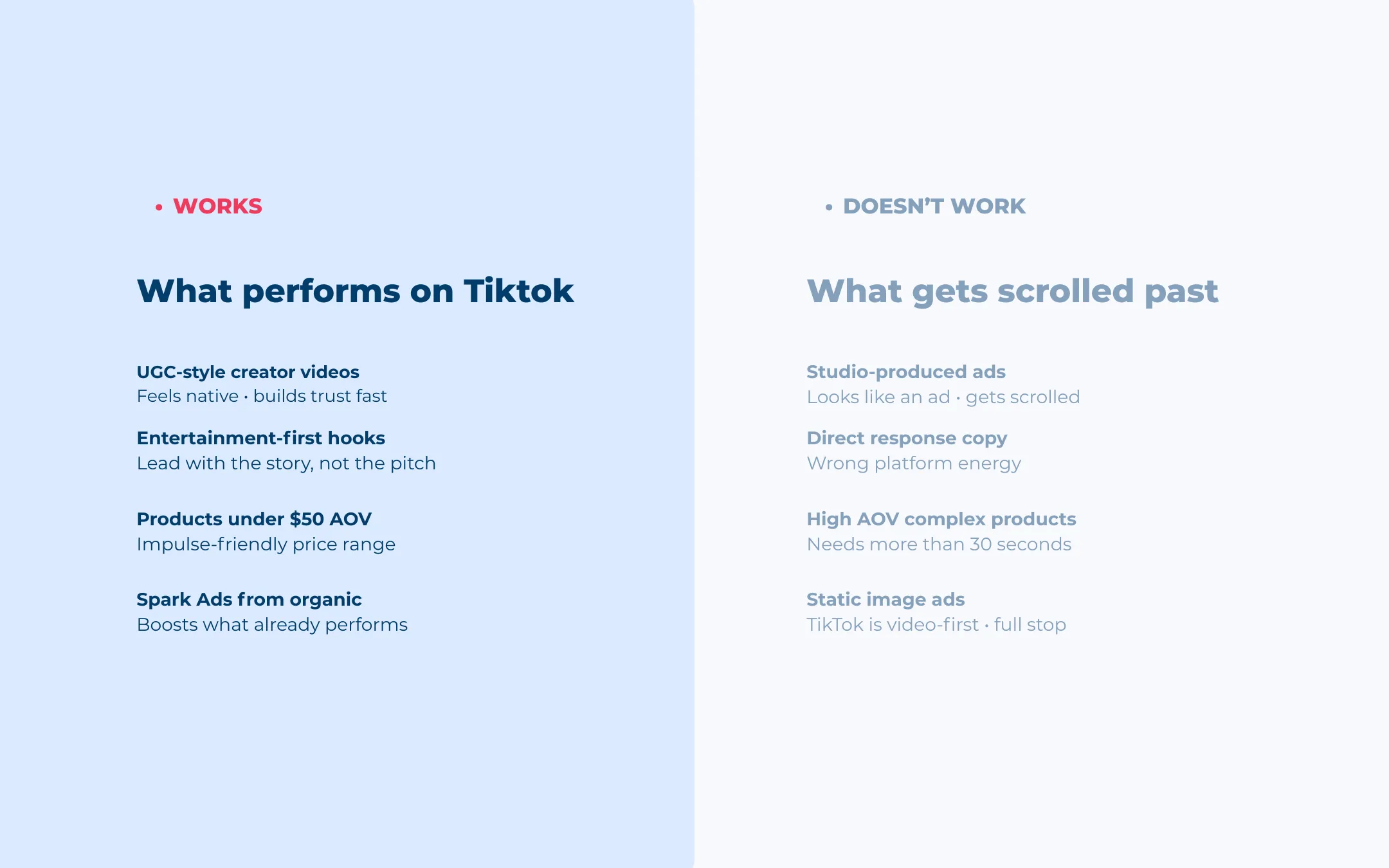
TikTok Shop converts discovery into purchases, not ads into purchases the way Meta does. The products that work best are visually compelling, low-friction to explain in 30 seconds, and priced under $50. Beauty, accessories, home gadgets, fitness products. If your average order value is $150 and your product takes a five-minute explanation to sell, TikTok Shop is a rough fit. If your SKUs are the kind of thing that makes someone stop scrolling and immediately think “I need that,” it’s worth a serious test.
The creative angle matters too. TikTok rewards content that looks like TikTok, not ads that happen to run on TikTok. UGC-style videos, creator hooks, and product demos that lead with entertainment consistently outperform direct-response formats on this platform.
Where Meta Still Wins
Meta’s advantages in 2026 come down to two things: targeting depth and purchase intent.
The Facebook Pixel, Conversions API, dynamic product ads, and Advantage+ Shopping all work together in a system trained on a decade of e-commerce purchase data. When someone browses your product page and doesn’t buy, Meta knows that. When they come back three days later, Meta knows that too. That infrastructure doesn’t exist at the same level on TikTok yet.
Meta’s targeting lets advertisers reach their exact audience with proven tools like dynamic product ads and the Facebook Pixel, helping track conversions and measure ROI more effectively. It also tends to learn purchase behavior faster, generating better CAC and ROAS more consistently week to week.
The trade-off is cost. Meta’s CPC increased 18.95%, moving from $1.40 in 2024 to $1.67 in 2025. And cost per lead jumped approximately 20%, reaching around $27.66. Meta is getting more expensive. But it stays dominant for e-commerce because it still converts better than anything else in paid social at scale.
One thing worth tracking: Meta spent 38% more of its budget reaching existing customers compared to TikTok’s 10% gap between CPA and net-new CPA. If new customer acquisition is your primary goal, TikTok actually has an edge there. Meta is great at closing, but a growing chunk of what it’s closing is people already in your funnel.
Meta vs TikTok Ads E-Commerce Budget Allocation
There’s no universal split that works for every Meta vs TikTok ads e-commerce setup. But there is a logical framework based on what each platform is actually built for.
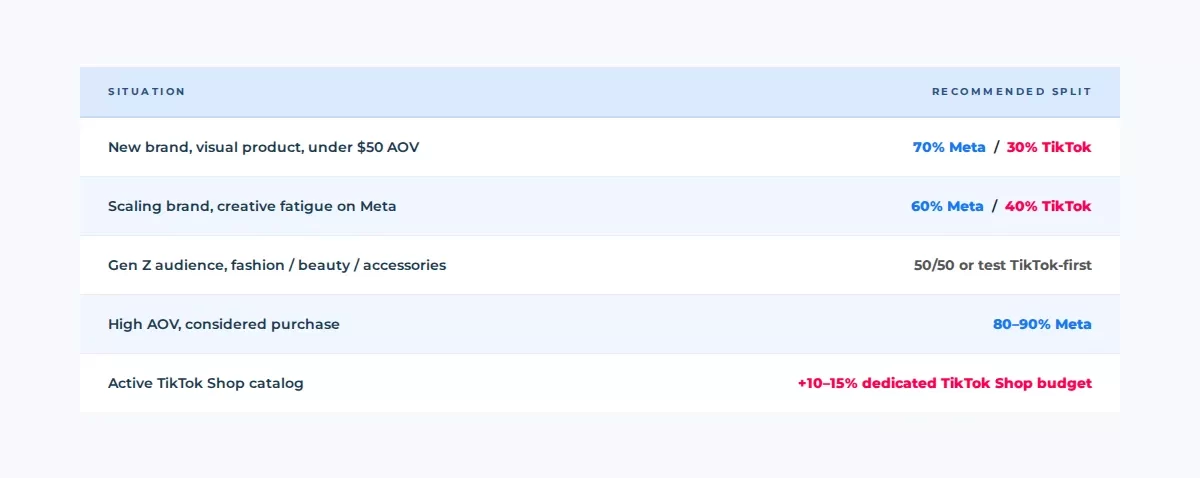
If you’re an early-stage brand or selling visually compelling, impulse-friendly products (beauty, accessories, home goods, fitness), start with roughly a 70/30 split leaning Meta. Put 15–20% of the TikTok budget toward UGC-style creative tests and treat it as a creative research investment as much as a paid channel. What performs on TikTok often tells you what hook to bring back to Meta.
If you’re scaling past $500/day on Meta and hitting creative fatigue on Meta, TikTok becomes genuinely useful for reaching cold audiences that Meta has already burned through. A practical cross-platform approach: capture audiences on TikTok, then retarget them on Meta where the conversion rate is stronger. TikTok handles top-of-funnel reach, Meta closes the sale.
If your product targets Gen Z specifically, the math shifts faster. Gen Z spends 67% more time on TikTok than on Instagram, and TikTok Shop’s buyer base skews heavily in that direction. In beauty and fashion especially, not being on TikTok means missing active demand, not just awareness.
If your AOV is above $100 or your product needs real explanation to sell, lean Meta hard. TikTok’s impulse-buying dynamic works against you when the purchase decision takes longer.
One thing to get right before making any of these calls: attribution. TikTok and Meta use different attribution methods, which means platform-reported ROAS comparisons between the two can be misleading. Always run blended or first-party attribution alongside what each platform reports about itself, otherwise you’ll end up cutting channels that are actually working.
Use Both and Use Them Right
When it comes to Meta vs TikTok ads e-commerce strategy, the two platforms aren’t competing for the same job in your funnel. Meta closes. TikTok discovers. The brands seeing the strongest results in e-commerce right now aren’t choosing between them. They’re using both deliberately, with clear roles for each.
Meta’s rising costs are real, and you should be tightening creative testing and leaning on Advantage+ Shopping to hold efficiency. But don’t let TikTok’s lower CPM trick you into thinking it’s a straight swap. A cheaper impression that doesn’t convert is still wasted spend.
Start where your audience is. Test with purpose. When splitting your Meta vs TikTok ads e-commerce budget, measure what actually matters: blended ROAS, CAC, and new customer rate across both platforms together, not just what each dashboard tells you about itself.
Start where your audience is and test with purpose. When splitting your Meta vs TikTok ads e-commerce budget, measure what actually matters: blended ROAS, CAC, and new customer rate across both platforms together, not just what each dashboard tells you about itself.

Isidora Matovic
Author
Social media enthusiast and a full time researcher. She takes digital presence very seriously and that is why you are always in touch in what is going on with us! Follow us for more posts like this.