
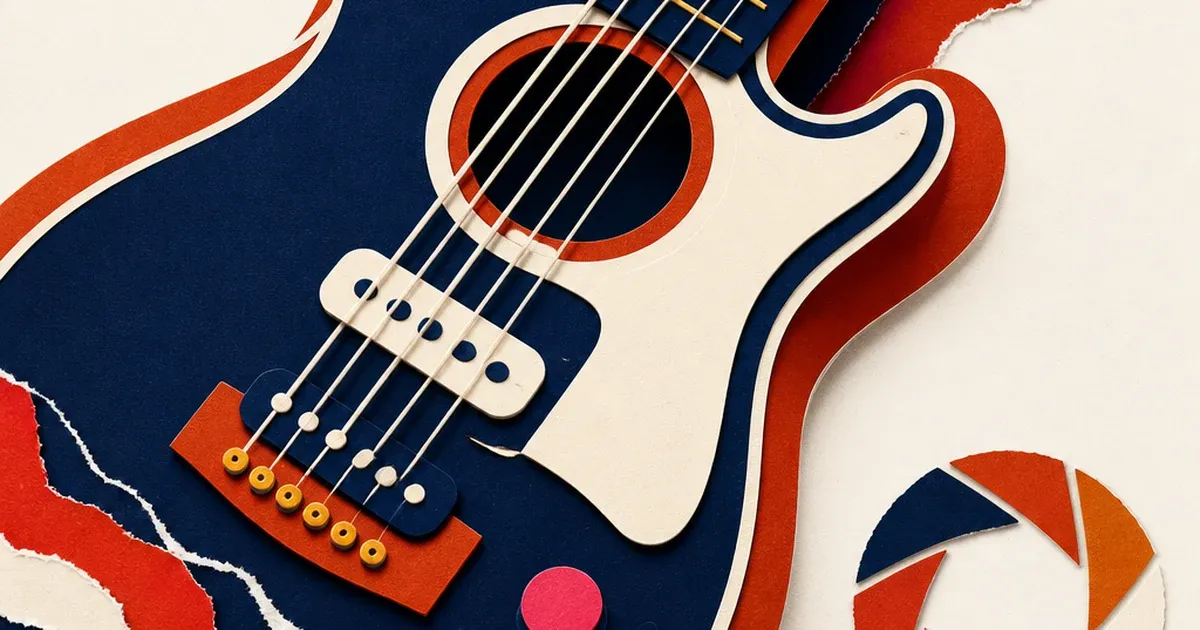
A guitar is about 39 inches long. A violin is smaller but still runs the better part of two feet scroll to chin rest. Point a camera at either one up close with a wide-open aperture, and physics does something most instrument sellers never account for: only a thin slice of that length ever lands inside the focus plane. Everything before it and after it falls into blur, no matter how good the lighting is.
That's why so many guitar-store listing photos look like this: the sound hole and top three frets are tack-sharp, and the headstock logo, the tuning pegs, the far end of the fretboard all dissolve into soft mush. The seller didn't do anything wrong on purpose. They just photographed a long object the way you'd photograph a face, and a face is a few inches deep. A guitar neck is closer to two feet.
Why the blur creeps in past the first few frets
Depth of field, the zone of a photo that reads as acceptably sharp, is controlled by three things: aperture, subject distance, and focal length. Adobe's own photography-education team explains the core trade-off plainly: a wide aperture (a low f-number, "1.4 to about 5.6") lets in more light and narrows that in-focus zone down to "between a few inches and a few feet," and the effect gets more extreme the closer the lens gets to the subject (source: Adobe Creative Cloud, "Understanding shallow depth of field photography," 2026).
That math is exactly why an instrument shot breaks in a way a bottle or a sneaker photo doesn't. A bottle is maybe six inches deep from label to back. A sneaker is a foot, sole to toe. A guitar or bass runs the length of an adult's arm and then some, and it's usually shot close enough to fill the frame at a nice wide aperture for that soft, professional-looking background blur. The subject is long, the lens is close, the aperture is wide: three conditions for a shallow depth of field, stacked on a product shape that needs a deep one. The sharp plane lands wherever the lens focused, usually right on the pickups or sound hole, and both ends of the instrument fall outside it.
Violin, cello, and mandolin sellers hit the same wall. So do drum kit sellers shooting a full kit at an angle, where the closest cymbal stand is sharp and the floor tom six feet back isn't.
What this actually costs a listing
Grand View Research's 2026 market report values the global musical instrument market at $18.8 billion for 2026, growing to a projected $31.4 billion by 2033, with stringed instruments (guitars, violins, basses) holding the largest single-type share at 64.9% (source: Grand View Research, "Musical Instrument Market Size & Share Report, 2026-2033"). The same report notes that buyers "rely heavily on ... performance demonstrations, peer comparisons, and recorded sound samples before committing to purchase" and that physical trial "remains important for acoustic instruments," with digital discovery increasingly carrying that trust-building weight through "tutorial videos, performance recordings, and side-by-side comparisons that highlight sound quality and build standards."
In the US retail layer specifically, IBISWorld puts the Musical Instrument & Supplies Stores industry at $6.6 billion in 2026 revenue, spread across roughly 9,014 businesses, a count that has actually shrunk at a 1.6% CAGR since 2021 even as online-forward retailers gain share (source: IBISWorld, "Musical Instrument & Supplies Stores in the US Industry Analysis," February 2026). Fewer stores, more of the buying decision made from a screen. When the one photo a buyer sees online can't show fretboard inlay condition, tuning peg wear, or bridge alignment because half the neck is smeared out of focus, that photo is actively working against a purchase decision the market data says is already trust-sensitive.
This is the same pattern already proven across other detail-sensitive product categories on this blog: a photography portfolio's own lens vignette and a jewelry piece's lost facet detail both quietly undercut a buyer's trust in a product they can only ever inspect through one photo.
Fixing the focus plane without a reshoot
The fix isn't "add more sharpening" (sharpening a blurred region just produces a crisper-looking blur, it can't recover detail the lens never captured). Coinis's AI photo-repair tool repairs the out-of-focus zones back to a level of apparent detail consistent with the sharp zone, so the whole instrument reads as one coherent, in-focus object the way a buyer expects a listing photo to look.
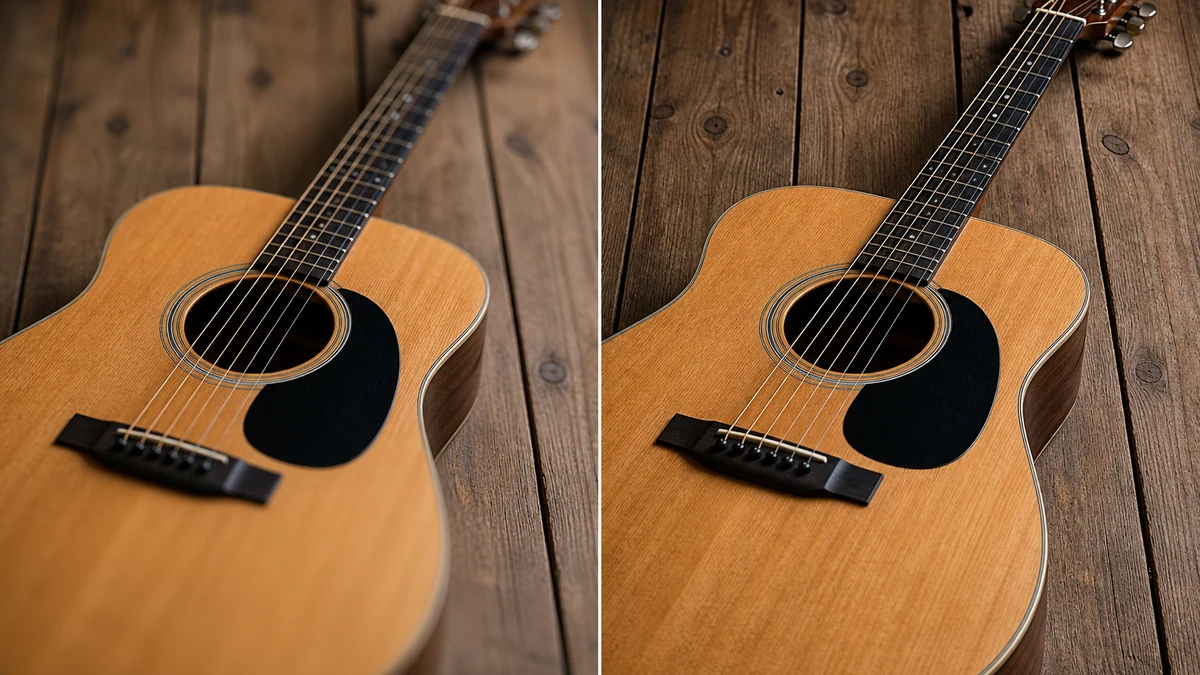
mcp.coinis.dev, the live pipeline for enhance_asset_proxy and generate_image_templates, is in an access-token outage as this article published. The image above is an illustrative OpenAI-generated still showing the same before/after concept, not a real Ad Studio render. See the fishing-tackle purple-fringe piece for a real enhance_asset_proxy output on this same repair mechanism, and check back here once the outage clears for the real render.
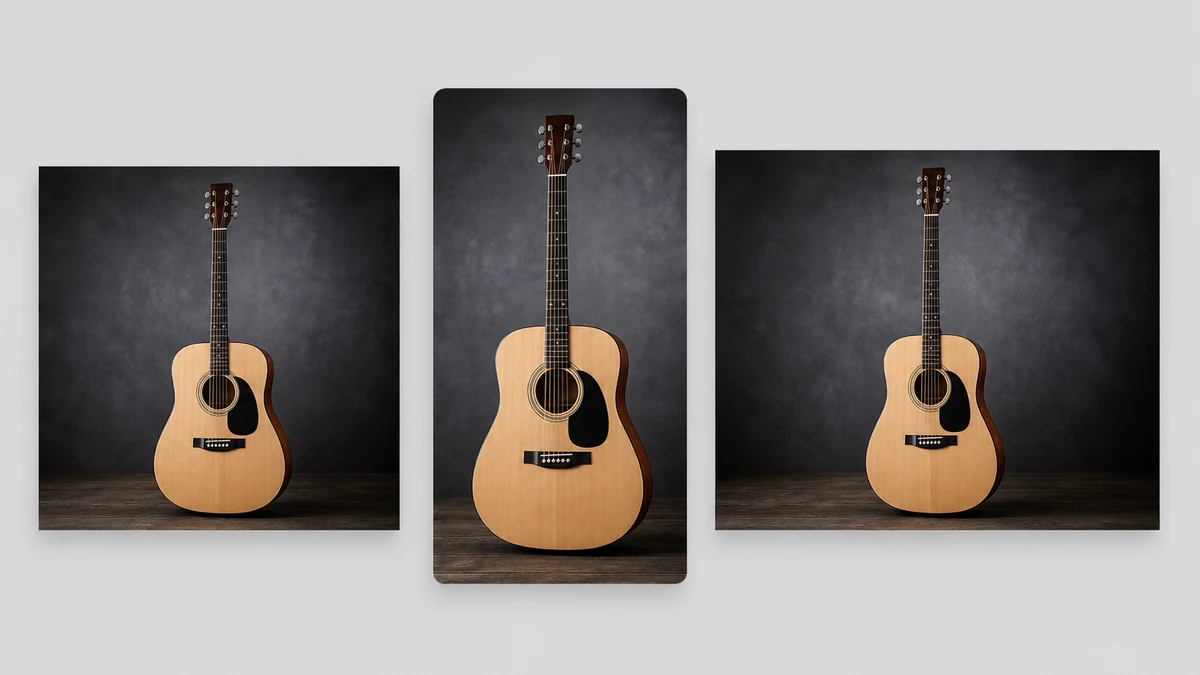
From that one corrected photo, the same asset gets pushed through Coinis's multi-format fan-out tool to produce square, portrait, and landscape crops sized for a marketplace listing, a Meta feed ad, and a Google Shopping tile, all sharing the identical corrected instrument.
What to do now
Sellers running music-industry ad campaigns on Coinis hit this exact defect constantly.
- Pull up your own current instrument listing photos and check the far ends, not just the center. If the headstock or the scroll is soft while the middle is crisp, that's this exact defect.
- Reshoot at a smaller aperture (a higher f-number, further from f/1.4-f/2.8) when you can, since a deeper depth of field avoids the problem at the source. Adobe's own guidance is blunt about the trade-off: shallow DOF is a deliberate creative choice for a face or a flower, not a default setting for a two-foot-long product.
- For the photos you already have, or for a seller who only has one shot to work with, run the corrected photo through Coinis's photo-repair and multi-format tools instead of a reshoot, and build the six ad-size variants from that single corrected asset in Ad Studio.
- Use a launch-ready Ad Studio template to turn that corrected instrument photo directly into a scheduled ad, rather than generating a static image and stopping there.
FAQ
Does this fix work on a full drum kit or just a single instrument? The same principle applies to any long or spread-out product where the aperture and shooting distance leave one area sharp and another soft, whether that's a guitar neck end to end or a drum kit's front-to-back depth. The mask just needs to cover the specific out-of-focus regions rather than the whole frame.
Is this the same problem as a blurry photo from camera shake? No. Camera shake or subject motion blurs the entire frame or a moving part unevenly and unpredictably. This is a depth-of-field falloff: a clean, deliberate blur gradient tied directly to distance from the focus plane, which is why it always shows up at the far ends of a long product and leaves the middle untouched.
Why not just increase the sharpening or clarity slider in editing software? Sharpening amplifies edge contrast in whatever detail already exists in the pixels. It cannot invent detail that was never in focus when the shutter opened, so pushing sharpening on an out-of-focus region just produces a harder-edged blur, not real detail.
Can a seller avoid this at the shoot instead of fixing it after? Yes, and it's the better long-term fix: shoot at a higher f-number (f/8 to f/11 is a common product-photography range), move the camera back and zoom in rather than getting physically close, or use a longer focal length from further away. Any of the three narrows the gap between the wide aperture and the deep subject.
Sources
- Adobe Creative Cloud, "Understanding shallow depth of field photography": https://www.adobe.com/creativecloud/photography/discover/shallow-depth-of-field.html
- Grand View Research, "Musical Instrument Market Size & Share Report, 2026-2033": https://www.grandviewresearch.com/industry-analysis/musical-instruments-market
- IBISWorld, "Musical Instrument & Supplies Stores in the US Industry Analysis" (February 2026): https://www.ibisworld.com/united-states/industry/musical-instrument-supplies-stores/1082/

Isidora Matovic
Author
Social media enthusiast and a full time researcher. She takes digital presence very seriously and that is why you are always in touch in what is going on with us! Follow us for more posts like this.