
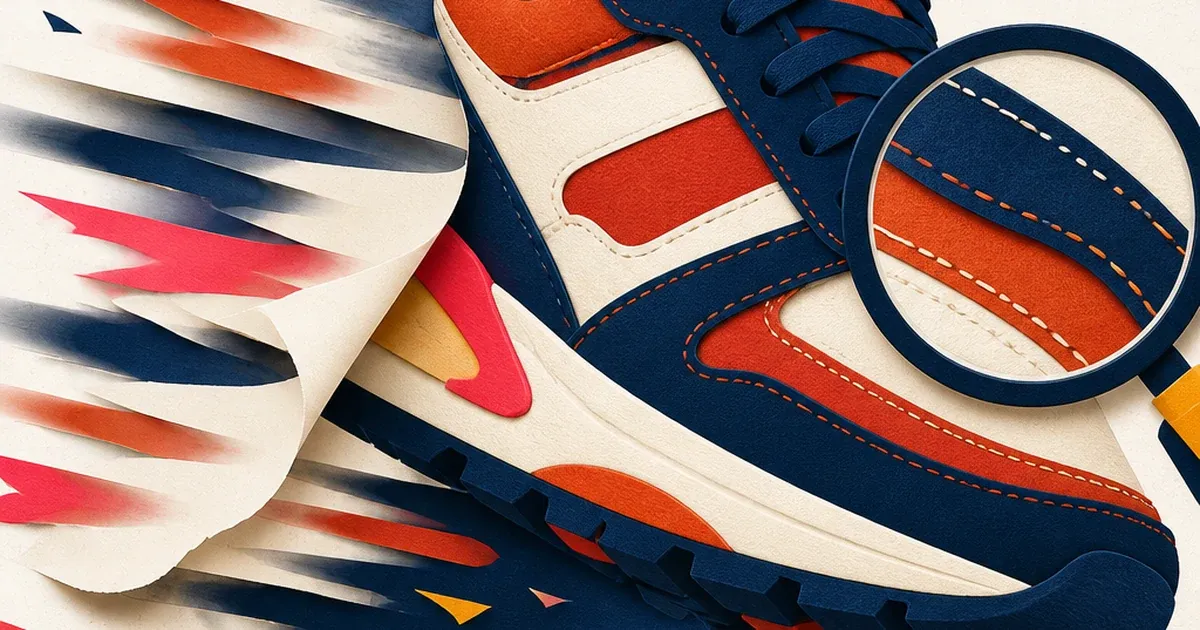
A basketball shoe caught mid-jump. A racket at the top of a swing. A soccer cleat planted a half-second before contact. Sporting-goods brands shoot action on purpose, that's the whole point of the category, but real action has a cost most product photographers pay without realizing it: motion blur.
Freeze a fast-moving subject with too slow a shutter, and the product itself smears. Stitching on a shoe turns into a gray streak. A logo on a jersey stretches into an unreadable smudge. The athlete looks dynamic. The product, the thing you're actually trying to sell, looks unfinished.
Why sports product shots blur when nothing else in the frame does
Canon's own motion-photography guide lays out the mechanics plainly: to freeze a fast-moving subject, the shutter has to be open for a very short slice of time, often 1/1000 sec or faster for an athlete in full motion (canon.ge, 2026). Anything slower and the subject travels a measurable distance across the sensor while the shutter is still open. That's motion blur, not a focus problem, not a lens problem. It's a timing problem: the shutter stayed open one beat too long for how fast the product was moving.
This is why a sports brand's own product shots blur more than almost any other retail category. A jewelry ring sits still on a table. A skincare bottle sits still on a shelf. A basketball shoe, by definition, is usually photographed while someone is wearing it and doing something athletic in it. The photographer is chasing a fast subject with a camera setting built for a still one, and the shutter speed math simply doesn't forgive that gap. It's a different failure mode than the geometric warp a spinning bike wheel produces under rolling-shutter distortion, or the glare a gym mirror wall throws back at a camera, but the outcome is the same: a defect baked into the shot that most brands ship anyway.
The result ships anyway, because reshoots are expensive and the athlete isn't always available for a second take. So the blurred shot goes into the catalog, into the paid social feed, into the retargeting carousel, smeared stitching and all.
What Coinis actually fixes here
Coinis Ad Studio includes a photo-repair layer (enhance_asset_proxy) built for exactly this: correcting a real defect in a real product photo without reshooting it. For a sharpness/motion problem, the tool targets just the blurred region and restores edge definition and texture detail that a slow shutter smeared away, without touching the parts of the frame that were never a problem. The rest of the composition, the athlete's pose, the background, the lighting, stays exactly as shot.
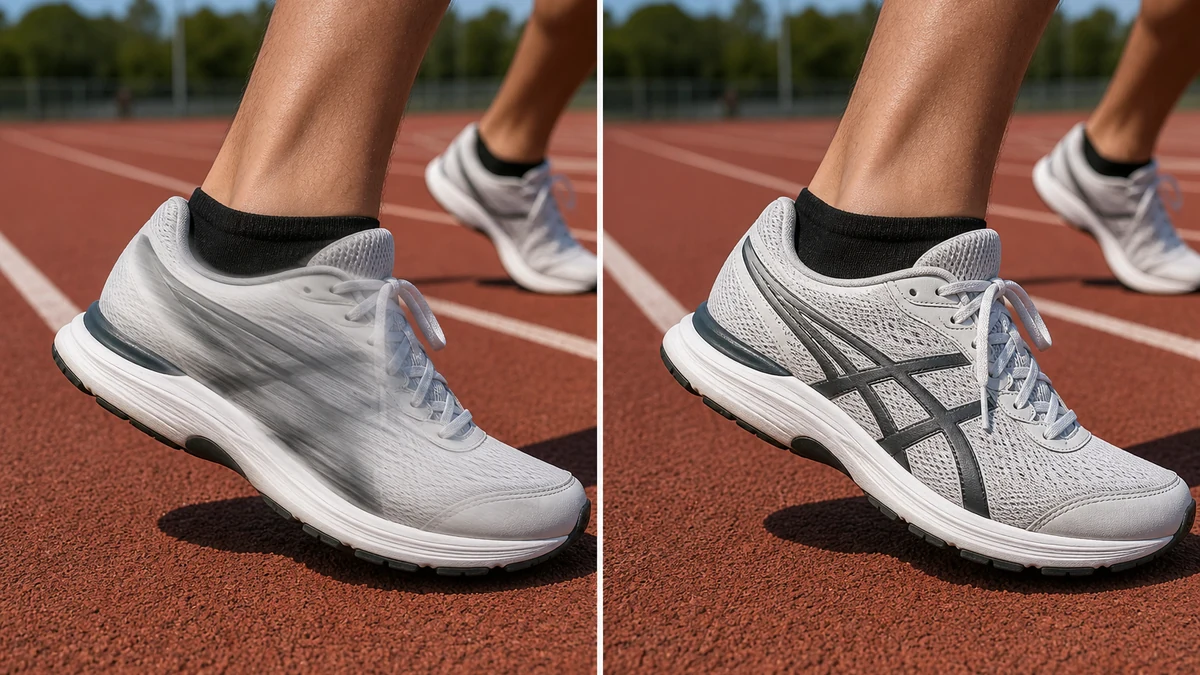
Illustrative example. mcp.coinis.dev (the live enhance_asset_proxy render pipeline) is experiencing an ongoing authentication outage as of this publish. This image was generated as an honest stand-in via a direct image-generation call. See a real enhance_asset_proxy before/after render in our AI photo enhancer article.
Once the product is sharp, the same corrected photo needs to work across every channel a sports brand actually runs: a square feed post, a 9:16 Story or Reel, a landscape banner for a retargeting network. Coinis's multi-format fan-out (generate_image_templates) takes that one corrected source image and produces it in every aspect ratio a campaign needs, so the fix happens once and pays out across the whole media plan.
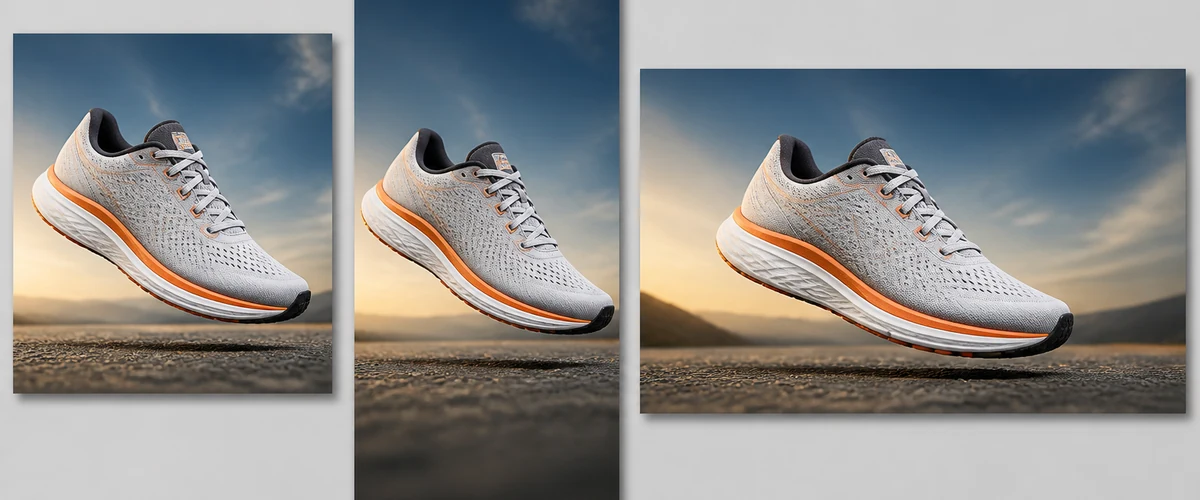
Illustrative example, same outage note as above. See a real generate_image_templates fan-out in our one-photo-every-ad-size article.
Why this matters for the category specifically
Sporting-goods retail is a $120.6 billion US industry in 2026, spread across more than 61,000 storefronts (ibisworld.com, 2026). Nearly all of that volume competes on the same visual territory: fast-moving product demos meant to convey energy and performance, same as the reflective-screen catalog shots covered in our electronics screen-reflection fix. That's exactly the kind of shot most prone to motion blur, and exactly the kind of ad creative that gets the most scrutiny at the pixel level, because shoppers zoom in on stitching, tread patterns, and fabric texture before they buy. Browse more category-specific examples on the sports industry page.
A blurred hero shot doesn't just look unfinished. It actively works against the sale: a shopper who can't see the shoe's actual texture has one less reason to trust the purchase, and one more reason to bounce to a competitor's cleaner image.
What to do now
- Pull your fastest-selling or newest product's action shots and check them at full zoom, not just thumbnail size. Motion blur on stitching, logos, and tread patterns is easy to miss at preview resolution and obvious the moment a shopper zooms in.
- Run the blurred shot through Coinis's photo-repair tool to restore product-level sharpness without reshooting the athlete or the scene.
- Fan the corrected photo out to every ad size your campaign needs (square, Story, landscape) from that single fixed source, instead of re-editing each format separately.
- Build the launch-ready ad in Ad Studio, not just the corrected image, using a template built for the format you're running, so the fix becomes a finished, launchable creative in the same workflow.
FAQ
Can a heavily motion-blurred photo actually be fixed, or does it need a reshoot? It depends on how much of the frame is blurred and how severe the smear is. A localized blur concentrated on the product (the shoe, the ball, the racket head) while the rest of the frame is sharp is a strong candidate for a targeted sharpen/deblur pass. A photo where camera shake blurred the entire frame, background included, is a harder case and may still need a reshoot.
Is this the same fix as a low-resolution or noisy photo? No. Motion blur is a timing problem (the shutter was open too long relative to how fast the subject moved). Low resolution is a pixel-count problem. Noise is a high-ISO/low-light problem. They can all make a photo look "soft," but the correction technique is different for each, which is why Coinis's photo-repair layer treats them as distinct operations rather than one generic "enhance" button.
Do I need a different shot for every ad platform, or just different crops? Once the product itself is corrected, most sports-brand campaigns only need different crops and aspect ratios of that same fixed image, not entirely new photography. That's the point of running the corrected photo through a multi-format fan-out before building each platform's version of the ad.
Why does action photography blur more than typical product photography? Because the shutter speed needed to freeze a fast subject (often 1/1000 sec or faster) is much higher than what a typical still-life product shot requires. A slower shutter, common when a photographer is balancing light and depth of field, leaves plenty of room for a fast-moving subject to smear (canon.ge, 2026).
Turn the fix into every launch-ready ad
A sharp product shot is the input. The output that actually moves budget is a launch-ready ad built for the platform you're running it on. Coinis Ad Studio takes the corrected photo straight into a template, so the same photo that was sitting in your catalog looking unfinished becomes a finished ad ready to launch, not just a nicer-looking file.
Sources
- Canon, "Motion photography: how to capture movement in your images," https://www.canon.ge/get-inspired/tips-and-techniques/capturing-motion/ (2026)
- IBISWorld, "Sporting Goods Stores in the US Industry Analysis, 2026," https://www.ibisworld.com/united-states/industry/sporting-goods-stores/1079/ (2026)

Isidora Matovic
Author
Social media enthusiast and a full time researcher. She takes digital presence very seriously and that is why you are always in touch in what is going on with us! Follow us for more posts like this.