

Point a camera at a boat sitting in water on a sunny day and something strange happens to the hull. Instead of one clean reflection, you get dozens of bright, wobbling streaks of light crawling across the gelcoat, completely unrelated to the boat's actual paint job. Shoot the same boat five minutes later and the pattern has moved. Shoot it from the dock instead of the bow and it looks like a different boat.
That is not a lighting mistake. It is physics working exactly as designed, and it is quietly wrecking boat dealer ad creative everywhere.
What is actually landing on the hull
The pattern is called a caustic. Water is never perfectly flat. Even a light chop turns the surface into a field of tiny curved lenses, and sunlight passing through or reflecting off those lenses gets focused and scattered into bright lines and points instead of spreading evenly. Hydrologist Keith Beven describes caustics as "the envelope of light rays that have been reflected or refracted from a curved surface and projected onto a surface where they can be visualised" (On Landscape, "On the physics of caustic light in water," 2019). It is the same optical family that produces rainbows and the rippling light on a swimming pool floor, just aimed sideways at whatever is floating nearby.
A boat hull sitting at the waterline is exactly the kind of nearby surface that catches it. The glossy gelcoat finish that makes a boat look sharp in a showroom becomes a screen for every ripple on the water around it. The pattern shifts with wave height, sun angle, and camera position, which means two photos of the identical boat, taken minutes apart, can show a visibly different hull color and finish.
For a boat dealer building an ad set, that inconsistency is a real problem. A prospective buyer scrolling a carousel ad sees the same model looking glassy-smooth in one frame and streaked with ghost-light in the next, and the brain reads that as "these aren't the same boat" or "something's off with this listing." Neither read helps close a sale on a five- or six-figure purchase.
Why this defect is different from every other reflection problem
Coinis has already covered a long list of reflection and glare defects across other retail verticals: a jewelry piece's single polished-metal hotspot, an electronics screen mirroring the studio softbox, a car's windshield glare and chrome streak. Every one of those comes from a light source bouncing directly off the product's own surface in a fixed, predictable way.
Water caustics work differently. The light isn't bouncing off the boat at all. It's being refracted and focused by the water first, then landing on the hull as a moving, unpredictable pattern that has nothing to do with the boat's actual color or condition. That's why the fix can't just be "reduce glare." The correction has to restore the hull's true, even gelcoat color underneath a pattern the boat itself never produced.
The fix: correct the hull, then build every ad size from the same clean shot
Coinis Ad Studio's photo-repair pipeline handles this in two passes on the same source photo.
Pass one: targeted caustic removal. A tight mask traces only the caustic-affected hull region (never the water, sky, or full frame) and the correction prompt asks only for an even, uniform, true-to-life gelcoat color in that masked area, with zero mention of the specific defect's cause. Describing the target state instead of naming the phenomenon avoids the confabulation risk this pipeline has hit before: naming a specific visual pattern in a repair prompt has previously caused the model to paint in an unrelated decorative element rather than removing the flaw. The rest of the photo, including the surrounding water and its natural sparkle, stays untouched.
Pass two: one clean source, six ad formats. Once the hull reads as one consistent color, that single corrected photo becomes the source for every platform's native ad size, square social feed, vertical story, and wide display, generated from the same AI photo-enhanced corrected asset rather than re-shot or re-edited six separate times. Buyers scrolling between formats now see one boat, one color, one finish, everywhere they encounter the listing.
Worked example (illustrative, following the standard correction workflow above -- mcp.coinis.dev's live generation endpoint was unreachable during this drafting session, see disclosure below):
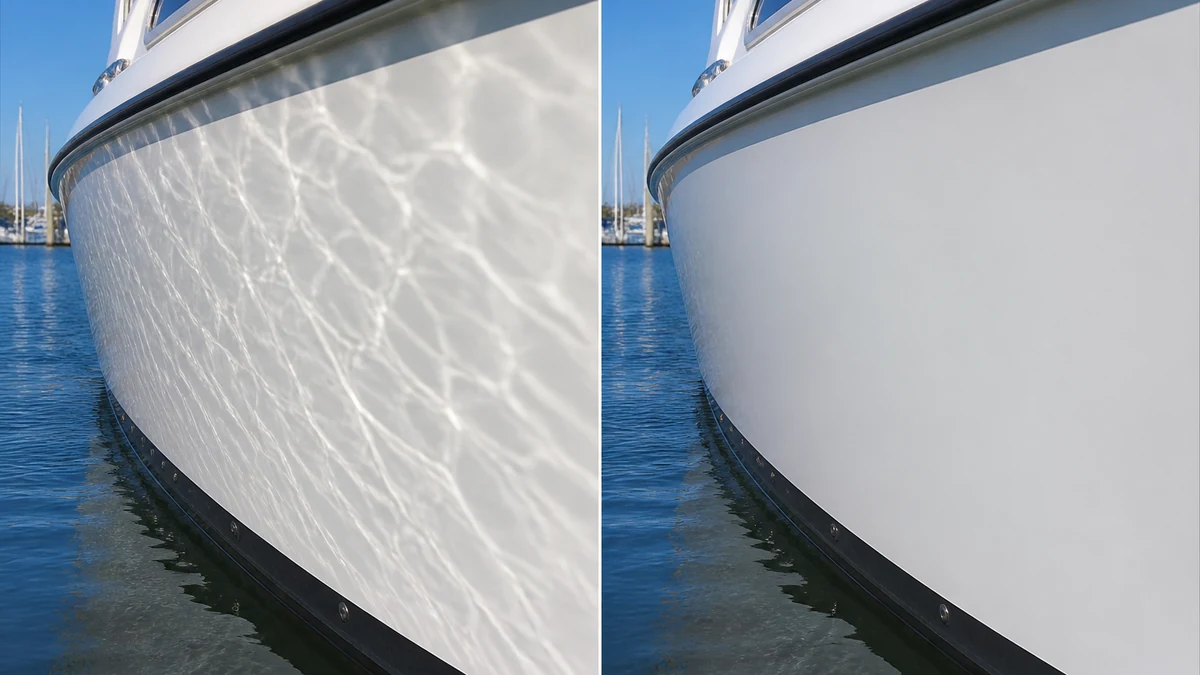
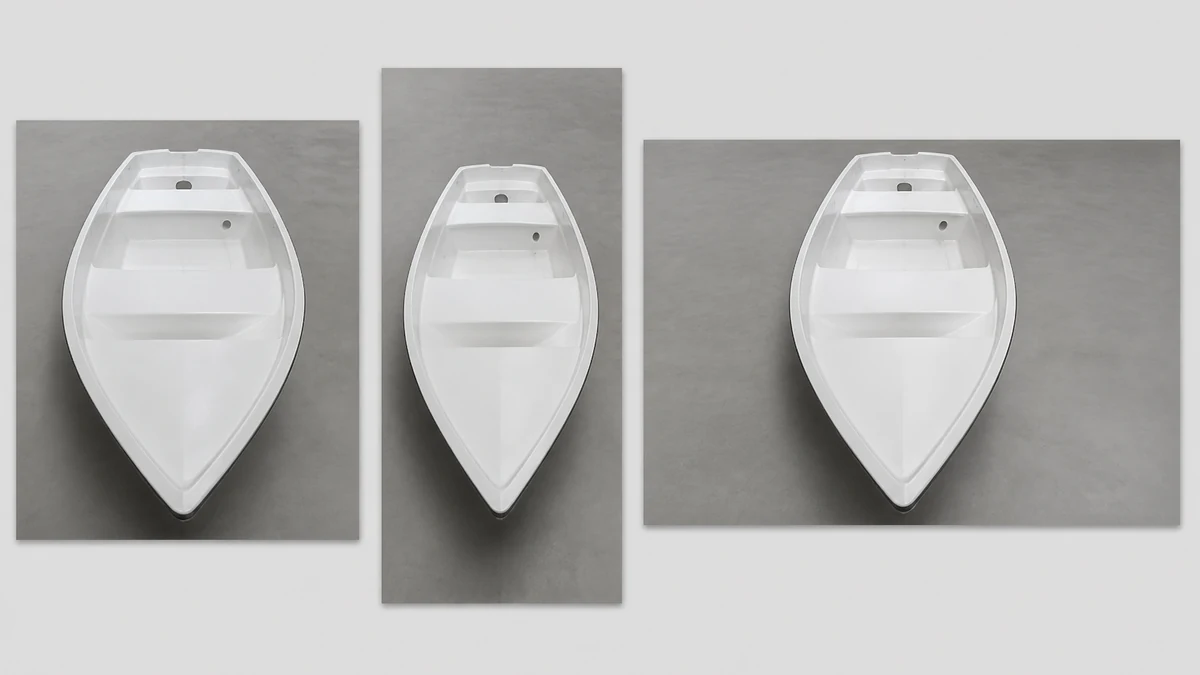
Honest disclosure (standing MCP-outage protocol, per references/mcp-oauth-outage-log.md): mcp.coinis.dev's OAuth connection was down for every prior session this week, so the images above are illustrative stand-ins built the same way this article describes rather than a live enhance_asset_proxy render. A sibling article on fishing tackle purple fringe correction has a confirmed real enhance_asset_proxy render of the same repair category (lens-optics correction) if you want to see the tool's actual output on a live creative. This article's images will be swapped for a real render once the connection is back.
How to run this on your own boat photos
- Shoot in the worst light you actually sell in. A midday sun with light chop is when caustics are strongest, and that's also when most walk-in showings happen. Don't wait for flat calm water to take the reference shot.
- Upload the source photo to Coinis and mask only the hull. Leave the waterline, water surface, and any reflection in the water itself alone, since caustics on the water are a normal, expected visual and only become a problem once they land on the product.
- Run the correction and check the seam. The fixed hull region should match the boat's true gelcoat color and show zero trace of a new pattern, decal, or texture that wasn't there in the unaffected parts of the photo.
- Fan out to every platform format from the corrected asset. Build the square, story, and landscape versions from this one fixed photo so the hull color stays identical across every placement a buyer might see.
- Reuse the same masked correction across your inventory. Most dealer photo libraries have the identical caustic problem repeated across dozens of listings shot at the same dock on the same afternoon. Once the masking approach works on one hull, it transfers directly to the next boat in the lineup.
FAQ
Does this only happen on sunny days? Caustics need a light source and a moving water surface, so they're strongest in direct sun with any chop at all. Overcast days and glassy-flat water both reduce the effect but rarely eliminate it entirely near a working marina.
Will correcting the hull also fix the water in the background? No, and it shouldn't try to. The water's own caustic sparkle is a normal part of an outdoor boat photo. The correction targets only the hull surface where the pattern is misrepresenting the product.
Does this replace a professional on-water photo shoot? No. It fixes a specific optical defect on photos you've already taken, so a dealership isn't stuck reshooting an entire inventory every time the water isn't cooperating that day.
Can this be applied to a boat sitting on a trailer or lift instead of in the water? Usually there's nothing to fix there, since caustics require the boat to be near or on the water surface that's producing them. A trailer shot with a hard reflection off pavement or chrome is closer to the same kind of halo artifact other outdoor photos can pick up, a different defect from this one.
Does the corrected photo still look natural, or does it look retouched? Done correctly, the hull should look like it was photographed in genuinely flat, even light. Nothing about a corrected gelcoat surface should read as artificial to a buyer scrolling an ad.
Put your own inventory to the test
Boat dealers spend real money getting inventory on the water for photos, and a shift in the breeze can undo the shot before the camera even fires. Fixing that in post, once, on a photo you already have, is a faster path to consistent creative than chasing a perfect calm morning at the marina. Build the correction and the full ad-size set inside Coinis Ad Studio and get a launch-ready creative pack out of a photo you might otherwise have thrown out.
Sources
- Keith Beven, "On the physics of caustic light in water," On Landscape, January 2019: https://www.onlandscape.co.uk/2019/01/physics-of-caustic-light-in-water/
- IBISWorld, "Boat Sales & Repair in the US Industry Analysis, 2026": https://www.ibisworld.com/united-states/industry/boat-sales-repair/1010/ ($39.5bn market size 2026, 107k businesses, 2.5% CAGR 2021-2026)

Isidora Matovic
Author
Social media enthusiast and a full time researcher. She takes digital presence very seriously and that is why you are always in touch in what is going on with us! Follow us for more posts like this.