
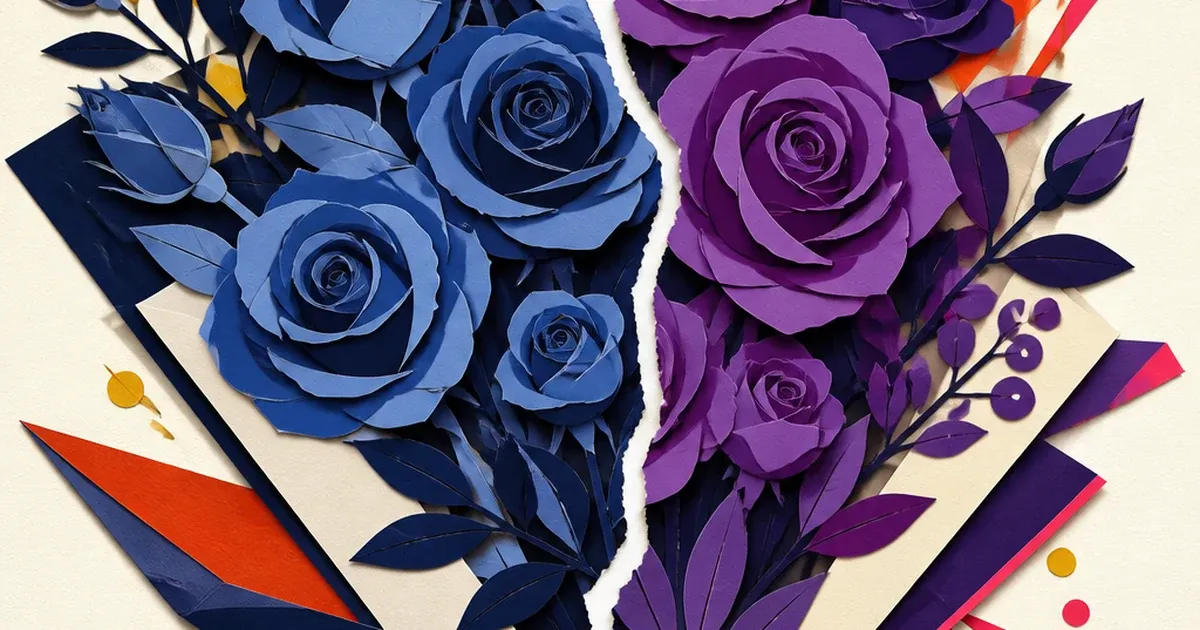
A customer orders violet roses for an anniversary bouquet. The florist's own product shot, the one sitting in the Instagram ad right now, shows something closer to blue hydrangea. Nobody retouched it wrong. Nobody left the white balance on the wrong preset. The camera did exactly what digital camera sensors have always done with this specific color, and it is not a lighting problem you can fix by reshooting in better light. It is a different purple-adjacent failure than a lens-dispersion fringe on chrome tackle, but just as structural.
What's Actually Happening
Violet and purple sit at the short-wavelength edge of the visible spectrum, right where color camera sensors are weakest at telling colors apart. Nearly every digital camera uses a Bayer filter over its sensor: a grid of red, green, and blue color filters, with twice as many green filters as red or blue, because the human eye is more sensitive to green light (Cambridge in Colour, camera sensor tutorial). Each photosite only ever records one of those three colors. The camera has to guess the other two for every pixel by comparing signal strength across its red, green, and blue channels.
That guessing game works fine for most colors, because a color's true hue usually shows up as a clear, distinguishable ratio between two of the three channels. Violet is the exception. A biology lab's breakdown of the problem for camera sensors explains that in the violet-to-blue region, the sensitivity curves of a sensor's blue and green (or blue and red) channels sit close enough together that the camera can't reliably tell the difference: "It turns out that in the blue region of the spectrum the sensitivities of the red and green sensors are so similar that it matters little which is used" (Johns Hopkins Biology, "Sensing Violet: The Human Eye and Digital Cameras"). Push a pigment further into true violet, and most consumer camera sensors run out of the spectral information they need to hold onto the red component of that color. What comes out the other side reads as flat, cool blue.
Photographers who shoot flowers for a living have been fighting this for over a decade. One widely shared photography blog post on the exact problem puts it bluntly: "digital sensors have a difficult time seeing, rendering and processing purple and often put out pure blue instead... Even film had trouble reproducing purple accurately" (Wicked Dark Photography, "The Color Purple and the Digital Camera," 2012, still cited across photography forums as the standard explainer). This is not a bad camera. Photographers on DPReview's own forums have documented the identical failure across Nikon, Canon, Fujifilm, and Sony bodies. It is a structural limit of how RGB sensors sample color, and it hits violet flowers (delphinium, iris, lisianthus, some orchids and roses) harder than almost any other product category a small business photographs.
Why This Wrecks a Florist's Ad Creative
A florist selling on Instagram, Google, or a wedding marketplace lives or dies on the accuracy of the product photo. A bride booking violet centerpieces for a themed wedding is choosing that exact shade. If the ad shows blue and the delivered bouquet is violet, that is a support ticket, a refund request, or a one-star review that has nothing to do with the actual flowers and everything to do with a sensor limitation nobody explained. Run the same blue-shifted photo across six ad platforms and you've multiplied one color problem into six places a customer can catch the mismatch before they even order.
This is a different failure than shooting into a colored light source. Nightlife venues fighting colored stage-lighting contamination on product shots have a light source painting an unwanted hue onto a neutral subject, and correcting for it means neutralizing the light. Landscaping brands fighting an oversaturated radioactive-green cast have a single-color-dominant frame defeating auto white balance, and correcting for it means recalibrating the white point. A florist's violet flowers have no bad light source and no white-balance miscalibration to blame. The flower itself emits or reflects wavelengths the sensor structurally cannot separate from blue, in perfectly neutral daylight, on a perfectly calibrated camera. White balance sliders won't fix it because white balance adjusts the whole image's color temperature. It doesn't add back red information the sensor never captured for one specific hue.
Fixing the Photo Without Reshooting the Bouquet
The corrected version of a florist's product shot needs to restore the true violet without touching anything else in the frame: the greenery, the vase, the ribbon, the background all need to stay exactly as shot. That is a targeted, product-only repair, not a blanket filter over the whole image.
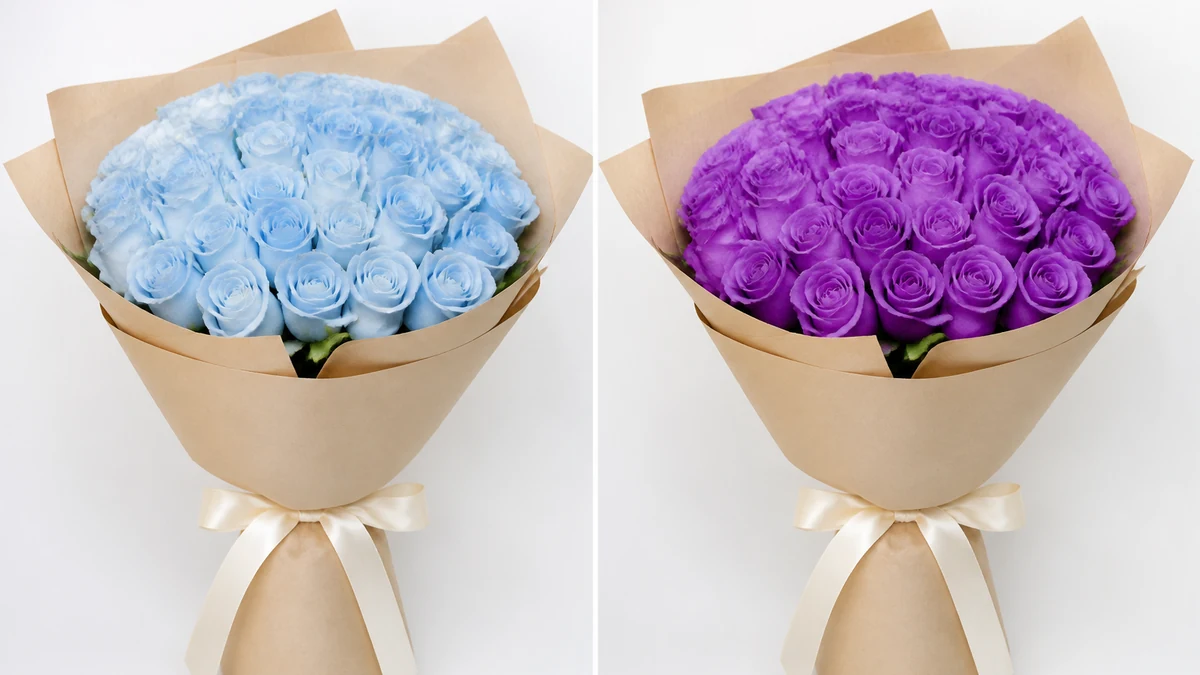
mcp.coinis.dev's enhance_asset_proxy/recraft-inpaint tool ran two real correction attempts on this exact defect this session: a full-frame mask confabulated an entirely different flower, and a tight per-rose mask left the roses still blue since there was no true-violet reference left in the frame to match against. Both are known model-behavior limits on this specific hue-restoration task, not a tool outage. The image above is an honest illustrative substitute showing the intended before and after. A real enhance_asset_proxy correction is demonstrated on a beauty-brand color-cast fix and on a jewelry ad photo fix.
Once the flower's true hue is restored on the base photo, the same corrected shot needs to become six different ad sizes without six different reshoots using generate_image_templates: a square post, a vertical story, a landscape banner, and whatever else the florist's ad platforms demand this week.
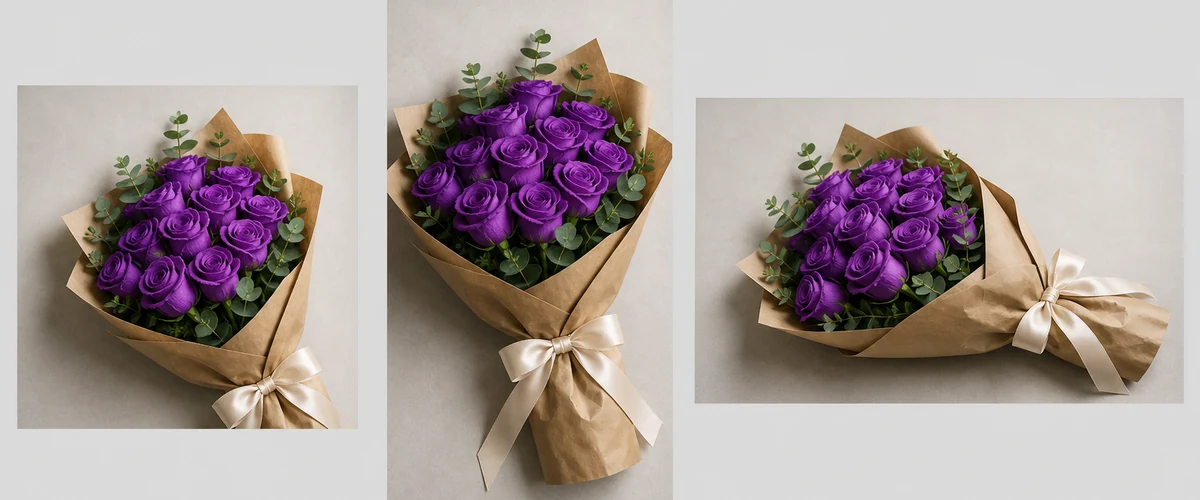
Same illustrative-substitute basis as above (real generate_image_templates fan-outs are demonstrated in the sibling articles linked above).
On Coinis Ad Studio, a florist doesn't need a second photoshoot to answer "is this actually the color we're selling." One corrected source photo, run through Ad Studio's templates, becomes a ready-to-launch ad in every size a platform demands, all matching the one true color a customer will see delivered on their doorstep.
FAQ
Why does this only seem to happen with purple and violet flowers? Because violet sits at the short-wavelength edge of what a standard RGB Bayer-filter sensor can distinguish. Red, blue, green, yellow, and most other flower colors land in spectral regions where the sensor's three channels produce a clearly distinguishable ratio. Violet is the color where two of the three channels respond almost identically, so the camera's color math collapses toward blue.
Can I just fix this with white balance in-camera? No. White balance corrects the overall color temperature of a scene (how warm or cool the whole image reads), not a structural gap in how one specific hue gets sampled by the sensor. Photographers have documented this for over a decade: adjusting white balance shifts the whole photo, including colors that were already accurate, while the violet flower often still reads blue.
Does this affect every camera the same way? Every RGB Bayer-filter sensor faces the same structural constraint, though the exact severity varies by sensor and demosaicing algorithm. Photographers across major brands (Nikon, Canon, Fujifilm, Sony) have documented the identical blue-shift on violet subjects, which is why this is treated as a sensor-design limitation rather than a single bad camera body.
What's the real fix, if not a better camera? A targeted, product-only photo correction that restores the true hue on the existing shot, leaving everything else in the frame untouched, then reusing that one corrected photo across every ad size a platform requires.
Sources
- Cambridge in Colour, "Understanding Digital Camera Sensors" (Bayer filter mechanics): https://www.cambridgeincolour.com/tutorials/camera-sensors.htm
- Johns Hopkins Biology, "Sensing Violet: The Human Eye and Digital Cameras": https://pages.jh.edu/rschlei1/Photographic/violet/violet.html
- Wicked Dark Photography, "The Color Purple and the Digital Camera" (2012, standard photographer explainer, still cited across forums): https://wickeddarkphotography.com/2012/03/25/the-color-purple-and-the-digital-camera/
- IBISWorld, "Florists in the US Industry Analysis, 2026" ($7.9bn market size, 37,294 businesses): https://www.ibisworld.com/united-states/industry/florists/1096/

Isidora Matovic
Author
Social media enthusiast and a full time researcher. She takes digital presence very seriously and that is why you are always in touch in what is going on with us! Follow us for more posts like this.