
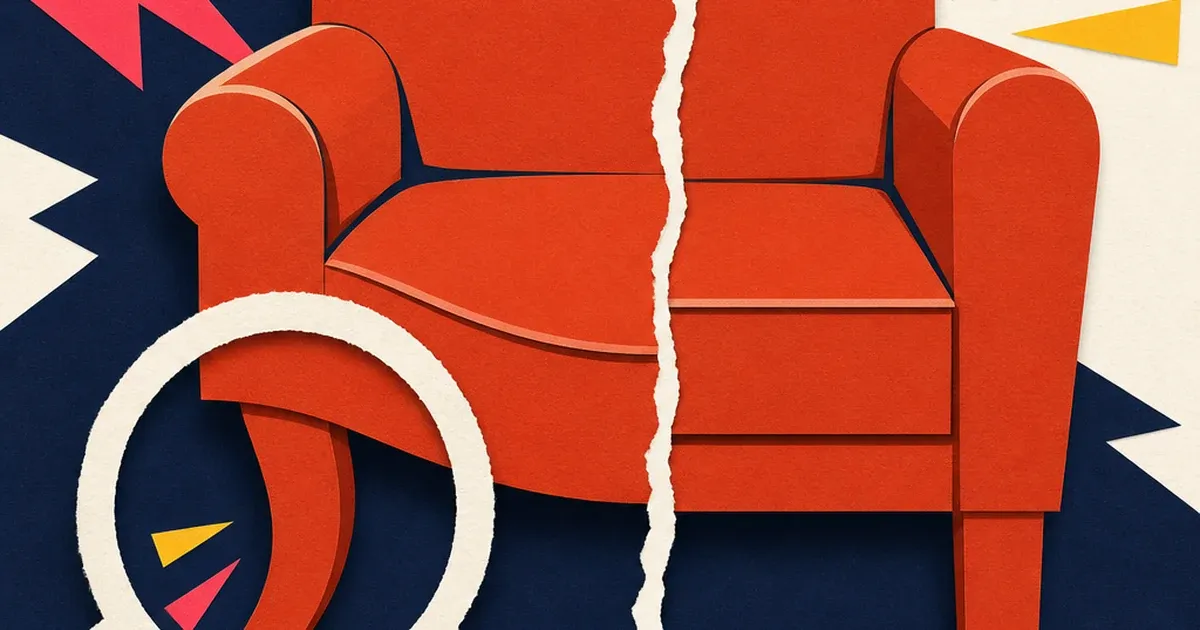
A sofa leg curves outward like it's made of rubber. A dining table's far edge tilts instead of running dead straight across the frame. A bookshelf's vertical sides lean inward at the top like they're about to fall together. None of this happened on the factory floor. It happened the moment someone stood too close with a wide lens to fit the whole piece in frame.
Furniture photography walks into this defect more than almost any other product category, and most brands never trace the crooked line back to its actual cause.
Why furniture shoots practically invite this defect
The defect has a name: lens distortion. Wikipedia's entry on the mechanism describes it plainly, a deviation from rectilinear projection, the property that keeps straight lines in a scene looking straight in the image. Barrel distortion, the most common version, "may be found in wide-angle lenses, and is often seen at the wide-angle end of zoom lenses" (en.wikipedia.org, 2026). The wider the lens and the closer the camera sits to the subject, the more a straight edge bows outward toward the frame's corners.
A furniture shoot sets up exactly this trap on purpose, without meaning to. A sofa, a sectional, or a dining set is large, and a showroom or warehouse rarely has the floor space to back the camera far away from it. A furniture-photography trade guide names the failure directly: "when the camera is too close to the furniture, it can distort the image, making it look larger or smaller than it actually is," and the fix it recommends is "capturing the entire piece in the frame without distortion by backing up the camera and using a standard to tele lens" (orbitvu.com, 2026). Most catalog and warehouse shoots don't have that luxury, so the wide lens stays, and so does the bowed leg.
What actually goes wrong in the ad creative
The failure shows up in a few predictable spots once a furniture photo gets used as ad creative:
- Straight legs and frame edges. A chair leg, a table leg, a bed frame rail, all meant to run perfectly straight, curve outward toward the edges of a wide-angle frame.
- Tabletop and shelf lines. A long, straight edge across the middle of the frame is exactly where barrel distortion is easiest to spot at full ad size.
- Bookshelf and cabinet verticals. Vertical sides shot from slightly above or below lean toward each other, a related perspective effect called keystoning, common whenever a wide lens gets angled even a little instead of held perfectly level.
None of this reads clearly on a phone-feed thumbnail. It shows up the moment the same photo becomes a full-width banner or a zoomed detail shot, where a subtly warped leg or a leaning shelf edge signals a rushed catalog snapshot instead of a piece built to last.
The fix: correct the geometry, not the shoot
Coinis's AI photo-repair layer (enhance_asset_proxy) handles exactly this kind of correction: straightening a lens-warped edge without touching the piece's actual proportions, finish, or material. Instead of re-shooting every piece from ten feet back with a longer lens, the correction targets the bowed or leaning lines directly, so the sofa's true shape and the table's true straight edges come through clean.
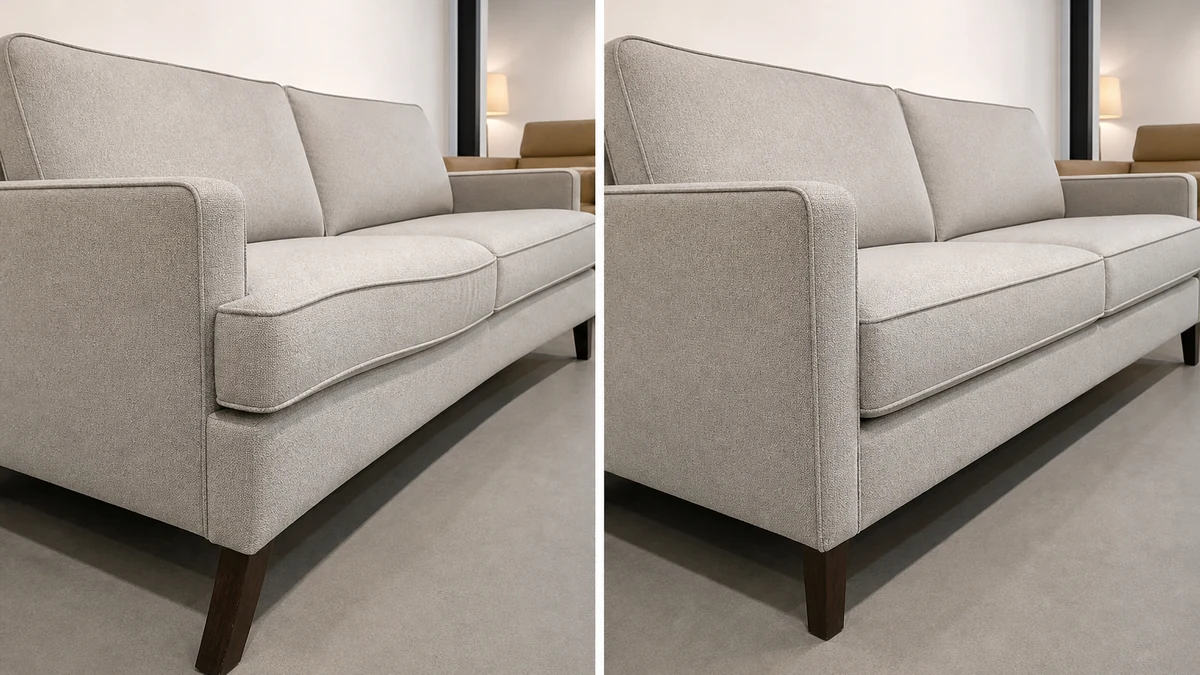
mcp.coinis.dev, the live pipeline for enhance_asset_proxy and generate_image_templates, is in an access-token outage as this article published. The image above is an illustrative OpenAI-generated still showing the same before/after concept, not a real Ad Studio render. See the fishing-tackle purple-fringe piece for a real enhance_asset_proxy output on this same repair mechanism, and check back here once the outage clears for the real render.
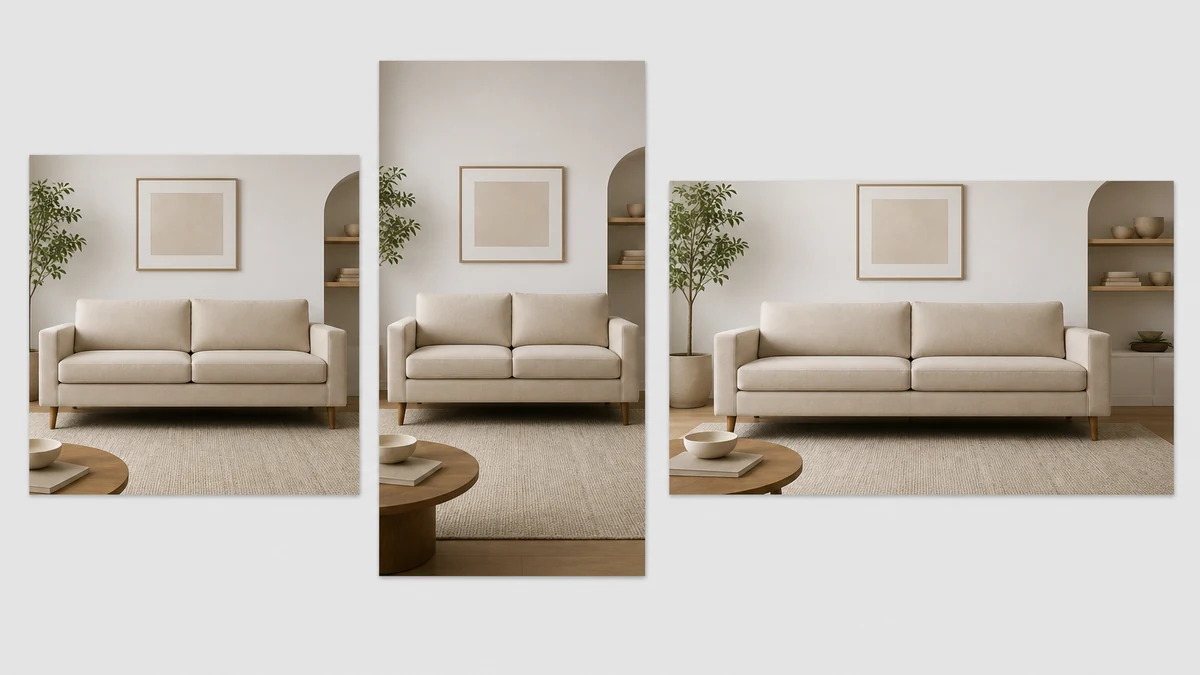
Once the geometry is corrected, the same photo needs to run everywhere a furniture or home-decor brand actually advertises: a square feed post, a 9:16 Story, a landscape banner for a display campaign. Coinis's multi-format fan-out (generate_image_templates) takes that one corrected source image and produces it across every aspect ratio a campaign needs, so the fix happens once and pays out across the whole media plan.
Why this matters for the category specifically
The global furniture market is worth an estimated $831.6 billion in 2026, on track to reach $1,334.1 billion by 2033 at a 7.0% compound annual growth rate, with the residential segment alone holding a 61.3% share (grandviewresearch.com, 2026). That's a category selling almost entirely on visual trust: shoppers can't sit in the chair or run a hand along the tabletop before they buy, so the photo has to do that convincing on its own.
A brand that never checks for lens distortion is shipping ad creative where the actual shape of the product reads slightly wrong, subtle enough that most viewers won't consciously name the problem, but obvious enough that the piece looks cheaper and less solidly built than it really is. For a category this dependent on perceived craftsmanship, that's a quiet tax on every ad dollar spent.
Furniture is not alone in this pattern. A device screen's glare and reflection, a pet product's messy background, and an apparel catalog's inconsistent backdrop are all the same underlying lesson: a category-specific photo flaw quietly undercuts perceived quality until the exact mechanism gets fixed at the source.
What to do now
- Pull any furniture or home-decor photo shot with a wide lens close to the piece and check the straightest lines in the frame: legs, tabletop edges, shelf sides, bed rails.
- Look for outward bowing at the edges of the frame or inward-leaning verticals near the corners, the tell that separates lens distortion from a genuine design detail or a curved piece.
- Run the flawed photo through Coinis's photo-repair tool to straighten the geometry without re-shooting the whole catalog from further back with a different lens.
- Fan the corrected photo out to every ad size your campaign needs from that single fixed source, then build the launch-ready ad in Ad Studio using a template built for the platform you're running.
FAQ
Why does this show up on furniture more than most other product categories? Furniture pieces are large and shoots are often space-constrained, which pushes photographers toward a closer distance and a wider lens, exactly the combination that produces the strongest barrel distortion (en.wikipedia.org, 2026, orbitvu.com, 2026).
Is this the same problem as a crooked camera angle? Not quite. A tilted camera produces converging verticals, known as keystoning, a perspective effect rather than an optical one. Lens distortion bows straight lines even when the camera is held perfectly level. Furniture photos frequently show both at once, since a wide lens close to a large piece invites the camera to tilt slightly to fit everything in frame.
Does correcting the distortion change the furniture's actual proportions? No. The correction targets the lens-induced bowing and leaning in the image, not the product's real dimensions. The piece's true size, shape, and finish stay exactly as photographed everywhere else in the frame.
Do I need a different photo for every platform, or just different crops? Once the geometry is corrected, most campaigns only need different crops and aspect ratios of that same corrected image, not new photography for every platform.
Turn the fix into every launch-ready ad
A corrected, true-to-shape product photo is the input. The output that actually moves budget is a launch-ready ad built for the platform you're running it on. Coinis Ad Studio takes the fixed photo straight into a template, so a furniture shot that was quietly bowing its own straight lines becomes a finished ad ready to launch, true shape intact.
Sources
- Wikipedia, "Distortion (optics)," https://en.wikipedia.org/wiki/Distortion_(optics) (2026)
- Orbitvu, "How To photograph furniture - 25 expert furniture photography tips," https://orbitvu.com/blog/how-photograph-furniture-25-tips-straight-product-photography-experts (2026)
- Grand View Research, "Furniture Market Size, Share & Trends Report, 2026-2033," https://www.grandviewresearch.com/industry-analysis/furniture-market (2026)

Isidora Matovic
Author
Social media enthusiast and a full time researcher. She takes digital presence very seriously and that is why you are always in touch in what is going on with us! Follow us for more posts like this.