
A technical outdoor brand photographs its flagship black shell jacket against a clean studio backdrop, exposure and white balance both dialed in correctly, and the product photo comes back with a faint purple or magenta cast running through the fabric that nobody sees standing in the room. The jacket is black. The lighting is neutral. The camera says otherwise.
This isn't a white-balance mistake and it isn't a bad dye batch. It's a mismatch between what a camera sensor actually measures and what the fabric was engineered to do, and it shows up specifically on the kind of high-performance synthetic textiles outdoor and technical apparel brands build their whole product line around.
Why a perfectly black jacket can photograph purple
Digital camera sensors are not naturally limited to the light humans can see. They're physically sensitive to near-infrared wavelengths as well as visible light, which is exactly why nearly every consumer and commercial camera ships with an infrared-blocking "hot mirror" filter in front of the sensor to keep that extra sensitivity out of ordinary photos (Wikipedia, "Infrared Photography," 2026). That filter cuts most of the infrared contribution, but not all of it, and the leftover sliver of near-infrared light the sensor still picks up gets rendered as color, typically a pink, magenta, or purple shift, because the camera has no real visible-light equivalent to map it to (Wikipedia, "Infrared Photography," 2026).
Most fabrics don't reflect enough infrared to make this visible. Technical and performance textiles are the exception. Some synthetic fibers and the dyes used on them, including coatings engineered for thermal performance or originally developed for camouflage concealment, reflect infrared far more strongly than ordinary fabric dyes do, a property textile researchers measure directly with near-infrared hyperspectral imaging when characterizing these materials (PMC/NIH, "Characterization of Near Infrared-Dye Colored Fabrics Using Hyperspectral Imaging," 2026). A jacket built from exactly this kind of high-performance synthetic can bounce back enough near-infrared light to leak through a hot mirror filter that handles ordinary cotton or wool without issue, and the result is a visible color artifact on a garment that is, to the human eye in the room, simply black.
A shopper standing in a retail aisle never sees any of this. Their eyes don't register near-infrared light at all. A camera does, every time it photographs that exact fabric under that exact filter stack, regardless of how carefully the shoot was lit.
What this costs a brand that ships the purple cast anyway
Outdoor and hiking retail is not a market growing on volume. IBISWorld projects the Hiking & Outdoor Equipment Stores industry in the US at $7.5 billion in 2026, with a -0.9% five-year CAGR through 2026 even as 2026 itself ticks up 2.4% (IBISWorld, "Hiking & Outdoor Equipment Stores in the US," 2026). Flat-to-shrinking categories are won on conversion, not on rising demand lifting every brand equally, and conversion research keeps landing on the same lever: the product photo.
Baymard Institute's shopper-behavior research found that 56% of online shoppers' very first action on a product page is to study the images, ahead of the title or the description (cited in letsenhance.io's review of academic ecommerce research, 2026). The same review cites Salsify's 2025 Consumer Research Report, where 77% of shoppers call high-quality images and video important to their purchase decision, and peer-reviewed research from Szulc and Musielak (2022) finding 68% of consumers prefer products shot in clean, distraction-free settings. A jacket that photographs with an unexplained purple tint over its signature black colorway fails that test before a shopper ever reads the fabric specs.
Apparel, fashion, and jewelry campaigns, the closest published benchmark to technical outdoor apparel, carry a median cost per click of $4.44 across US Google and Microsoft Ads search campaigns in the 2026 benchmark year (WordStream/LocaliQ, "Search Advertising Benchmarks for Every Industry," 2026). Every one of those paid clicks lands on whatever image is running in the ad, color artifact included.
Fix the dye-reflectance artifact, not the whole photo
Ad Studio's repair layer, enhance_asset_proxy, is built for exactly this kind of localized optical correction rather than a full relight or a reshoot. One tool covers upscaling, sharpening, denoising, lighting and white-balance fixes, background swaps, and masked inpainting, selected through a single model field matched to the specific flaw on the photo.
An infrared dye-reflectance cast sits inside the garment's own fabric area, never on the zipper pulls, the background, or any hardware, so the correction that fits is a tight masked inpaint: a mask traced around the jacket's body fabric, paired with a prompt describing the same jacket in a clean, uniform, true black with no color cast, consistent texture preserved. That keeps the fix scoped to the exact surface the artifact is on.
Per the standing lesson from this pipeline's own prior color-correction work, the prompt never names the specific hue showing up in the cast. It describes only the desired end state (uniform, true-black, no shift, same fabric weave and texture) rather than instructing the model to "remove the purple," because naming a color in a defect-repair prompt risks the model reading it as a design instruction instead of a flaw description.
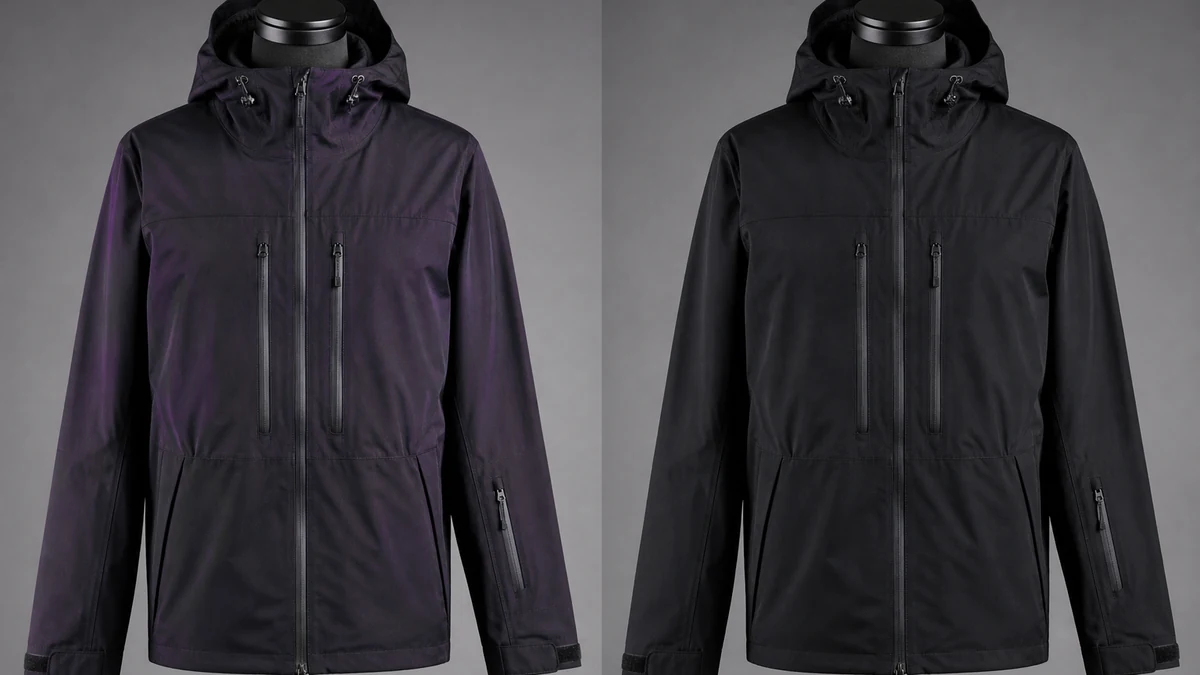
mcp.coinis.dev, the live pipeline for enhance_asset_proxy and generate_image_templates, is in an access-token outage as this article published. The image above is an illustrative OpenAI-generated still showing the same before/after concept, not a real Ad Studio render. See the fishing-tackle purple-fringe piece for a real enhance_asset_proxy output on this same repair mechanism, and check back here once the outage clears for the real render.
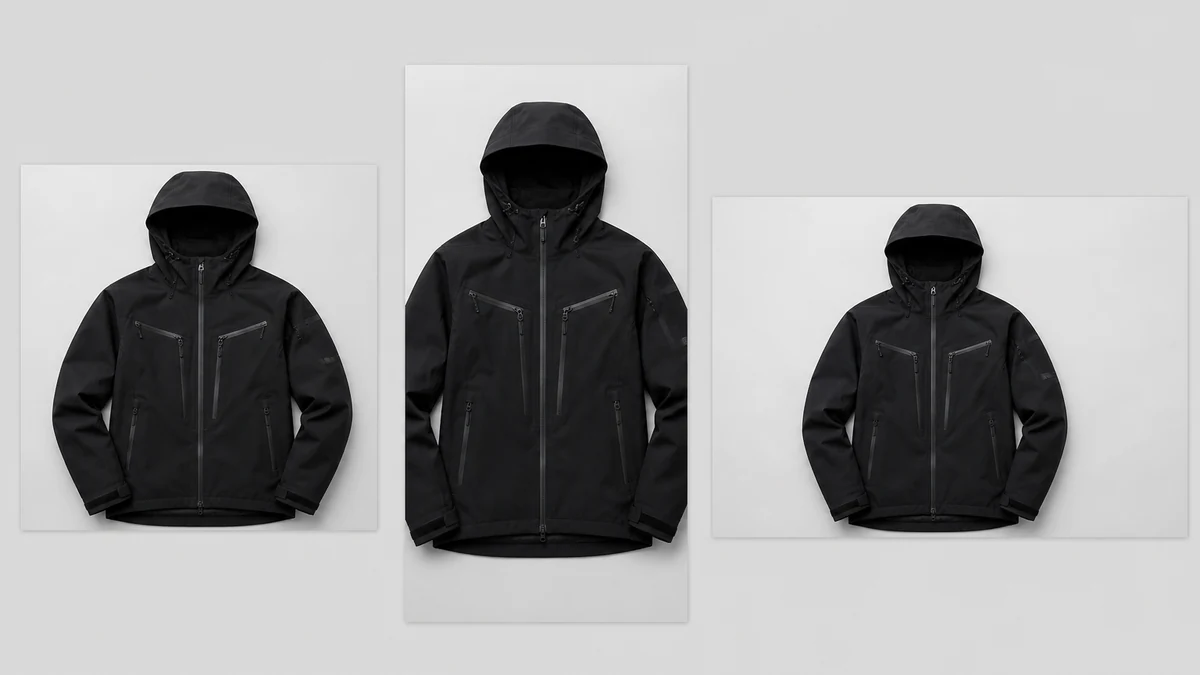
Once the fabric reads true black, the fan-out step is generate_image_templates, Ad Studio's primary image-ad generator. One corrected product photo becomes a square feed post, a 9:16 Story, and a horizontal Display banner in a single pass, without rebooking the same studio session three more times to catch every placement's spec.
Why this keeps happening across a technical apparel line
Outdoor and performance apparel brands run new colorways and new fabric technologies on a constant seasonal cycle, and infrared-reflective dyes and coatings show up across far more of a technical line than just one jacket, since the same thermal and performance-grade treatments get reused across base layers, shells, and packs. Any of them photographed under a studio hot mirror filter can trigger this same mismatch, independent of how dialed-in the white balance and exposure are. The order that holds up: repair the specific fabric-area cast first with enhance_asset_proxy, confirm hardware and trim are untouched, then hand the clean file to generate_image_templates for the size fan-out. Resizing a cast-tinted photo before fixing it just multiplies the same artifact across every placement instead of solving it once.
This is the same underlying pattern already proven across other optically sensitive product categories on this blog: a roofing drone photo's lens flare, a travel destination photo's halo artifact, and a hunting brand's camouflage pattern defeating background-removal segmentation are all versions of the same lesson applied to the outdoor/technical-gear space: a material fails in a way specific to its own optical or physical properties, and the fix has to target that exact mechanism rather than a generic filter pass. It is distinct from camping gear's harsh midday-sun dynamic-range clipping, which is an exposure problem from direct sunlight, not a sensor-infrared interaction with the fabric itself.
FAQ
Is this a flaw in the fabric or the dye itself? No. The fabric and dye are performing exactly as engineered, often for genuine thermal or performance reasons. The artifact is entirely a camera-sensor phenomenon: near-infrared light the fabric reflects strongly leaks past the camera's infrared-blocking filter and gets rendered as visible color that was never there to begin with.
Does a different studio light fix this? Not reliably. The interaction depends on how much infrared the specific fabric/dye combination reflects and how much the camera's own hot mirror filter lets through, not on the color temperature of the studio lights. A repair step covers whatever photo is already on file, including ones shot before anyone diagnosed the cause.
Will every black garment in a catalog show this? No. Ordinary cotton, wool, and most standard synthetic fabrics don't reflect enough infrared to produce a visible cast. It shows up specifically on technical/performance textiles and dyes engineered for thermal or camouflage-adjacent properties, which is common in outdoor and performance apparel lines but far less common in standard clothing retail.
Do I need a separate photo for every ad platform's size spec? No. generate_image_templates crops and composes each platform's spec from one corrected source photo, which is the entire point of fixing the fabric cast once instead of re-shooting for every export.
Sources
- Wikipedia, "Infrared Photography" (accessed 2026): https://en.wikipedia.org/wiki/Infrared_photography
- PMC/NIH, "Characterization of Near Infrared-Dye Colored Fabrics Using Hyperspectral Imaging" (2026): https://pmc.ncbi.nlm.nih.gov/articles/PMC11491044/
- IBISWorld, "Hiking & Outdoor Equipment Stores in the US" (2026): https://www.ibisworld.com/united-states/industry/hiking-outdoor-equipment-stores/4378/
- letsenhance.io, review of Baymard Institute / Salsify 2025 Consumer Research Report / Szulc & Musielak (2022) ecommerce image research (2026)
- WordStream/LocaliQ, "Search Advertising Benchmarks for Every Industry" (2026)

Isidora Matovic
Author
Social media enthusiast and a full time researcher. She takes digital presence very seriously and that is why you are always in touch in what is going on with us! Follow us for more posts like this.